
Puppy Grain-Free Dry Dog Food, 25-lb bag
Graded by The Sniff System
ACANA Puppy Grain-Free Dry Dog Food is a dry food for puppies, featuring chicken and turkey as its main protein sources.
This formula boasts a strong protein profile, with chicken as the primary ingredient, offering high biological value. It also includes quality fat sources like named chicken fat and marine oil, which provides beneficial EPA and DHA. Plus, it has AAFCO feeding trial substantiation for growth.
The main thing to watch out for is the high legume stacking, with green peas, red lentils, and peas all appearing in the top ingredients. This pattern is what the FDA flagged in its DCM investigation, which capped the score.
Good fit for puppies of any size. Less ideal if you prefer to avoid high legume content in your dog's diet.
Summary written by The Sniff System from the data above. Same rubric, same drivers, expressed in English.
Strong fit for lower-energy small companion breeds like French Bulldogs, Bulldogs, and Boston Terriers navigating a sensitive stomach. Working in its favor: prebiotic fiber (chicory or FOS) for gut health. Chicken leads at position 1. What we'd flag: multiple protein sources stacked (harder to isolate triggers). Frenchies have notoriously sensitive GI tracts plus a tendency toward obesity given their low activity needs. Limited-ingredient formulas with moderate calorie density tend to fit them well.
Looking at this for puppy French Bulldogs or French Bulldogs with a sensitive stomach ? We are building dedicated pages for these combinations.
Auto-matched from this product's measurements (ingredients, life stage, calorie density) to a breed archetype. Not a substitute for vet input on your specific dog.
Solid grade. 64/100 (B) reflects the structural fit of this formula against The Sniff System's eight scoring components. Protein quality did the heavy lifting (+22 points): Strong protein profile with chicken as the primary ingredient, delivering high biological value. What capped it: the score can't exceed 64 because pulse-family ingredients (peas, lentils, chickpeas) are stacked in the top 15 (the pattern the FDA flagged in its diet-associated DCM investigation). How it could climb: a version with fewer pulses and more named animal protein in the top deck, which would lift the cap into A-band range.
Strong protein profile with chicken as the primary ingredient, delivering high biological value.
Quality fat sources: named fat with marine oil (EPA and DHA source).
AAFCO feeding trial substantiation for growth.
Contains high legume stacking. Three or more pulse-family ingredients in top 10. Split-ingredient evidence of pea/lentil/chickpea reliance..
- Lowest carb quality in ACANA's lineup (8/16)
- Top 10% for DMB fat in grain-free dry kibbles (21.6%)
- Bottom 10% for fat quality in ACANA's lineup (12/16)
Computed against the rest of our catalog. Percentiles refresh on each catalog update.
Similar dog foods worth considering
Three lenses on products with formulation profiles similar to this one.
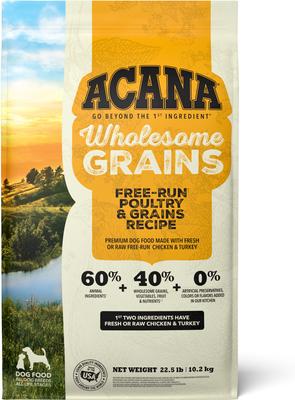
ACANA Free-Run Poultry Wholesome Grains Dry Dog Food, 22.5-lb bag
Scores 19 points higher with a similar formulation profile.
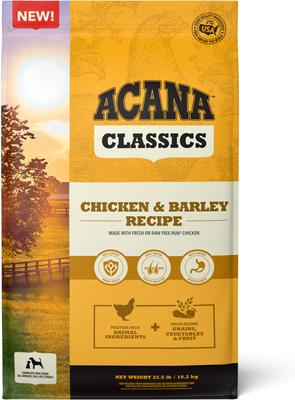
ACANA Classics Chicken & Barley Dry Dog Food, 22.5-lb bag
$2.89/lb vs your seed's $3.16/lb (9% less) at a comparable score.
Surfaced from a vector similarity search across 3,491 scored dog foods. How this works.
Read why each ingredient is good or bad for dogs.
- 1protein animalchicken
Real meat. Primary protein source, with the amino acid profile dogs actually evolved to eat.
Position 1: primary protein source. After cooking removes water, this may drop in proportional weight, but it anchors the recipe.
- 2protein animalturkey
Real meat. Lean protein, good amino acid profile, often well-tolerated by dogs sensitive to chicken.
Position 2: co-primary protein. Two named animal proteins in the top 2 is a strong protein build.
- 3protein animalchicken meal
Chicken with the water cooked out. Per pound, packs more protein than fresh chicken. See why →
Position 3: significant protein contributor. Adds amino-acid diversity to the top of the deck.
- 4legumegreen peas
Same as peas. Useful in small amounts. The concern is when pulses dominate the top of the ingredient list. See why →
Position 4. Within the FDA's top-5 DCM-pattern threshold. Especially notable if multiple pulses stack here.
- 5legumered lentils
Same concern as other lentils. Affordable plant protein, part of the legume stack the FDA examined. See why →
Position 5. Within the FDA's top-5 DCM-pattern threshold. Especially notable if multiple pulses stack here.
- 6fatchicken fat
Despite the name, a high-quality energy source. Concentrated calories plus essential fatty acids like linoleic acid. See why →
Position 6: secondary fat. Often where marine oils sit when present alongside a primary land-animal fat.
- 7protein animalturkey meal
Turkey with the water cooked out. Per pound, packs more protein than fresh turkey. See why →
Position 7: supporting protein. Modest contribution to total protein weight.
- 8flounder
Position 8: supporting protein. Modest contribution to total protein weight.
- 9eggs
Whole eggs. The highest-quality protein on any ingredient label by amino acid score.
Position 9: supporting protein. Modest contribution to total protein weight.
- 10fatfish oil
Concentrated omega-3s. The reason 'EPA' and 'DHA' get to show up on the bag.
Position 10. Moderate marine-oil inclusion. Supplements EPA/DHA without being the primary fat.
- 11legumepeas
Cheap protein bulk. Fine in small amounts, but when peas stack with lentils and chickpeas in the top ingredients, it's the pattern the FDA flagged in its heart-disease investigation. See why →
Position 11. Trace inclusion. Below the level associated with the FDA's DCM-pattern concerns.
- 12lentil fiber
Position 12. Trace inclusion. Below the level associated with the FDA's DCM-pattern concerns.
- 13chicken broth
Real broth, adds flavor and moisture. Negligible nutrition on its own but tells you the recipe leans on real meat.
Position 13: trace protein. Likely there for amino-acid diversity or label appeal more than nutritional weight.
- 14legumechickpeas
Also called garbanzo beans. Affordable plant protein source, part of the legume stack the FDA examined in its heart-disease investigation. See why →
Position 14. Trace inclusion. Below the level associated with the FDA's DCM-pattern concerns.
- 15legumelentils
Same concern as peas. Affordable plant protein, but when they pile up in the top 5 ingredients, it's a flag. See why →
Position 15. Trace inclusion. Below the level associated with the FDA's DCM-pattern concerns.
- 16legumepinto beans
- 17pea starch
Refined starch from peas, mostly carbs after the protein is removed. Counts toward the legume stack the FDA examined.
- 18othernatural flavor
Legal term for animal-derived flavoring, usually hydrolyzed liver or broth. Adds taste, says nothing about quality.
- 19protein animalchicken liver
Organ meat. Dense in protein, iron, vitamin A, and the B vitamins. Among the most nutrient-rich ingredients a dog can eat.
- 20protein animalchicken heart
Organ meat. Dense in taurine, B vitamins, and CoQ10. One of the best ingredients dogs can eat.
- 21mineralsalt
Sodium chloride. Required at small doses for normal physiology. Not a quality concern in standard amounts.
- 22vitaminvitamin e supplement
Required nutrient and a natural antioxidant. Often pulls double duty as a preservative.
- 23supplementdried kelp
Natural source of iodine and trace minerals. A common premium-brand inclusion.
- 24mineralzinc proteinate
Zinc bound to protein for better absorption. The premium form of the mineral, versus zinc oxide which sits cheaper on the label.
- 25preservative naturalmixed tocopherols
Natural vitamin E used to keep fats from going rancid. The good kind of preservative. See why →
Showing first 25 of 47. Position 1-5 has the largest weight in the recipe.
22 of 25 ingredients have a curated note. Coverage grows over time.