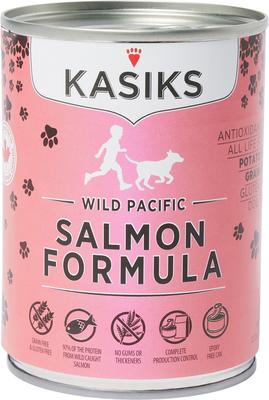
Wild Coho Salmon Formula Grain-Free Canned Dog Food, 12.2-oz, case of 12
Graded by The Sniff System
KASIKS Wild Coho Salmon Formula Grain-Free Canned Dog Food is a wet food featuring salmon as its main protein source.
The formula includes chelated minerals like zinc proteinate and iron proteinate, which are generally easier for dogs to absorb than inorganic forms. It also uses named fish, salmon, as the primary protein.
A significant concern is the absence of an AAFCO statement, which means the nutritional completeness of this food is unverified. Also, the boneless and skinless salmon used may offer limited bioavailable amino acids.
Good fit for adult dogs who enjoy wet food with salmon. Less ideal if you prioritize foods with verified nutritional completeness.
Summary written by The Sniff System from the data above. Same rubric, same drivers, expressed in English.
Good fit for adult Labrador Retrievers navigating skin allergies. The protein deck is built around a single species (salmon). For Labrador Retrievers with suspected cutaneous adverse food reactions, a strict elimination diet trial must last a minimum of 8 weeks to reliably diagnose or rule out a food-based trigger. Zinc is essential for skin immunity and healing; the NRC (2006) established a recommended allowance of 20 mg of zinc per 1000 kcal ME for adult dogs at maintenance (NRC, 2006) .
Looking at this for adult Labrador Retrievers or Labrador Retrievers with skin allergies ? We are building dedicated pages for these combinations.
Auto-matched from this product's measurements (ingredients, life stage, calorie density) to a breed archetype. Not a substitute for vet input on your specific dog.
Sniff scored this formula 45/100, landing in C-tier (acceptable-with-notes). The biggest contributor was ingredient diversity (+5 points): Includes egg, named fish, or organ meat for diverse high-bioavailability protein. A hard cap of 59 also applied because the AAFCO nutritional adequacy statement isn't disclosed on the retailer page (so our methodology can't verify the formula meets adult, growth, or all-life-stages standards). Even without the cap, the base component scores sit below the next band. The structural fix would need to address protein quality as well.
Includes egg, named fish, or organ meat for diverse high-bioavailability protein.
Low protein quality. boneless/skinless salmon delivers limited bioavailable amino acids.
No AAFCO statement. Nutritional completeness unverified.
- Bottom 1% for crude fiber in grain-free wet foods (0.9% DMB)
- Top 4% for DMB protein in wet foods (59.1%)
- Bottom 4% for carb quality in grain-free wet foods (6/16)
Computed against the rest of our catalog. Percentiles refresh on each catalog update.
Similar dog foods worth considering
Three lenses on products with formulation profiles similar to this one.
Wellness CORE Grain-Free Whitefish, Salmon & Herring Formula Canned Dog Food, 12.5-oz, case of 12
Scores 21 points higher with a similar formulation profile.
Canada Fresh Chicken Canned Dog Food, 13-oz, case of 12
$4.07/lb vs your seed's $6.45/lb (37% less) at a comparable score.
Surfaced from a vector similarity search across 3,491 scored dog foods. How this works.
Wet and fresh foods contain more water than kibble (typically 65-78%). On a dry-matter basis, this food's protein content is roughly 59%, comparable to premium kibble (typically 30-45% DMB protein).
Read why each ingredient is good or bad for dogs.
- 1boneless/skinless salmon
Position 1: primary protein source. After cooking removes water, this may drop in proportional weight, but it anchors the recipe.
- 2water sufficient for processing
The regulatory phrase for cooking water in wet food. Has no nutritional implication, just labeling formality.
- 3pea starch
Refined starch from peas, mostly carbs after the protein is removed. Counts toward the legume stack the FDA examined.
Position 3. Pulse-family ingredient this high in the deck is a notable build choice. When stacked with other pulses in the top 10, matches the formulation pattern the FDA flagged in its diet-associated DCM investigation.
- 4mineralsodium chloride
Same as salt. Required mineral, necessary at small doses.
- 5mineralcalcium carbonate
Source of calcium. Functional. Required in complete dog foods, especially those without bone-in meat meals.
- 6mineraldicalcium phosphate
Calcium and phosphorus combined. Required source of both minerals, especially in formulas without much bone content.
- 7mineralpotassium chloride
Required mineral. Sometimes used as a salt substitute. Standard inclusion in complete diets.
- 8supplementcholine chloride
Essential nutrient for liver and brain function. Standard inclusion in complete dog foods.
- 9supplementtaurine
Amino acid critical for heart health. Especially important in grain-free or pulse-heavy formulas where natural taurine precursors run thin.
- 10vegetablekale
Leafy green with antioxidants and fiber. Small dose in kibble, but it's not just for marketing.
Position 10: garnish-level inclusion. Marketing-prominent but minimal nutritional impact at this position.
- 11mineralzinc proteinate
Zinc bound to protein for better absorption. The premium form of the mineral, versus zinc oxide which sits cheaper on the label.
- 12mineraliron proteinate
Iron bound to protein for better absorption. The premium form versus inorganic iron sulfate.
- 13mineralcopper proteinate
Copper bound to protein for better absorption. Common in better-formulated diets.
- 14mineralmanganese proteinate
Manganese bound to protein for better absorption. The chelated form most premium brands use.
- 15mineralcalcium iodate
Source of iodine for thyroid function. Functional, required in complete formulas.
- 16vitaminvitamin e supplement
Required nutrient and a natural antioxidant. Often pulls double duty as a preservative.
- 17vitaminniacin supplement
B vitamin (B3). Required in complete dog foods, added as a supplement to standardize the dose.
- 18vitaminvitamin a supplement
Vitamin A in stable, standardized form. Required for vision, immune function, and growth.
- 19vitaminthiamine mononitrate
B vitamin (B1). Essential for nervous system function. Cooked-in vitamin loss is why thiamine is always added back.
- 20vitaminriboflavin supplement
B vitamin (B2). Required in complete dog foods. The standardized form ensures consistent dosing.
- 21vitaminbiotin
B vitamin that supports skin and coat health. Required for AAFCO-complete formulas.
- 22vitaminvitamin b12 supplement
Essential for red blood cell formation and neurological function. Plant ingredients lack B12, so it has to be added.
- 23d-pantothenic acid
- 24vitaminfolic acid
B vitamin (B9), essential for cell function. Standard in complete dog foods.
- 25vitaminvitamin d3 supplement
The active form of vitamin D dogs need. Required for calcium absorption and bone health.
Showing first 25 of 28. Position 1-5 has the largest weight in the recipe.
23 of 25 ingredients have a curated note. Coverage grows over time.