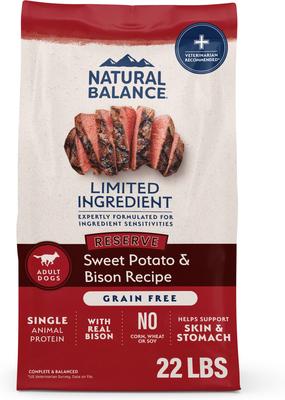
Limited Ingredient Reserve Grain-Free Sweet Potato & Bison Recipe Dry Dog Food, 22-lb bag
Graded by The Sniff System
Natural Balance Limited Ingredient Reserve Grain-Free Sweet Potato & Bison Recipe Dry Dog Food is a dry food with bison as its primary protein.
This formula includes quality fat sources like menhaden fish oil, which provides EPA and DHA. It also uses premium micronutrient forms, such as chelated minerals, which are easier for your dog to absorb.
The biggest watch item is the lack of an AAFCO statement, which means its nutritional completeness is unverified. Also, sweet potato is the first ingredient, making this a plant-protein-dominated formula despite the bison.
Good fit for dogs needing a limited ingredient diet, assuming you're comfortable with unverified nutritional completeness. Less ideal if you prioritize AAFCO verification.
Summary written by The Sniff System from the data above. Same rubric, same drivers, expressed in English.
Good fit for active large sporting breeds like Labrador Retrievers, Golden Retrievers, and English Setters navigating skin allergies. Working in its favor: single-named-protein deck (limited-ingredient friendly). The protein deck is limited to bison and menhaden fish oil, with menhaden fish oil at position 8 for EPA/DHA skin support, and the product is explicitly marketed as limited-ingredient. For Labrador Retrievers with suspected cutaneous adverse food reactions, a strict elimination diet trial must last a minimum of 8 weeks to reliably diagnose or rule out a food-based trigger. The National Research Council (2006) recommends a minimum of 2.6 grams of linoleic acid (an omega-6) per 1000 kcal of metabolizable energy to maintain skin barrier function in adult dogs (NRC, 2006) .
Looking at this for adult Labrador Retrievers or Labrador Retrievers with skin allergies ? We are building dedicated pages for these combinations.
Auto-matched from this product's measurements (ingredients, life stage, calorie density) to a breed archetype. Not a substitute for vet input on your specific dog.
Below-average grade. 44/100 (D) reflects the structural fit of this formula against The Sniff System's eight scoring components. Fat quality did the heavy lifting (+12 points): Quality fat sources: named fat with marine oil (EPA and DHA source). What capped it: the score can't exceed 59 because the AAFCO nutritional adequacy statement isn't disclosed on the retailer page (so our methodology can't verify the formula meets adult, growth, or all-life-stages standards). Removing the cap alone wouldn't change the band. Protein quality is the deeper issue.
Quality fat sources: named fat with marine oil (EPA and DHA source).
Premium micronutrient forms such as chelated minerals or natural vitamin E.
Plant-protein-dominated formula. sweet potato as the #1 ingredient.
No AAFCO statement. Nutritional completeness unverified.
- Lowest crude fiber in Natural Balance's lineup (4.4% DMB)
- Lowest carb quality in Natural Balance's lineup (9/16)
- Bottom 4% for DMB protein in Natural Balance's lineup (22.2%)
Computed against the rest of our catalog. Percentiles refresh on each catalog update.
Similar dog foods worth considering
Three lenses on products with formulation profiles similar to this one.
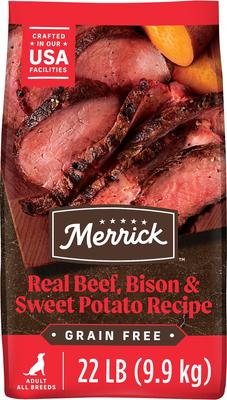
Merrick Grain-Free Dry Dog Food Real Bison, Beef & Sweet Potato Recipe, 22-lb bag
Scores 24 points higher with a similar formulation profile.
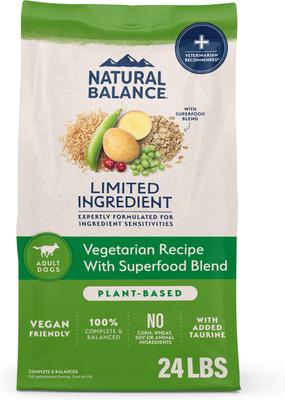
Natural Balance Limited Ingredient Vegetarian Recipe Dry Dog Food, 24-lb bag
$3.04/lb vs your seed's $3.64/lb (16% less) at a comparable score.
Surfaced from a vector similarity search across 3,491 scored dog foods. How this works.
Read why each ingredient is good or bad for dogs.
- 1vegetablesweet potato
Complex carb with fiber and beta-carotene. Gentle on the stomach.
Position 1: meaningful whole-food inclusion. Source of vitamins, antioxidants, or natural fiber.
- 2protein animalbison
Real meat, leaner than beef. Used as a novel protein, mostly in premium formulas.
Position 2: co-primary protein. Two named animal proteins in the top 2 is a strong protein build.
- 3vegetablepotato
Standard white potato. Steady carb source, common starch in grain-free recipes.
Position 3: meaningful whole-food inclusion. Source of vitamins, antioxidants, or natural fiber.
- 4protein plantpotato protein
Concentrated potato protein. Like pea protein, it inflates the protein number without matching meat-quality amino acids.
Position 4: plant protein in the top 5. Stacked with animal protein, can inflate the crude protein number without matching the amino-acid quality of named animal sources.
- 5protein plantpea protein
Concentrated plant protein. Inflates the protein number on the label without matching the amino acid quality of meat.
Position 5. Within the FDA's top-5 DCM-pattern threshold. Especially notable if multiple pulses stack here.
- 6fatcanola oil
Plant oil. Some omega-3 from the parent plant, though dogs absorb it less efficiently than fish-derived omega-3. Fine in moderation.
Position 6: secondary fat. Often where marine oils sit when present alongside a primary land-animal fat.
- 7mineraldicalcium phosphate
Calcium and phosphorus combined. Required source of both minerals, especially in formulas without much bone content.
- 8fatmenhaden fish oil
Omega-3 from menhaden, a small oily fish. Same skin and coat support as salmon oil.
Position 8. Moderate marine-oil inclusion. Supplements EPA/DHA without being the primary fat.
- 9othernatural flavor
Legal term for animal-derived flavoring, usually hydrolyzed liver or broth. Adds taste, says nothing about quality.
- 10mineralcalcium carbonate
Source of calcium. Functional. Required in complete dog foods, especially those without bone-in meat meals.
- 11mineralsalt
Sodium chloride. Required at small doses for normal physiology. Not a quality concern in standard amounts.
- 12vegetablepotato
Standard white potato. Steady carb source, common starch in grain-free recipes.
Position 12: garnish-level inclusion. Marketing-prominent but minimal nutritional impact at this position.
- 13fatflaxseed
Plant source of omega-3. Helpful for skin and coat, though dogs absorb omega-3 from fish more efficiently.
Position 13: trace fat. Below the level that materially shifts the fat profile.
- 14supplementtaurine
Amino acid critical for heart health. Especially important in grain-free or pulse-heavy formulas where natural taurine precursors run thin.
- 15supplementdl-methionine
Essential amino acid. Often added when plant proteins dominate, since methionine is naturally lower in pulses than meat.
- 16vitaminvitamin e supplement
Required nutrient and a natural antioxidant. Often pulls double duty as a preservative.
- 17vitaminascorbic acid
Vitamin C. Pulls double duty as a natural antioxidant preservative.
- 18vitaminniacin supplement
B vitamin (B3). Required in complete dog foods, added as a supplement to standardize the dose.
- 19vitaminvitamin a supplement
Vitamin A in stable, standardized form. Required for vision, immune function, and growth.
- 20vitaminthiamine mononitrate
B vitamin (B1). Essential for nervous system function. Cooked-in vitamin loss is why thiamine is always added back.
- 21vitamind-calcium pantothenate
B vitamin (B5). Standard inclusion in complete dog foods.
- 22vitaminriboflavin supplement
B vitamin (B2). Required in complete dog foods. The standardized form ensures consistent dosing.
- 23vitaminpyridoxine hydrochloride
B vitamin (B6). Essential for protein metabolism. Standard inclusion in complete formulas.
- 24vitaminvitamin b12 supplement
Essential for red blood cell formation and neurological function. Plant ingredients lack B12, so it has to be added.
- 25vitaminfolic acid
B vitamin (B9), essential for cell function. Standard in complete dog foods.
Showing first 25 of 41. Position 1-5 has the largest weight in the recipe.
25 of 25 ingredients have a curated note. Coverage grows over time.