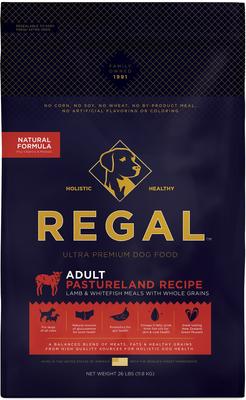
Pastureland Recipe Lamb & Whitefish Meals Whole Grains Dry Dog Food, 26-lb bag
Graded by The Sniff System
Regal Pet Foods Pastureland Recipe is a dry dog food featuring lamb and whitefish meals, along with whole grains.
This recipe uses quality carbohydrate sources that provide fermentable fiber, which is good for gut health. It also includes quality fat sources like canola oil and menhaden fish oil, which provides beneficial EPA and DHA. The inclusion of whitefish meal adds diverse, high-bioavailability protein.
The main thing to note is that this product does not have an AAFCO statement, which means its nutritional completeness is unverified. This lack of verification capped its overall score.
Good fit for dogs whose owners prioritize quality carbs and fats. Less ideal if you prefer a food with a verified AAFCO statement.
Summary written by The Sniff System from the data above. Same rubric, same drivers, expressed in English.
Strong fit for medium-sized herding breeds like Australian Shepherds, Australian Cattle Dogs, and Border Collies navigating skin allergies. Working in its favor: calorie density (400 kcal/cup) matches a high-energy working breed. The protein deck is limited to lamb meal and whitefish meal, with menhaden fish oil at position 12 for EPA/DHA skin support. Aussies are working-line dogs that thrive on high-protein performance formulas. Coat quality also benefits from EPA+DHA. The National Research Council (2006) recommends a minimum of 2.6 grams of linoleic acid (an omega-6) per 1000 kcal of metabolizable energy to maintain skin barrier function in adult dogs (NRC, 2006) .
Looking at this for adult Australian Shepherds or Australian Shepherds with skin allergies ? We are building dedicated pages for these combinations.
Auto-matched from this product's measurements (ingredients, life stage, calorie density) to a breed archetype. Not a substitute for vet input on your specific dog.
Middle-of-pack grade. 59/100 (C) reflects the structural fit of this formula against The Sniff System's eight scoring components. Carbohydrate quality did the heavy lifting (+15 points): Quality carbohydrate sources with fermentable fiber. What capped it: the score can't exceed 59 because the AAFCO nutritional adequacy statement isn't disclosed on the retailer page (so our methodology can't verify the formula meets adult, growth, or all-life-stages standards). How it could climb: the brand publishing the AAFCO statement, which would lift the cap into B-band range.
Quality carbohydrate sources with fermentable fiber.
Quality fat sources: named fat with marine oil (EPA and DHA source).
Includes egg, named fish, or organ meat for diverse high-bioavailability protein.
No AAFCO statement. Nutritional completeness unverified.
- Bottom quartile for DMB protein in Regal Pet Foods's lineup (26.7%)
- Bottom quartile for DMB fat in Regal Pet Foods's lineup (14.4%)
- Bottom quartile for caloric density in Regal Pet Foods's lineup (400 kcal/cup)
Computed against the rest of our catalog. Percentiles refresh on each catalog update.
Similar dog foods worth considering
Three lenses on products with formulation profiles similar to this one.
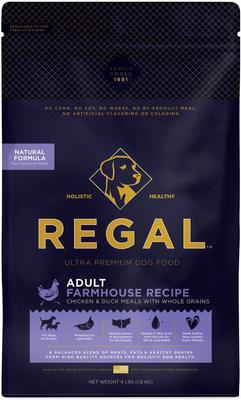
Regal Pet Foods Farmhouse Recipe Chicken & Duck Meals Whole Grains Adult Dry Dog Food, 4-lb bag
Scores 8 points higher with a similar formulation profile.
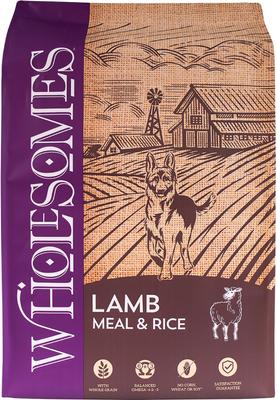
Wholesomes with Lamb Meal & Rice Formula Dry Dog Food, 40-lb bag
$1.30/lb vs your seed's $2.65/lb (51% less) at a comparable score.
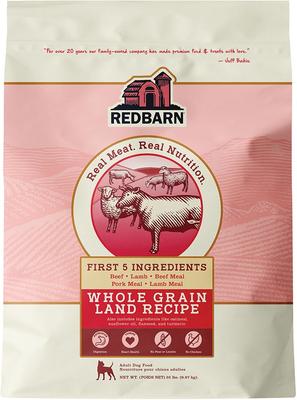
Redbarn Whole Grain Land Recipe Dry Dog Food, 22-lb bag
Beef instead of lamb, matched score, different brand.
Surfaced from a vector similarity search across 3,491 scored dog foods. How this works.
Read why each ingredient is good or bad for dogs.
- 1protein animallamb meal
Lamb cooked down to a dry concentrate. Per pound, more protein than fresh lamb. See why →
Position 1: primary protein source. After cooking removes water, this may drop in proportional weight, but it anchors the recipe.
- 2grainbrown rice
Whole grain that's easy to digest. Steady carb energy plus a little fiber.
Position 2: major carbohydrate source.
- 3grainsorghum
Whole grain with a low glycemic index. Gluten-free, well-tolerated, decent fiber content.
Position 3: major carbohydrate source.
- 4grainpearled barley
Barley with the outer hull removed. Easy to digest, steady carb release.
Position 4: supporting grain. Smaller contribution to the carb deck.
- 5grainoatmeal
Gentle on the stomach. Slow-release carbs and soluble fiber that supports stool quality.
Position 5: supporting grain. Smaller contribution to the carb deck.
- 6protein animalwhitefish meal
Whitefish cooked into a dry concentrate. Strong protein source, common in premium formulas.
Position 6: supporting protein. Modest contribution to total protein weight.
- 7fatcanola oil
Plant oil. Some omega-3 from the parent plant, though dogs absorb it less efficiently than fish-derived omega-3. Fine in moderation.
Position 7: trace fat. Below the level that materially shifts the fat profile.
- 8fiberdried beet pulp
Soluble fiber from sugar-beet processing. Sometimes treated as a filler, but it's actually one of the better fiber sources in kibble. See why →
Position 8: functional fiber for digestion or satiety.
- 9protein plantpea protein
Concentrated plant protein. Inflates the protein number on the label without matching the amino acid quality of meat.
Position 9. Moderate inclusion. Contributes carbohydrate and some plant protein.
- 10othernatural flavor
Legal term for animal-derived flavoring, usually hydrolyzed liver or broth. Adds taste, says nothing about quality.
- 11fatground flaxseed
Cracked flaxseed for better digestibility. Same plant omega-3s as whole flaxseed, just easier for the dog to extract.
Position 11: trace fat. Below the level that materially shifts the fat profile.
- 12fatmenhaden fish oil
Omega-3 from menhaden, a small oily fish. Same skin and coat support as salmon oil.
Position 12. Moderate marine-oil inclusion. Supplements EPA/DHA without being the primary fat.
- 13lecithin
Natural emulsifier, usually from soy or sunflower. Helps blend fats and water. Safe at typical inclusion.
- 14supplementdried kelp
Natural source of iodine and trace minerals. A common premium-brand inclusion.
- 15green mussel
Mussel from New Zealand. Natural source of glucosamine and omega-3s. Common in joint-support formulas.
- 16mineralpotassium chloride
Required mineral. Sometimes used as a salt substitute. Standard inclusion in complete diets.
- 17mineralsalt
Sodium chloride. Required at small doses for normal physiology. Not a quality concern in standard amounts.
- 18supplementdl-methionine
Essential amino acid. Often added when plant proteins dominate, since methionine is naturally lower in pulses than meat.
- 19supplementl-lysine
Essential amino acid. Plant-protein-heavy formulas sometimes add it to round out the amino acid profile.
- 20supplementtaurine
Amino acid critical for heart health. Especially important in grain-free or pulse-heavy formulas where natural taurine precursors run thin.
- 21probioticdried lactobacillus acidophilus fermentation product
A probiotic strain. Whether the dose is high enough to actually colonize is debated, but it's a real beneficial bacterium.
- 22vitaminvitamin e supplement
Required nutrient and a natural antioxidant. Often pulls double duty as a preservative.
- 23vitaminascorbic acid
Vitamin C. Pulls double duty as a natural antioxidant preservative.
- 24vitaminniacin supplement
B vitamin (B3). Required in complete dog foods, added as a supplement to standardize the dose.
- 25vitamind-calcium pantothenate
B vitamin (B5). Standard inclusion in complete dog foods.
Showing first 25 of 47. Position 1-5 has the largest weight in the recipe.
25 of 25 ingredients have a curated note. Coverage grows over time.