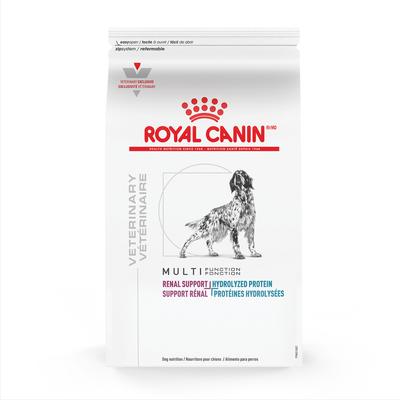
Multifunction Renal Support + Hydrolyzed Protein Dry Dog Food, 7.7-lb bag
Graded by The Sniff System
Royal Canin Veterinary Diet Multifunction Renal Support + Hydrolyzed Protein is a dry food formulated as a veterinary diet, featuring hydrolyzed soy protein.
This formula includes quality fat sources like chicken fat and fish oil, which provides EPA and DHA. It also features quality carbohydrate sources with fermentable fiber, and the product has AAFCO feeding trial substantiation.
The formula is plant-protein-dominated, with brewers rice as the first ingredient. The protein content is quite low, and the fat content is high, which capped its overall score.
Good fit for dogs requiring renal support or a hydrolyzed protein diet. Less ideal if your dog does not have these specific dietary needs.
Summary written by The Sniff System from the data above. Same rubric, same drivers, expressed in English.
Strong fit for active large sporting breeds like Labrador Retrievers, Golden Retrievers, and English Setters navigating skin allergies. The protein deck is built around a single species (chicken), with fish oil at position 7 for EPA/DHA skin support. For Labrador Retrievers with suspected cutaneous adverse food reactions, a strict elimination diet trial must last a minimum of 8 weeks to reliably diagnose or rule out a food-based trigger. The National Research Council (2006) recommends a minimum of 2.6 grams of linoleic acid (an omega-6) per 1000 kcal of metabolizable energy to maintain skin barrier function in adult dogs (NRC, 2006) .
Looking at this for adult Labrador Retrievers or Labrador Retrievers with skin allergies ? We are building dedicated pages for these combinations.
Auto-matched from this product's measurements (ingredients, life stage, calorie density) to a breed archetype. Not a substitute for vet input on your specific dog.
Sniff scored this formula 49/100, landing in C-tier (acceptable-with-notes). The biggest contributor was fat quality (+12 points): Quality fat sources: named fat with marine oil (EPA and DHA source). A hard cap of 49 also applied because the guaranteed analysis falls below AAFCO's minimum nutrient profile. If a formula update that meets AAFCO minimums were on the label, the cap would lift and this formula could clear the B-band threshold (60).
Quality fat sources: named fat with marine oil (EPA and DHA source).
Quality carbohydrate sources with fermentable fiber.
AAFCO feeding trial substantiation for not stated.
Plant-protein-dominated formula. brewers rice as the #1 ingredient.
- Bottom 2% for fat quality in Royal Canin Veterinary Diet's lineup (12/16)
- Top 10% for caloric density in Royal Canin Veterinary Diet's lineup (385 kcal/cup)
- Bottom quartile for overall Sniff Score in Royal Canin Veterinary Diet's lineup (49/100)
Computed against the rest of our catalog. Percentiles refresh on each catalog update.
Similar dog foods worth considering
Three lenses on products with formulation profiles similar to this one.
Royal Canin Veterinary Diet Multifunction Advanced Mobility Support + Satiety Dry Dog Food, 26.4-lb bag
Scores 10 points higher with a similar formulation profile.
Royal Canin Veterinary Diet Hydrolyzed Protein Dry Puppy Dog Food, 22-lb bag
$5.86/lb vs your seed's $8.31/lb (29% less) at a comparable score.
Surfaced from a vector similarity search across 3,491 scored dog foods. How this works.
Read why each ingredient is good or bad for dogs.
- 1brewers rice
Broken rice kernels left over from milling, usually destined for human beer-making. Cheaper than whole or even white rice. Same carbs, less nutrition than the brown version. See why →
Position 1 grain: primary carbohydrate base. This is a grain-inclusive formula with brewers rice as the dominant carb.
- 2fatchicken fat
Despite the name, a high-quality energy source. Concentrated calories plus essential fatty acids like linoleic acid. See why →
Position 2: primary fat source. Drives the formula's caloric density and omega-6 content.
- 3hydrolyzed soy protein
- 4fiberdried chicory root
Natural prebiotic. Feeds beneficial gut bacteria. The same compound (inulin) used in human gut-health products.
Position 4: functional fiber for digestion or satiety.
- 5othernatural flavors
Same as natural flavor. Usually hydrolyzed liver or broth, adds palatability.
- 6vegetable oil
Unnamed plant oil. Could be soy, canola, corn, or a blend. Named oils like sunflower or canola are more transparent.
Position 6: secondary fat. Often where marine oils sit when present alongside a primary land-animal fat.
- 7fatfish oil
Concentrated omega-3s. The reason 'EPA' and 'DHA' get to show up on the bag.
Position 7. Moderate marine-oil inclusion. Supplements EPA/DHA without being the primary fat.
- 8fiberpea fiber
Insoluble fiber from peas. Doesn't carry the protein-inflation concern of pea protein. Mostly there for stool quality.
Position 8. Moderate inclusion. Contributes carbohydrate and some plant protein.
- 9sodium aluminosilicate
Anti-caking agent that keeps powder ingredients flowing. Functional, not nutritional.
- 10mineralpotassium chloride
Required mineral. Sometimes used as a salt substitute. Standard inclusion in complete diets.
- 11supplementl-lysine
Essential amino acid. Plant-protein-heavy formulas sometimes add it to round out the amino acid profile.
- 12fiberfructooligosaccharides
Prebiotic fiber, often called FOS. Feeds beneficial gut bacteria, similar in function to inulin.
Position 12: trace fiber inclusion.
- 13mineralcalcium carbonate
Source of calcium. Functional. Required in complete dog foods, especially those without bone-in meat meals.
- 14supplementcholine chloride
Essential nutrient for liver and brain function. Standard inclusion in complete dog foods.
- 15n-butyric acid
- 16supplementdl-methionine
Essential amino acid. Often added when plant proteins dominate, since methionine is naturally lower in pulses than meat.
- 17mineralsalt
Sodium chloride. Required at small doses for normal physiology. Not a quality concern in standard amounts.
- 18l-tyrosine
- 19supplementtaurine
Amino acid critical for heart health. Especially important in grain-free or pulse-heavy formulas where natural taurine precursors run thin.
- 20gla safflower oil
- 21marigold extract
- 22mineralzinc proteinate
Zinc bound to protein for better absorption. The premium form of the mineral, versus zinc oxide which sits cheaper on the label.
- 23zinc oxide
Inorganic zinc. Cheapest mineral form on the market. Functional but less bioavailable than chelated alternatives.
- 24mineralmanganese proteinate
Manganese bound to protein for better absorption. The chelated form most premium brands use.
- 25manganous oxide
Inorganic manganese. Functional, cheaper than chelated forms, less efficiently absorbed.
Showing first 25 of 34. Position 1-5 has the largest weight in the recipe.
20 of 25 ingredients have a curated note. Coverage grows over time.