Beggin' Thick Cut Hickory Smoke Flavor
Graded by The Sniff System
Purina Beggin' Thick Cut Hickory Smoke Flavor is a dry food, primarily featuring pork, though its intended life stage is not stated.
The formula does include quality carbohydrate sources with declared fiber, which is a small positive. However, this is overshadowed by other concerns.
This product contains BHA, a synthetic preservative classified as a probable carcinogen. Also, there's no AAFCO statement, meaning it's not guaranteed to be a complete and balanced meal for dogs.
Hard to recommend for any dog, as it's not a complete food and contains BHA, a probable carcinogen.
Summary written by The Sniff System from the data above. Same rubric, same drivers, expressed in English.
For Labrador Retrievers with suspected cutaneous adverse food reactions, a strict elimination diet trial must last a minimum of 8 weeks to reliably diagnose or rule out a food-based trigger. Good fit for active large sporting breeds like Labrador Retrievers, Golden Retrievers, and English Setters navigating skin allergies. The protein deck is built around a single species (pork). The National Research Council (2006) recommends a minimum of 2.6 grams of linoleic acid (an omega-6) per 1000 kcal of metabolizable energy to maintain skin barrier function in adult dogs (NRC, 2006) .
Looking at this for adult Labrador Retrievers or Labrador Retrievers with skin allergies ? We are building dedicated pages for these combinations.
Auto-matched from this product's measurements (ingredients, life stage, calorie density) to a breed archetype. Not a substitute for vet input on your specific dog.
At 18/100, this formula sits in territory where we recommend switching. The lift comes from carbohydrate quality, worth 13 points to the final number: Quality carbohydrate sources with declared fiber. The ceiling on this score is 49, set because one FLAG-tier ingredient is in the formula. The cap isn't the binding constraint here. Controversial-ingredient penalty would also need to improve to reach the next band.
Quality carbohydrate sources with declared fiber.
- Bottom 4% for fat quality in grain-inclusive dry kibbles (4/16)
- Bottom 4% for overall Sniff Score in grain-inclusive dry kibbles (18/100)
- Bottom quartile for protein quality in grain-inclusive dry kibbles (10/27)
Computed against the rest of our catalog. Percentiles refresh on each catalog update.
Similar dog foods worth considering
Three lenses on products with formulation profiles similar to this one.
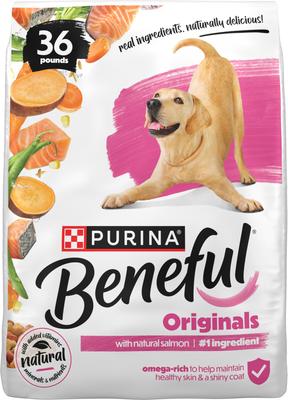
Purina Beneful Originals with Natural Salmon Dry Dog Food, 36-lb bag
Scores 41 points higher with a similar formulation profile.
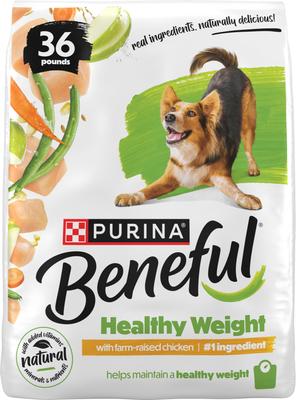
Purina Beneful Healthy Weight with Farm-Raised Chicken Dry Dog Food, 36-lb bag
Chicken instead of pork, 41 points higher, different brand.
Surfaced from a vector similarity search across 3,491 scored dog foods. How this works.
Controversial ingredients · 1
- bhaSynthetic preservative classified by the U.S. National Toxicology Program as 'reasonably anticipated to be a human carcinogen.' Many premium brands have removed it.
Every flagged ingredient has a published basis (confirmed harm / regulatory action / precautionary). See methodology →
Read why each ingredient is good or bad for dogs.
- 1protein animalpork
Real meat. Dense protein and fat, though less common in dog food than chicken or beef.
Position 1: primary protein source. After cooking removes water, this may drop in proportional weight, but it anchors the recipe.
- 2grainbarley
Whole grain with a low glycemic profile and some soluble fiber. Easy on blood sugar.
Position 2: major carbohydrate source.
- 3grainrice
Generic rice. Could be white or brown, the label doesn't say. Brown rice would be specified if it were.
Position 3: major carbohydrate source.
- 4grainground wheat
Whole wheat. Fine for most dogs, though a portion are sensitive. Not a quality concern, just a fit-for-your-dog question.
Position 4: supporting grain. Smaller contribution to the carb deck.
- 5oat meal
Alternate spelling of oatmeal. Gentle whole grain, steady carb energy, soluble fiber.
- 6soybean
- 7meal
- 8glycerin
Humectant used in soft-moist foods to keep them chewy. Safe in moderation but a signal of a processed semi-moist product.
- 9sugar
Added sugar. No nutritional purpose for dogs. Most often found in budget semi-moist foods. See why →
- 10protein plantcorn gluten meal
Concentrated corn protein. Inflates the protein percent on the label without matching meat-quality amino acids.
Position 10: moderate plant-protein boost. Less likely to materially shift the protein profile.
- 11grainyellow corn
Position 11: minor grain inclusion.
- 12grainwheat
Whole wheat. Fine for most dogs, though a portion are sensitive. Not a quality concern, just a fit-for-your-dog question.
Position 12: minor grain inclusion.
- 13flour
- 14water
Just water. Counted on the label of any wet or fresh food. The number tells you the moisture content.
- 15soy flour
Refined soy. Cheap plant protein, common in budget formulas. Pads the protein percent without matching meat amino acids.
- 16bacon
- 17soy protein concentrate
- 18protein plantwheat gluten
Concentrated wheat protein. Like other plant gluten meals, it pads the protein number on the label without contributing meat-quality amino acids.
- 19mineralsalt
Sodium chloride. Required at small doses for normal physiology. Not a quality concern in standard amounts.
- 20phosphoric acid
- 21bacon fat
- 21preservative syntheticbha Flagged
Synthetic preservative. Listed as a possible human carcinogen by the IARC. Banned from human food in Japan and parts of the EU, still permitted in US pet food. See why →
- 22othernatural flavor
Legal term for animal-derived flavoring, usually hydrolyzed liver or broth. Adds taste, says nothing about quality.
- 23sorbic acid
- 24natural hickory smoke
Showing first 25 of 30. Position 1-5 has the largest weight in the recipe.
15 of 25 ingredients have a curated note. Coverage grows over time.