Tasty Chicken Flavor
Graded by The Sniff System
Blue wilderness Tasty Chicken Flavor is a dry food with deboned chicken and chicken meal as its main protein sources.
The protein quality looks reasonable, with deboned chicken providing solid amino acid coverage. It also uses a good extrusion architecture, pairing named fresh meat with a same-species meal.
The main thing to watch out for is the lack of an AAFCO statement, which means the nutritional completeness of this food is unverified.
Good fit for dogs who enjoy chicken as a primary protein. Less ideal if you prioritize verified nutritional completeness.
Summary written by The Sniff System from the data above. Same rubric, same drivers, expressed in English.
Neutral fit for adult moderately active small sporting breeds like Cocker Spaniels, English Cocker Spaniels, and English Springer Spaniels. Deboned chicken leads the deck at position 1.
Looking at this for adult Cocker Spaniels ? We are building dedicated pages for these combinations.
Auto-matched from this product's measurements (ingredients, life stage, calorie density) to a breed archetype. Not a substitute for vet input on your specific dog.
Middle-of-pack grade. 50/100 (C) reflects the structural fit of this formula against The Sniff System's eight scoring components. Protein quality did the heavy lifting (+17.5 points): Reasonable protein quality. deboned chicken delivers solid amino acid coverage. What capped it: the score can't exceed 59 because the AAFCO nutritional adequacy statement isn't disclosed on the retailer page (so our methodology can't verify the formula meets adult, growth, or all-life-stages standards). Removing the cap alone wouldn't change the band. AAFCO compliance is the deeper issue.
Reasonable protein quality. deboned chicken delivers solid amino acid coverage.
Named fresh meat paired with same-species meal, a strong extrusion architecture.
No AAFCO statement. Nutritional completeness unverified.
- Bottom 4% for carb quality in dry kibbles (6/16)
- Bottom quartile for fat quality in grain-free dry kibbles (8/16)
- Bottom quartile for overall Sniff Score in grain-free dry kibbles (50/100)
Computed against the rest of our catalog. Percentiles refresh on each catalog update.
Similar dog foods worth considering
Three lenses on products with formulation profiles similar to this one.

Blue Buffalo Wilderness Chicken Recipe High-Protein Puppy Dry Dog Food, 24-lb bag
Scores 32 points higher with a similar formulation profile.
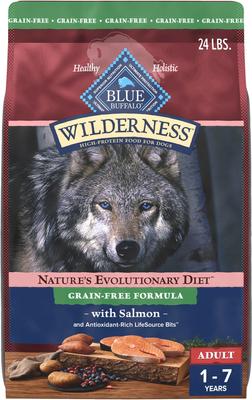
Blue Buffalo Wilderness Salmon Recipe Adult High-Protein Grain-Free Dry Dog Food, 24-lb bag
Salmon instead of chicken, 15 points higher, different brand.
Surfaced from a vector similarity search across 3,491 scored dog foods. How this works.
Read why each ingredient is good or bad for dogs.
- 1protein animaldeboned chicken
Real meat with the bones removed before grinding. The cleanest version of chicken on an ingredient label.
Position 1: primary protein source. After cooking removes water, this may drop in proportional weight, but it anchors the recipe.
- 2protein animalchicken meal
Chicken with the water cooked out. Per pound, packs more protein than fresh chicken. See why →
Position 2: co-primary protein. Two named animal proteins in the top 2 is a strong protein build.
- 3potato starch
Refined potato. Pure carb energy, low on other nutrition. Often used as a binder in grain-free recipes.
- 4legumepeas
Cheap protein bulk. Fine in small amounts, but when peas stack with lentils and chickpeas in the top ingredients, it's the pattern the FDA flagged in its heart-disease investigation. See why →
Position 4. Within the FDA's top-5 DCM-pattern threshold. Especially notable if multiple pulses stack here.
- 5brewers dried yeast
Yeast left over from brewing. Rich in B vitamins and amino acids. A traditional and well-tolerated inclusion.
- 6fatchicken fat
Despite the name, a high-quality energy source. Concentrated calories plus essential fatty acids like linoleic acid. See why →
Position 6: secondary fat. Often where marine oils sit when present alongside a primary land-animal fat.
- 7othernatural flavor
Legal term for animal-derived flavoring, usually hydrolyzed liver or broth. Adds taste, says nothing about quality.
- 8preservative naturalcitric acid
Natural antioxidant preservative. Helps keep fats from going rancid.
Natural preservative. Methodologically preferred over synthetic alternatives.
- 9mineralpotassium chloride
Required mineral. Sometimes used as a salt substitute. Standard inclusion in complete diets.
- 10preserved with mixed tocopherols
- 11oil of rosemary
Position 11: trace fat. Below the level that materially shifts the fat profile.
- 12crude protein 28%
- 13crude fat 12%
Position 13: trace fat. Below the level that materially shifts the fat profile.
- 14bcrude fiber 4%
- 15moisture 10%
9 of 15 ingredients have a curated note. Coverage grows over time.