Pekingese
Pekingeses have a cited life expectancy of 13.3 years (McMillan 2024 / VetCompass, n=695, 95% CI 13 to 13.8). The most carried tested variant is Chondrodystrophy and Intervertebral Disc Disease Risk, in 42% of 238 Pekingeses tested (Donner 2023), then Degenerative Myelopathy (1.3%) and Congenital Dyshormonogenic Hypothyroidism with Goiter (1%). 26 dogs stand behind the atlas figures here, so treat this page as an early sketch.
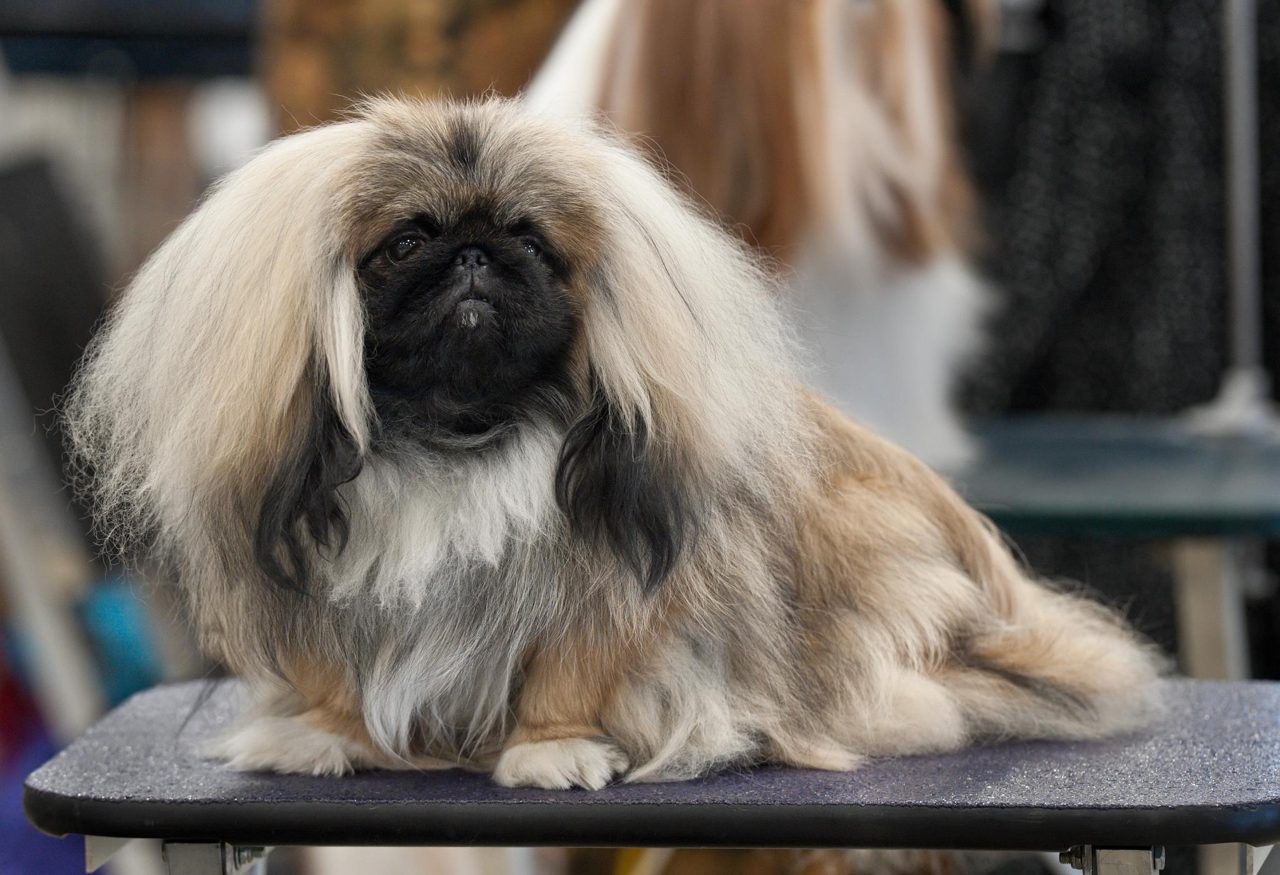
Also known as Chinese Spaniel, Lion Dog, Peke, and Pekinese.
What genetic diseases do Pekingeses carry?
From a panel of 250 Mendelian-disease variants screened in 1,054,293 dogs (Donner et al. 2023), Pekingeses carry 6 of them at observable frequency. Carrier frequency is not clinical risk. Most recessive variants require two copies for disease expression; many dominant variants show incomplete penetrance. Read this as a population fingerprint of what's in the gene pool, not a per-dog prediction.
FGF4what this gene does
FGF4 influences leg length by affecting bone growth, leading to shorter legs in certain breeds.
For your dog: If your dog is from a breed known to carry this gene, it's worth discussing spinal health with your vet, but being a carrier doesn’t guarantee problems.
SOD1what this gene does
SOD1 is a gene that helps protect cells from damage caused by harmful molecules called free radicals.
For your dog: If your dog is a carrier of SOD1 variants, it's worth discussing with your vet, but remember carrier status doesn't mean your dog will get the disease.
PRCDwhat this gene does
PRCD is a gene involved in the health of a dog's retina, the part of the eye that detects light and helps with vision.
For your dog: If your dog belongs to a breed known to carry PRCD changes, it's worth discussing eye health and potential genetic testing with your vet.
SLC37A2what this gene does
SLC37A2 is a gene involved in how cells manage certain sugar molecules, which can affect bone development.
For your dog: If your dog is from a breed known to carry this gene variant, it's worth discussing with your vet, especially if you notice jaw discomfort or eating issues.
PDK4what this gene does
PDK4 helps regulate how cells use energy, especially in the heart muscle.
For your dog: If your dog is one of the breeds known to carry this gene, it’s worth discussing heart health with your vet, but being a carrier doesn’t mean your dog will develop disease.
What these results mean for a Pekingese
41.6% of Pekingeses in the Donner 2023 cohort carried it (n=238).
- Two extra copies of a growth gene, FGF4, shape dog legs and spines. The one on chromosome 12 is the one tied to disc disease; the one on chromosome 18 shortens legs.
OMIA 000157-9615
“Two FGF4 retrogenes (FGF4L1 on chromosome 18 and FGF4L2 on chromosome 12) have been identified to cause dwarfism across many dog breeds.” OMIA 000157-9615
“Brown et al. (2017) reported that an FGF4 retrogene insertion in chromosome CFA12” OMIA 000157-9615
- Carrying it raises risk. It does not say which dog will have a disc problem. In Dachshunds researchers found the test is not a valid risk indicator on its own.
OMIA 000157-9615
“the FGF4 retrogene insertion on CFA12 is not a valid risk indicator on its own” OMIA 000157-9615
What to do
Ask your veterinarian what a carrier result changes for your dog. What lowers risk in a carrier is not established in the sources this page draws on.
No test, or a mix
Without a test nobody can say whether a dog carries it. Leg length alone does not tell you: the disc-disease copy and the short-leg copy are different insertions.
1.3% of Pekingeses in the Donner 2023 cohort carried it (n=239).
- DM is a loss of function in the spinal cord that begins in adulthood and progresses to paralysis of the back legs. There is no treatment that stops it.
OMIA 000263-9615
“This is an adult onset degeneration of the spinal cord that progresses to paraplegia and tetraparesis. There is no successful treatment. A genetic test is available.” OMIA 000263-9615
- Two copies of the SOD1 variant mean at risk, not affected. Some dogs with two copies never show signs.
OMIA 000263-9615
“some homozygous mutant dogs had no signs of degenerative myelopathy, which suggests incomplete penetrance or other causative loci” OMIA 000263-9615
- One copy makes a dog a carrier. In the study that found the variant, every affected dog tested had two copies.
OMIA 000263-9615
“All affected dogs tested were homozygous mutant.” OMIA 000263-9615
What to do
A DNA result is not a diagnosis. Take the result, and any change in how the dog walks, to a veterinarian.
No test, or a mix
Without a test nobody can say how many copies a dog has. A breed's carrier frequency describes the breed, not this dog.
Other names
The Pekingese is also recorded as Chinese Spaniel, Lion Dog, Peke, Pekinese, Peking lion dog, Peking Palasthund, and Pelchie Dog.
Identified as Pekingese (VBO:0200994) in the Vertebrate Breed Ontology (Mullen et al. 2025, CC-BY 4.0) · registry IDs FCI 207 · iDog 178 · VeNom 14511.
For researchers Population genetics, disease models and every recorded condition Open the research detail for the Pekingese
In the atlas, the Pekingese clusters consistently as Pekingese (100% of the 26 dogs here). Dogs here sit in a relatively sparse region of the atlas, fewer close neighbors than typical.
Only 26 dogs of this breed in the atlas, modestly sampled.
What the atlas genotypes say about Pekingese
Computed from the 14,478 CanVAS dogs in the Atlas, on an imputed genotype backbone: 77,215 directly typed sites per dog, imputed to 9.67 million variants.
The confidence below counts dogs, not reads: it is the size of the sample, and it is separate from how the genotypes were measured.
What does genetic diversity mean?
How varied a breed's gene pool is — the share of gene spots where a typical dog of the breed carries two different versions rather than two identical ones.
How to read it: Higher = more diverse. Among well-sampled breeds it ranges roughly 0.22 (least diverse) to 0.33 (most diverse).
Diversity is a strength, not a verdict on any individual dog. Lower diversity means it's worth paying attention to recessive-risk testing — not that a dog is doomed.
What does within-breed variation mean?
How much individual dogs within the breed differ from each other genetically.
How to read it: Higher = more internal variety among individuals of the breed.
Sensitive to how many dogs of the breed we've sampled.
What does typical lifespan mean?
The median age dogs of the breed tend to reach.
How to read it: Higher = longer-lived. Compare to longevity-for-size to see whether it's just a size effect.
Drawn from population lifespan records; individual dogs vary widely with care, genetics, and luck.
Pekingeses are a natural model for human disease
Because the same genes cause the same conditions across species, the inherited conditions documented in Pekingeses help researchers understand, and work toward treating, the human diseases they model. This is the dog advancing human medicine. The breed models the human disease; it does not have it, and this is not a prediction for your dog.
- X-linked hypohidrotic ectodermal dysplasia, modeled by the breed's Hypohidrotic ectodermal dysplasia, X-linked, EDA-related via EDA, the same underlying biology.
- OMIM:164980, modeled by the breed's Chondrodysplasia, FGF4 retrogene-related , the same underlying biology.
- oculocutaneous albinism type 4, modeled by the breed's Coat colour, albinism, oculocutaneous type IV , the same underlying biology.
- Griscelli syndrome type 3, modeled by the breed's Coat colour, dilution, MLPH-related , the same underlying biology.
- thyroid dyshormonogenesis 1, modeled by the breed's Hypothyroidism, congenital dyshormonogenic, with goiter, SLC5A5-related , the same underlying biology.
- OMIM:603245, modeled by the breed's Spinal dysraphism , the same underlying biology.
Every condition recorded in the Pekingese
Beyond the testable carriers above, OMIA's literature catalogue records 10 genetic conditions in the Pekingese, 7 of which have a known human equivalent. This is the documented landscape across all Pekingeses ever studied, not a prediction for any one dog.
- Hypohidrotic ectodermal dysplasia, X-linked, EDA-related X-linked recessiveHuman equivalent: X-linked hypohidrotic ectodermal dysplasia
- Chondrodysplasia, FGF4 retrogene-related AutosomalHuman equivalent: OMIM:164980
- Coat colour, albinism, oculocutaneous type IV Autosomal recessiveHuman equivalent: oculocutaneous albinism type 4
- Coat colour, dilution, MLPH-related Autosomal recessiveHuman equivalent: Griscelli syndrome type 3
- Hypothyroidism, congenital dyshormonogenic, with goiter, SLC5A5-related Autosomal recessiveHuman equivalent: thyroid dyshormonogenesis 1
- Spinal dysraphism Autosomal recessiveHuman equivalent: OMIM:603245
- Urolithiasis Autosomal recessiveHuman equivalent: OMIM:220150
- Intervertebral disc disease Autosomal dominant
- Meningoencephalitis Multifactorial
Where every number on this page came from.
This page draws on three primary data sources. Carrier frequencies for the Mendelian section come from Donner et al. 2023 (CC-BY-4.0). We grade these data at evidence Limited because the cohort is a direct-to-consumer ascertainment, which biases toward owners who chose to test their dogs. The panel also uses tag-SNP proxies for some variants rather than direct causal-variant assays. Limited is a study-design grade, not a quality grade: the Donner cohort is the largest open canine-genotype dataset in existence and we are grateful for it. We rate the confounding MEDIUM.
Population-genetic dimensions (heterozygosity, intra-breed PCA distance, nearest neighbors, trait-locus frequencies) come from CanVAS (Brundage 2026), harmonized through the Sniff Atlas. The exact release date and verification commit are pinned at the bottom of the page so a researcher can trace a number back to a specific snapshot. The disease-gene-variant graph comes from OMIA (Online Mendelian Inheritance in Animals; Nicholas, Tammen, and the Sydney Informatics Hub at the Sydney School of Veterinary Science, The University of Sydney; retrieved April 2026, DOI 10.25910/2AMR-PV70).
What this page does not yet have. Inheritance modes and per-disease penetrance evidence from Donner 2023 are in the structured data for every variant the panel covers. Mondo, OMIM, Ensembl, and HGNC cross-references live on the gene and disease pages this page links to, rather than being repeated here. What is still absent from this breed page is anything not in the cited panel, and each such gap carries its cause where it appears.
How to cite this page. The computed dimensions on this page are derived from the open Sniff Atlas v1.0.1 (Gehring 2026, doi:10.5281/zenodo.20566358, CC-BY 4.0). Full citation formats including BibTeX, RIS, and CITATION.cff at sniff.world/cite.
Some things about living with a pekingese never make it into a database. Add what you know as a Keeper, in your words →
Lived experience, kept beside the science.We have 26 pekingeses. We do not have yours.
Every pekingese added sharpens the breed's genetic neighborhood. Enrollment is free. The data stays open. The star is permanent.
- Donner J, Freyer J, Davison S, Anderson H, Blades M, Honkanen L, et al. (2023). Genetic prevalence and clinical relevance of canine Mendelian disease variants in over one million dogs. PLOS Genetics 19(2):e1010651. doi:10.1371/journal.pgen.1010651
- Brundage DM (2026). CanVAS: A Harmonized and Imputed Canine Variant Atlas. bioRxiv. doi:10.64898/2026.04.13.718238
- Nicholas, F.W., Tammen, I., & Sydney Informatics Hub. (2026). Online Mendelian Inheritance in Animals (OMIA) [dataset]. The University of Sydney. https://omia.org. doi:10.25910/2AMR-PV70 (retrieved April 2026).