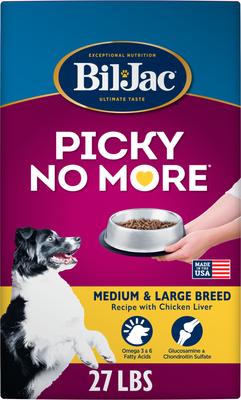
Picky No More Medium & Large Breed Chicken Liver Recipe Dry Dog Food, 27-lb bag
Graded by The Sniff System
Bil-Jac Picky No More Medium & Large Breed Chicken Liver Recipe is a dry dog food featuring chicken and chicken by-products as its main protein sources.
This formula offers quality carbohydrate sources with fermentable fiber. It also provides reasonable protein quality, with chicken delivering solid amino acid coverage, and includes chicken liver for diverse, high-bioavailability protein.
A significant concern is the presence of BHA, an IARC Group 2B probable carcinogen. The product also lacks an AAFCO statement, which is a basic expectation for nutritional completeness.
Good fit for medium and large breed dogs. Less ideal if you prefer foods without synthetic preservatives or a clear AAFCO statement.
Summary written by The Sniff System from the data above. Same rubric, same drivers, expressed in English.
In its 2022 update on diet-associated DCM, the FDA identified Golden Retrievers as the most reported breed, with 121 cases out of 1,382 total canine reports (8.8%) received between January 1, 2014, and November 1, 2022 (FDA, 2022) . Strong fit for adult Golden Retrievers navigating diet-associated DCM concerns. Chicken anchors position 1, with zero pulses in the top 15, plus chicken liver at position 6 (a natural taurine precursor).
Looking at this for adult Golden Retrievers or Golden Retrievers with diet-associated DCM concerns ? We are building dedicated pages for these combinations.
Auto-matched from this product's measurements (ingredients, life stage, calorie density) to a breed archetype. Not a substitute for vet input on your specific dog.
Research informing this analysis
MethodologyThe Sniff System grades this product against 3 cited studies relevant to its profile. Each link opens the original source.
- FDA, 2022cardiac · epidemiology · breed predisposition· cited in 5 claims
- FDA, 2019diet composition· cited in 2 claims
- NRC, 2006nutrient bioavailability
Every claim on Sniff traces to a source. If you find a citation that's wrong, outdated, or misapplied, tell us.
At 42/100, this formula sits below where we look for everyday picks. The lift comes from carbohydrate quality, worth 16 points to the final number: Quality carbohydrate sources with fermentable fiber. The ceiling on this score is 49, set because one FLAG-tier ingredient is in the formula. The cap isn't the binding constraint here. Controversial-ingredient penalty would also need to improve to reach the next band.
Quality carbohydrate sources with fermentable fiber.
Reasonable protein quality. chicken delivers solid amino acid coverage.
Includes egg, named fish, or organ meat for diverse high-bioavailability protein.
- Lowest crude fiber in Bil-Jac's lineup (4.4% DMB)
- Top quartile for caloric density in Bil-Jac's lineup (412 kcal/cup)
- Bottom 10% for fat quality in grain-inclusive dry kibbles (6/16)
Computed against the rest of our catalog. Percentiles refresh on each catalog update.
Similar dog foods worth considering
Three lenses on products with formulation profiles similar to this one.
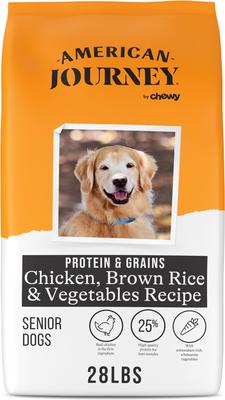
American Journey Protein & Grains Senior Chicken, Brown Rice & Vegetables Recipe Dry Dog Food, 28-lb bag
Scores 32 points higher with a similar formulation profile.
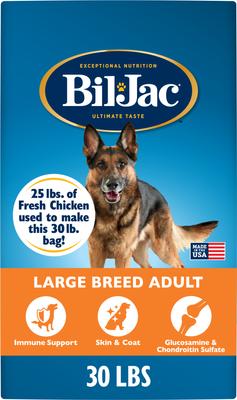
Large Breed Adult Chicken Recipe Dry Dog Food, 30-lb bag
$2.17/lb vs your seed's $2.41/lb (10% less) at a comparable score.
Surfaced from a vector similarity search across 3,491 scored dog foods. How this works.
Read why each ingredient is good or bad for dogs.
- 1protein animalchicken
Real meat. Primary protein source, with the amino acid profile dogs actually evolved to eat.
Position 1: primary protein source. After cooking removes water, this may drop in proportional weight, but it anchors the recipe.
- 2chicken by-products
Position 2: co-primary protein. Two named animal proteins in the top 2 is a strong protein build.
- 3corn meal
Ground corn. Cheap energy, fills out the formula. Whether it's a problem depends on what's around it.
Position 3: major carbohydrate source.
- 4protein animalchicken by-product meal
Ground organs, bone, and tissue. Nutritionally dense, especially the liver and gizzard fractions. Named species ('chicken') is what matters. Generic 'poultry by-product meal' is the one to worry about. See why →
Position 4: significant protein contributor. Adds amino-acid diversity to the top of the deck.
- 5fiberdried beet pulp
Soluble fiber from sugar-beet processing. Sometimes treated as a filler, but it's actually one of the better fiber sources in kibble. See why →
Position 5: functional fiber for digestion or satiety.
- 6protein animalchicken liver
Organ meat. Dense in protein, iron, vitamin A, and the B vitamins. Among the most nutrient-rich ingredients a dog can eat.
Position 6. Functional organ inclusion. Adds amino acids and micronutrients even at smaller weight.
- 7grainoatmeal
Gentle on the stomach. Slow-release carbs and soluble fiber that supports stool quality.
Position 7: supporting grain. Smaller contribution to the carb deck.
- 8brewers dried yeast
Yeast left over from brewing. Rich in B vitamins and amino acids. A traditional and well-tolerated inclusion.
- 9fatflaxseed
Plant source of omega-3. Helpful for skin and coat, though dogs absorb omega-3 from fish more efficiently.
Position 9: trace fat. Below the level that materially shifts the fat profile.
- 10supplementcholine chloride
Essential nutrient for liver and brain function. Standard inclusion in complete dog foods.
- 11supplementdl-methionine
Essential amino acid. Often added when plant proteins dominate, since methionine is naturally lower in pulses than meat.
- 12sodium propionate
- 13supplementl-lysine
Essential amino acid. Plant-protein-heavy formulas sometimes add it to round out the amino acid profile.
- 14monocalcium phosphate
Source of calcium and phosphorus. Standard mineral inclusion in complete dog foods.
- 15vitaminvitamin e supplement
Required nutrient and a natural antioxidant. Often pulls double duty as a preservative.
- 16mineralcalcium carbonate
Source of calcium. Functional. Required in complete dog foods, especially those without bone-in meat meals.
- 17l-ascorbyl-2-polyphosphate
A stable form of vitamin C used in pet food. Provides antioxidant support and survives processing better than plain ascorbic acid.
- 18mineralzinc proteinate
Zinc bound to protein for better absorption. The premium form of the mineral, versus zinc oxide which sits cheaper on the label.
- 19zinc oxide
Inorganic zinc. Cheapest mineral form on the market. Functional but less bioavailable than chelated alternatives.
- 20mineralcopper proteinate
Copper bound to protein for better absorption. Common in better-formulated diets.
- 21probioticdried lactobacillus acidophilus fermentation product
A probiotic strain. Whether the dose is high enough to actually colonize is debated, but it's a real beneficial bacterium.
- 22probioticdried lactobacillus casei fermentation product
- 23dried bifidobacterium animalis fermentation product
- 24vitamin a acetate
- 25mineralcopper sulfate
Inorganic copper. Standard, effective at small doses. Premium formulas tend to use copper proteinate instead.
Showing first 25 of 44. Position 1-5 has the largest weight in the recipe.
20 of 25 ingredients have a curated note. Coverage grows over time.