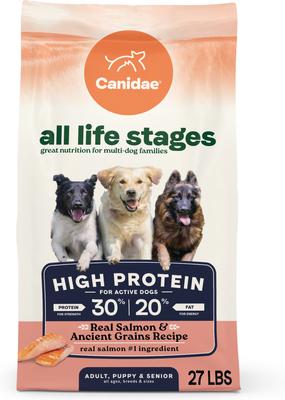
All Life Stages Salmon Recipe High Protein Dry Dog Food, 27-lb bag
Graded by The Sniff System
CANIDAE All Life Stages Salmon Recipe High Protein Dry Dog Food is a dry food with salmon as the primary protein, supported by turkey and chicken, formulated for all life stages.
This food offers a strong protein profile, with salmon as the first ingredient, providing high biological value. It includes quality named fat sources like chicken fat and flaxseed, which contribute marine oils. The overall protein blend offers good diversity.
The formula contains menadione, a synthetic vitamin K3. While permitted in pet food, it's banned in human supplements due to toxicity concerns at high doses, and premium brands often use natural vitamin K alternatives.
Good fit for dogs of all life stages who can benefit from a high-protein diet. Less ideal if you prefer foods without synthetic vitamin K.
Summary written by The Sniff System from the data above. Same rubric, same drivers, expressed in English.
Good fit for large sporting breeds like German Shorthaired Pointers, Weimaraners, and Brittanys navigating hip and joint concerns. No glucosamine or chondroitin on the label, with salmon oil at position 15 for anti-inflammatory EPA/DHA, though caloric density (564 kcal/cup) runs rich for a mobility-limited dog. Based on 28,157 evaluations through 2023, the Orthopedic Foundation for Animals reports a 5.6% hip dysplasia prevalence in German Shorthaired Pointers, with 91.5% of hips rated as excellent, good, or fair (OFA) .
Looking at this for adult German Shorthaired Pointers or German Shorthaired Pointers with hip and joint concerns ? We are building dedicated pages for these combinations.
Auto-matched from this product's measurements (ingredients, life stage, calorie density) to a breed archetype. Not a substitute for vet input on your specific dog.
Research informing this analysis
MethodologyThe Sniff System grades this product against 5 cited studies relevant to its profile. Each link opens the original source.
- OFAorthopedics · breed predisposition· cited in 4 claims
- APOP, 2023weight management
- Bhathal et al., 2017glucosamine
- Brooks et al., 2014weight management
- OFAorthopedics
Every claim on Sniff traces to a source. If you find a citation that's wrong, outdated, or misapplied, tell us.
Sniff scored this formula 65/100, landing in B-tier territory. The biggest contributor was protein quality (+22.5 points): Strong protein profile with salmon as the primary ingredient, delivering high biological value. The biggest detractor was controversial-ingredient penalty (-5 points): Contains menadione. Banned for human OTC use but tolerated at AAFCO-permitted levels in pet food. The only AAFCO-permitted vitamin K source. To reach A-tier, this formula would need to gain about 10 points, most likely through controversial-ingredient penalty.
Strong protein profile with salmon as the primary ingredient, delivering high biological value.
Quality fat sources: named fat with marine oil (EPA and DHA source).
Includes egg, named fish, or organ meat for diverse high-bioavailability protein.
Contains menadione. Banned for human OTC use but tolerated at AAFCO-permitted levels in pet food. The only AAFCO-permitted vitamin K source..
- Lowest crude fiber in CANIDAE's lineup (4.4% DMB)
- Top 5% for DMB fat in grain-inclusive dry kibbles (22.2%)
- Bottom 2% for carb quality in grain-inclusive dry kibbles (9/16)
Computed against the rest of our catalog. Percentiles refresh on each catalog update.
Similar dog foods worth considering
Three lenses on products with formulation profiles similar to this one.
All Life Stages Dry Dog Food Real Chicken & Ancient Grains Recipe
Scores 8 points higher with a similar formulation profile.
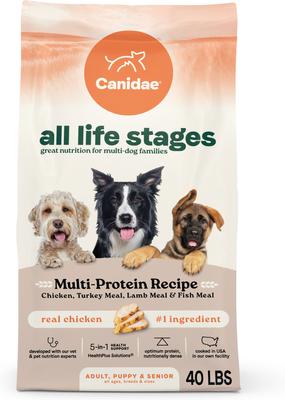
CANIDAE All Life Stages Multi-Protein Recipe Dry Dog Food, 40-lb bag
$1.62/lb vs your seed's $2.22/lb (27% less) at a comparable score.
All Life Stages Grain Free Dry Dog Food Real Chicken & Potato Recipe
Chicken instead of salmon, 6 points higher, different brand.
Surfaced from a vector similarity search across 3,491 scored dog foods. How this works.
Controversial ingredients · 1
- menadioneSynthetic vitamin K3. Banned in human supplements due to toxicity concerns at high doses. Permitted in pet food but premium brands use natural vitamin K alternatives.
Every flagged ingredient has a published basis (confirmed harm / regulatory action / precautionary). See methodology →
Read why each ingredient is good or bad for dogs.
- 1protein animalsalmon
Real fish meat. Natural source of omega-3s, which kibble usually has to add back from oil.
Position 1: primary protein source. After cooking removes water, this may drop in proportional weight, but it anchors the recipe.
- 2protein animalturkey meal
Turkey with the water cooked out. Per pound, packs more protein than fresh turkey. See why →
Position 2: co-primary protein. Two named animal proteins in the top 2 is a strong protein build.
- 3protein animalchicken meal
Chicken with the water cooked out. Per pound, packs more protein than fresh chicken. See why →
Position 3: significant protein contributor. Adds amino-acid diversity to the top of the deck.
- 4fatchicken fat
Despite the name, a high-quality energy source. Concentrated calories plus essential fatty acids like linoleic acid. See why →
Position 4: secondary fat. Often where marine oils sit when present alongside a primary land-animal fat.
- 5grainsorghum
Whole grain with a low glycemic index. Gluten-free, well-tolerated, decent fiber content.
Position 5: supporting grain. Smaller contribution to the carb deck.
- 6grainmillet
Gluten-free whole grain. Fine for most dogs, often used as an alternative to rice.
Position 6: supporting grain. Smaller contribution to the carb deck.
- 7protein plantpea protein
Concentrated plant protein. Inflates the protein number on the label without matching the amino acid quality of meat.
Position 7. Moderate inclusion. Contributes carbohydrate and some plant protein.
- 8dried yeast
Natural source of B vitamins and trace minerals. Adds a savory flavor that dogs respond well to.
- 9legumepeas
Cheap protein bulk. Fine in small amounts, but when peas stack with lentils and chickpeas in the top ingredients, it's the pattern the FDA flagged in its heart-disease investigation. See why →
Position 9. Moderate inclusion. Contributes carbohydrate and some plant protein.
- 10grainoatmeal
Gentle on the stomach. Slow-release carbs and soluble fiber that supports stool quality.
Position 10: minor grain inclusion.
- 11fatflaxseed
Plant source of omega-3. Helpful for skin and coat, though dogs absorb omega-3 from fish more efficiently.
Position 11: trace fat. Below the level that materially shifts the fat profile.
- 12fatcanola oil
Plant oil. Some omega-3 from the parent plant, though dogs absorb it less efficiently than fish-derived omega-3. Fine in moderation.
Position 12: trace fat. Below the level that materially shifts the fat profile.
- 13protein animalpork meal
Pork cooked into a dry concentrate. Per pound, more protein than fresh pork.
Position 13: trace protein. Likely there for amino-acid diversity or label appeal more than nutritional weight.
- 14suncured alfalfa meal
Sun-dried alfalfa, preserving more of the natural vitamins than heat-dried versions.
- 15fatsalmon oil
Pure omega-3s. The thing skin-and-coat formulas are usually built around.
Position 15. Trace marine oil. Contributes some omega-3 but well below the level that drives EPA/DHA totals.
- 16othernatural flavor
Legal term for animal-derived flavoring, usually hydrolyzed liver or broth. Adds taste, says nothing about quality.
- 17threonine
- 18mineralsalt
Sodium chloride. Required at small doses for normal physiology. Not a quality concern in standard amounts.
- 19supplementcholine chloride
Essential nutrient for liver and brain function. Standard inclusion in complete dog foods.
- 20mineralpotassium chloride
Required mineral. Sometimes used as a salt substitute. Standard inclusion in complete diets.
- 21supplementtaurine
Amino acid critical for heart health. Especially important in grain-free or pulse-heavy formulas where natural taurine precursors run thin.
- 22vitaminvitamin e supplement
Required nutrient and a natural antioxidant. Often pulls double duty as a preservative.
- 23tryptophan
- 24preservative naturalmixed tocopherols
Natural vitamin E used to keep fats from going rancid. The good kind of preservative. See why →
- 25mineralpotassium chloride
Required mineral. Sometimes used as a salt substitute. Standard inclusion in complete diets.
Showing first 25 of 51. Position 1-5 has the largest weight in the recipe.
23 of 25 ingredients have a curated note. Coverage grows over time.