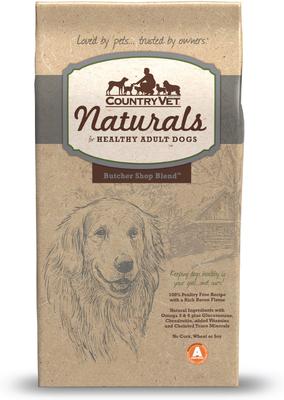
Butcher Shop Blend Beef & Bacon Flavor Dry Dog Food, 35-lb bag
Graded by The Sniff System
Country Vet Naturals Butcher Shop Blend Beef & Bacon Flavor Dry Dog Food is a dry formula for adult dogs, featuring beef and pork as primary proteins.
This food includes quality carbohydrate sources that provide fermentable fiber, which is good for gut health. It also uses premium micronutrient forms, like chelated minerals, which are easier for dogs to absorb and utilize.
The main thing to note is the absence of a declared omega-3 source, like fish oil or algae oil, which are important for skin, coat, and brain health.
Good fit for adult dogs needing a solid, balanced diet. Less ideal if you're looking for a food with a specific omega-3 source.
Summary written by The Sniff System from the data above. Same rubric, same drivers, expressed in English.
Good fit for adult Labrador Retrievers navigating hip and joint concerns. No glucosamine or chondroitin on the label. Elbow dysplasia affects 10.1% of Labrador Retrievers evaluated by the Orthopedic Foundation for Animals, from a sample size of 103,130 dogs submitted through 2023 (OFA) .
Looking at this for adult Labrador Retrievers or Labrador Retrievers with hip and joint concerns ? We are building dedicated pages for these combinations.
Auto-matched from this product's measurements (ingredients, life stage, calorie density) to a breed archetype. Not a substitute for vet input on your specific dog.
Research informing this analysis
MethodologyThe Sniff System grades this product against 5 cited studies relevant to its profile. Each link opens the original source.
- OFAorthopedics · breed predisposition· cited in 4 claims
- APOP, 2023weight management
- Bhathal et al., 2017glucosamine
- Brooks et al., 2014weight management
- OFAorthopedics
Every claim on Sniff traces to a source. If you find a citation that's wrong, outdated, or misapplied, tell us.
Sniff scored this formula 64/100, landing in B-tier territory. The biggest contributor was carbohydrate quality (+15 points): Quality carbohydrate sources with fermentable fiber. The biggest detractor was fat quality (-8 points): No declared omega-3 source. Fish oil, salmon oil, and algae oil all absent. To reach A-tier, this formula would need to gain about 11 points, most likely through fat quality.
Quality carbohydrate sources with fermentable fiber.
Premium micronutrient forms such as chelated minerals or natural vitamin E.
No declared omega-3 source. Fish oil, salmon oil, and algae oil all absent.
- Bottom 4% for fat quality in grain-inclusive dry kibbles (4/16)
- Bottom quartile for DMB protein in dry kibbles (26.7%)
- Bottom quartile for crude fiber in dry kibbles (4.4% DMB)
Computed against the rest of our catalog. Percentiles refresh on each catalog update.
Similar dog foods worth considering
Three lenses on products with formulation profiles similar to this one.
Diamond Naturals Senior Formula Dry Dog Food, 35-lb bag
Scores 14 points higher with a similar formulation profile.
Diamond Naturals Beef Meal & Rice Formula Adult Dry Dog Food, 40-lb bag
$1.07/lb vs your seed's $1.31/lb (18% less) at a comparable score.
Diamond Naturals Grain-Free Chicken & Sweet Potato Formula Dry Dog Food, 28-lb bag
Chicken instead of beef, 3 points higher, different brand.
Surfaced from a vector similarity search across 3,491 scored dog foods. How this works.
Read why each ingredient is good or bad for dogs.
- 1protein animalbeef meal
Beef cooked down to a dry concentrate. More protein per pound than fresh beef. See why →
Position 1: primary protein source. After cooking removes water, this may drop in proportional weight, but it anchors the recipe.
- 2grainbrown rice
Whole grain that's easy to digest. Steady carb energy plus a little fiber.
Position 2: major carbohydrate source.
- 3grainpearled barley
Barley with the outer hull removed. Easy to digest, steady carb release.
Position 3: major carbohydrate source.
- 4bacon fat
Position 4: secondary fat. Often where marine oils sit when present alongside a primary land-animal fat.
- 5protein animalpork meal
Pork cooked into a dry concentrate. Per pound, more protein than fresh pork.
Position 5: significant protein contributor. Adds amino-acid diversity to the top of the deck.
- 6feeding oatmeal
Position 6: supporting grain. Smaller contribution to the carb deck.
- 7legumepeas
Cheap protein bulk. Fine in small amounts, but when peas stack with lentils and chickpeas in the top ingredients, it's the pattern the FDA flagged in its heart-disease investigation. See why →
Position 7. Moderate inclusion. Contributes carbohydrate and some plant protein.
- 8vegetablepumpkin
Soluble fiber that supports stool quality. Mild and well-tolerated.
Position 8: meaningful whole-food inclusion. Source of vitamins, antioxidants, or natural fiber.
- 9flaxseeds
Plural form, same as flaxseed. Plant source of omega-3, helpful for skin and coat.
- 10yeast culture
Fermented yeast. Source of B vitamins and beta-glucans that some research suggests support immune function.
- 11mineralsalt
Sodium chloride. Required at small doses for normal physiology. Not a quality concern in standard amounts.
- 12mineralpotassium chloride
Required mineral. Sometimes used as a salt substitute. Standard inclusion in complete diets.
- 13supplementcholine chloride
Essential nutrient for liver and brain function. Standard inclusion in complete dog foods.
- 14vegetablecarrots
Real vegetable. Fiber, beta-carotene, and a small amount of antioxidant value.
Position 14: garnish-level inclusion. Marketing-prominent but minimal nutritional impact at this position.
- 15vegetablespinach
Leafy green. Some iron, vitamin K, and fiber. The dose in kibble is small but it's real food.
Position 15: garnish-level inclusion. Marketing-prominent but minimal nutritional impact at this position.
- 16dried chicory
- 17probioticdried aspergillus oryzae fermentation product
- 18probioticdried bacillus subtilis fermentation product
- 19probioticdried bacillus coagulans fermentation product
Probiotic strain. More heat-stable than lactobacillus, which means more of it likely survives kibble processing.
- 20probioticdried enterococcus faecium fermentation product
- 21probioticdried lactobacillus acidophilus fermentation product
A probiotic strain. Whether the dose is high enough to actually colonize is debated, but it's a real beneficial bacterium.
- 22probioticdried lactobacillus casei fermentation product
- 23probioticdried lactobacillus plantarum fermentation product
- 24lecithin
Natural emulsifier, usually from soy or sunflower. Helps blend fats and water. Safe at typical inclusion.
- 25supplementglucosamine hydrochloride
Joint-support compound. Most useful in larger doses for older dogs. The kibble dose is real but modest.
Showing first 25 of 43. Position 1-5 has the largest weight in the recipe.
17 of 25 ingredients have a curated note. Coverage grows over time.
This recipe is formulated to meet the nutritional requirements established by the AAFCO Dog Food Nutrient Profile for maintenance.