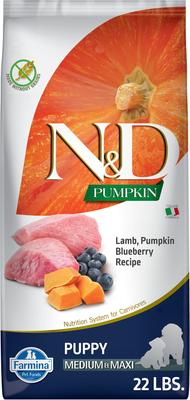
N&D Pumpkin Canine Puppy Lamb & Blueberry Dry Dog Food, 22-lb bag
Graded by The Sniff System
Farmina N&D Pumpkin Canine Puppy Lamb & Blueberry Dry Dog Food is a dry food for puppies, featuring lamb as its primary protein source.
This formula boasts a strong protein profile, with lamb as the main ingredient, providing high biological value. It also includes quality fat sources like named chicken fat and marine oil, which is a good source of EPA and DHA. The carbohydrate sources are also high quality, offering beneficial fermentable fiber.
Nothing concerning in the deck.
Good fit for puppies of all sizes. Nothing serious working against it.
Summary written by The Sniff System from the data above. Same rubric, same drivers, expressed in English.
Labs are the canonical food-motivated breed. Weight management is the dominant practical concern, even more than breed-specific health risks. Good fit for active large sporting breeds like Labrador Retrievers, Golden Retrievers, and English Setters navigating weight management. Caloric density is not declared. The 2014 AAHA Weight Management Guidelines define overweight as a Body Condition Score (BCS) of 6-7 on a 9-point scale. A score of 8 or 9 indicates obesity, representing 20-30% and >30% above ideal body weight, respectively (Brooks et al., 2014) .
Looking at this for puppy Labrador Retrievers or Labrador Retrievers with weight management ? We are building dedicated pages for these combinations.
Auto-matched from this product's measurements (ingredients, life stage, calorie density) to a breed archetype. Not a substitute for vet input on your specific dog.
Research informing this analysis
MethodologyThe Sniff System grades this product against 2 cited studies relevant to its profile. Each link opens the original source.
- Brooks et al., 2014diagnostic · protocol · satiety· cited in 3 claims
- Raffan et al., 2016genetics
Every claim on Sniff traces to a source. If you find a citation that's wrong, outdated, or misapplied, tell us.
At 79/100, this formula sits near the top of our catalog. The lift comes from protein quality, worth 22 points to the final number: Strong protein profile with lamb as the primary ingredient, delivering high biological value. Secondary contribution comes from fat quality (+12 points). Quality fat sources: named fat with marine oil (EPA and DHA source).
Strong protein profile with lamb as the primary ingredient, delivering high biological value.
Quality fat sources: named fat with marine oil (EPA and DHA source).
Quality carbohydrate sources with fermentable fiber.
No negative drivers crossed our reporting threshold.
- Top 5% for protein quality in Farmina's lineup (22.1/27)
- Bottom 1% for crude fiber in grain-free dry kibbles (2.7% DMB)
- Top 5% for DMB fat in grain-free dry kibbles (22.0%)
Computed against the rest of our catalog. Percentiles refresh on each catalog update.
Similar dog foods worth considering
Three lenses on products with formulation profiles similar to this one.
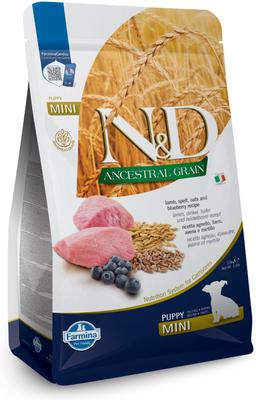
Farmina N&D Ancestral Grain Lamb & Blueberry Recipe Puppy Mini Dry Dog Food, 5.5-lb bag
Scores 2 points higher with a similar formulation profile.
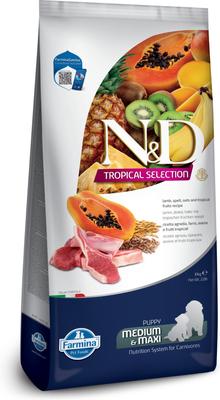
Farmina N&D Tropical Selection Lamb Puppy Medium & Maxi Dry Dog Food, 22-lb bag
$3.64/lb vs your seed's $5.23/lb (30% less) at a comparable score.
Surfaced from a vector similarity search across 3,491 scored dog foods. How this works.
Read why each ingredient is good or bad for dogs.
- 1protein animallamb
Real meat. Often used for dogs with chicken or beef sensitivities. Slightly higher fat content than chicken.
Position 1: primary protein source. After cooking removes water, this may drop in proportional weight, but it anchors the recipe.
- 2dehydrated lamb
Real meat. Often used for dogs with chicken or beef sensitivities. Slightly higher fat content than chicken.
Position 2: co-primary protein. Two named animal proteins in the top 2 is a strong protein build.
- 3pea starch
Refined starch from peas, mostly carbs after the protein is removed. Counts toward the legume stack the FDA examined.
Position 3. Pulse-family ingredient this high in the deck is a notable build choice. When stacked with other pulses in the top 10, matches the formulation pattern the FDA flagged in its diet-associated DCM investigation.
- 4fatchicken fat
Despite the name, a high-quality energy source. Concentrated calories plus essential fatty acids like linoleic acid. See why →
Position 4: secondary fat. Often where marine oils sit when present alongside a primary land-animal fat.
- 5dehydrated herring
Whole fish, naturally high in omega-3s and very digestible protein. Common in premium formulas.
Position 5: significant protein contributor. Adds amino-acid diversity to the top of the deck.
- 6vegetablepumpkin
Soluble fiber that supports stool quality. Mild and well-tolerated.
Position 6: meaningful whole-food inclusion. Source of vitamins, antioxidants, or natural fiber.
- 7dehydrated chicken
Real meat. Primary protein source, with the amino acid profile dogs actually evolved to eat.
Position 7: supporting protein. Modest contribution to total protein weight.
- 8vegetablesweet potato
Complex carb with fiber and beta-carotene. Gentle on the stomach.
Position 8: meaningful whole-food inclusion. Source of vitamins, antioxidants, or natural fiber.
- 9dehydrated pork
Real meat. Dense protein and fat, though less common in dog food than chicken or beef.
Position 9: supporting protein. Modest contribution to total protein weight.
- 10pork fat
Real animal fat from a named species. Clean energy source.
Position 10: supporting protein. Modest contribution to total protein weight.
- 11herring
Whole fish, naturally high in omega-3s and very digestible protein. Common in premium formulas.
Position 11: trace protein. Likely there for amino-acid diversity or label appeal more than nutritional weight.
- 12dried whole eggs
Position 12: trace protein. Likely there for amino-acid diversity or label appeal more than nutritional weight.
- 13othernatural flavors
Same as natural flavor. Usually hydrolyzed liver or broth, adds palatability.
- 14fiberdried beet pulp
Soluble fiber from sugar-beet processing. Sometimes treated as a filler, but it's actually one of the better fiber sources in kibble. See why →
Position 14: trace fiber inclusion.
- 15fatflaxseed
Plant source of omega-3. Helpful for skin and coat, though dogs absorb omega-3 from fish more efficiently.
Position 15: trace fat. Below the level that materially shifts the fat profile.
- 16hydrolyzed fish
- 17herring oil
Concentrated omega-3 from herring. Same role as salmon oil, skin and coat support.
- 18fiberpea fiber
Insoluble fiber from peas. Doesn't carry the protein-inflation concern of pea protein. Mostly there for stool quality.
- 19dried carrot
Real vegetable. Fiber, beta-carotene, antioxidants. Same as carrots, sometimes singular on labels.
- 20suncured alfalfa meal
Sun-dried alfalfa, preserving more of the natural vitamins than heat-dried versions.
- 21fiberinulin
Prebiotic fiber that feeds beneficial gut bacteria. Same compound found in chicory root.
- 22fructooligosaccharide
Prebiotic fiber, often abbreviated FOS. Feeds beneficial gut bacteria.
- 23mineralpotassium chloride
Required mineral. Sometimes used as a salt substitute. Standard inclusion in complete diets.
- 24monocalcium phosphate
Source of calcium and phosphorus. Standard mineral inclusion in complete dog foods.
- 25dried blueberry
Showing first 25 of 59. Position 1-5 has the largest weight in the recipe.
22 of 25 ingredients have a curated note. Coverage grows over time.