
Grain Friendly Wild Pacific Caught Fish Meal & Oats Formula Dog Food, 25-lb bag
Graded by The Sniff System
Firstmate Grain Friendly Wild Pacific Caught Fish Meal & Oats Formula Dog Food is a dry food with ocean fish meal as its primary protein.
This formula uses quality carbohydrate sources like oatmeal and brown rice, which also provide declared fiber. It also includes quality fat sources, such as named chicken fat, and premium micronutrient forms like chelated minerals.
The biggest concern is the lack of an AAFCO statement, meaning its nutritional completeness is unverified. Also, the ocean fish meal provides limited bioavailable amino acids, indicating lower protein quality.
Hard to recommend for any dog due to the unverified nutritional completeness and lower protein quality.
Summary written by The Sniff System from the data above. Same rubric, same drivers, expressed in English.
Good fit for large sporting breeds, including the German Shorthaired Pointer, navigating hip and joint concerns. Working in its favor: glucosamine/chondroitin listed. No glucosamine or chondroitin on the label, though caloric density (494 kcal/cup) runs rich for a mobility-limited dog. Elbow dysplasia prevalence in German Shorthaired Pointers is 0.8% based on 10,233 OFA evaluations through 2023. Over 98% of evaluated GSPs have normal elbows, making the condition uncommon for the breed (OFA) .
Looking at this for adult German Shorthaired Pointers or German Shorthaired Pointers with hip and joint concerns ? We are building dedicated pages for these combinations.
Auto-matched from this product's measurements (ingredients, life stage, calorie density) to a breed archetype. Not a substitute for vet input on your specific dog.
Research informing this analysis
MethodologyThe Sniff System grades this product against 5 cited studies relevant to its profile. Each link opens the original source.
- OFAorthopedics · breed predisposition· cited in 4 claims
- APOP, 2023weight management
- Bhathal et al., 2017glucosamine
- Brooks et al., 2014weight management
- OFAorthopedics
Every claim on Sniff traces to a source. If you find a citation that's wrong, outdated, or misapplied, tell us.
Below-average grade. 44/100 (D) reflects the structural fit of this formula against The Sniff System's eight scoring components. Carbohydrate quality did the heavy lifting (+13 points): Quality carbohydrate sources with declared fiber. What capped it: the score can't exceed 59 because the AAFCO nutritional adequacy statement isn't disclosed on the retailer page (so our methodology can't verify the formula meets adult, growth, or all-life-stages standards). Removing the cap alone wouldn't change the band. Protein quality is the deeper issue.
Quality carbohydrate sources with declared fiber.
Quality fat sources: named fat with declared fat sources.
Premium micronutrient forms such as chelated minerals or natural vitamin E.
Low protein quality. ocean fish meal delivers limited bioavailable amino acids.
No AAFCO statement. Nutritional completeness unverified.
- Top 10% for caloric density in grain-inclusive dry kibbles (494 kcal/cup)
- Bottom 10% for protein quality in grain-inclusive dry kibbles (5.5/27)
- Top quartile for fat quality in Firstmate's lineup (11/16)
Computed against the rest of our catalog. Percentiles refresh on each catalog update.
Similar dog foods worth considering
Three lenses on products with formulation profiles similar to this one.
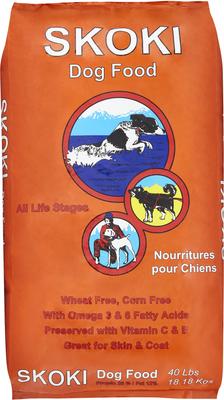
Firstmate Skoki Dry Dog Food, 40-lb bag
Scores 18 points higher with a similar formulation profile.
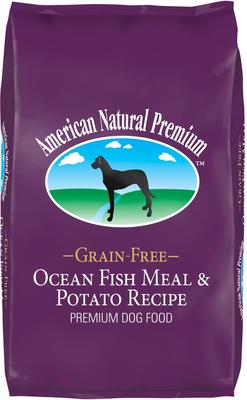
American Natural Premium Grain-Free Ocean Fish Meal & Potato Recipe Dry Dog Food, 26-lb bag
Fish instead of ocean, matched score, different brand.
Surfaced from a vector similarity search across 3,491 scored dog foods. How this works.
Read why each ingredient is good or bad for dogs.
- 1protein animalocean fish meal
Position 1: primary protein source. After cooking removes water, this may drop in proportional weight, but it anchors the recipe.
- 2grainoatmeal
Gentle on the stomach. Slow-release carbs and soluble fiber that supports stool quality.
Position 2: major carbohydrate source.
- 3grainbrown rice
Whole grain that's easy to digest. Steady carb energy plus a little fiber.
Position 3: major carbohydrate source.
- 4fatchicken fat
Despite the name, a high-quality energy source. Concentrated calories plus essential fatty acids like linoleic acid. See why →
Position 4: secondary fat. Often where marine oils sit when present alongside a primary land-animal fat.
- 5fibertomato pomace
The fiber-rich byproduct of tomato processing. Sometimes flagged unfairly. It's a real fiber source, not a filler shortcut.
Position 5: functional fiber for digestion or satiety.
- 6brewer's yeast
- 7mineraldicalcium phosphate
Calcium and phosphorus combined. Required source of both minerals, especially in formulas without much bone content.
- 8calcium propionate
- 9fruitblueberries
Antioxidants, real. But the amount in any kibble is too small to do much. Mostly marketing.
Position 9: garnish-level inclusion. Marketing-prominent but minimal nutritional impact at this position.
- 10fruitraspberries
Position 10: garnish-level inclusion. Marketing-prominent but minimal nutritional impact at this position.
- 11fruitcranberries
Often added with a urinary-tract-support marketing angle. Real cranberry compounds help in concentrate form, but kibble doses are small.
Position 11: garnish-level inclusion. Marketing-prominent but minimal nutritional impact at this position.
- 12mineralzinc proteinate
Zinc bound to protein for better absorption. The premium form of the mineral, versus zinc oxide which sits cheaper on the label.
- 13mineraliron proteinate
Iron bound to protein for better absorption. The premium form versus inorganic iron sulfate.
- 14mineralcalcium carbonate
Source of calcium. Functional. Required in complete dog foods, especially those without bone-in meat meals.
- 15mineralmanganese proteinate
Manganese bound to protein for better absorption. The chelated form most premium brands use.
- 16mineralcopper proteinate
Copper bound to protein for better absorption. Common in better-formulated diets.
- 17mineralselenium yeast
Organic selenium grown in yeast. The form premium brands use, gentler and more bioavailable than sodium selenite.
- 18mineralcalcium iodate
Source of iodine for thyroid function. Functional, required in complete formulas.
- 19vitaminvitamin e supplement
Required nutrient and a natural antioxidant. Often pulls double duty as a preservative.
- 20vitaminniacin supplement
B vitamin (B3). Required in complete dog foods, added as a supplement to standardize the dose.
- 21vitaminthiamine mononitrate
B vitamin (B1). Essential for nervous system function. Cooked-in vitamin loss is why thiamine is always added back.
- 22d-pantothenic acid
- 23vitaminvitamin a supplement
Vitamin A in stable, standardized form. Required for vision, immune function, and growth.
- 24vitaminriboflavin supplement
B vitamin (B2). Required in complete dog foods. The standardized form ensures consistent dosing.
- 25vitaminpyridoxine hydrochloride
B vitamin (B6). Essential for protein metabolism. Standard inclusion in complete formulas.
Showing first 25 of 30. Position 1-5 has the largest weight in the recipe.
20 of 25 ingredients have a curated note. Coverage grows over time.