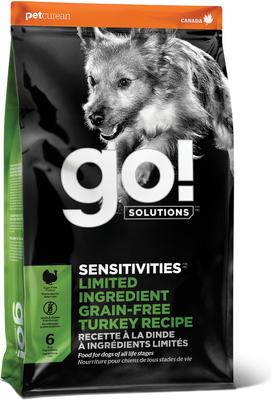
Sensitivities Limited Ingredient Turkey Grain-Free Dry Dog Food, 22-lb bag
Graded by The Sniff System
Go! Solutions Sensitivities Limited Ingredient Turkey Grain-Free Dry Dog Food is a dry food built around turkey as its primary protein.
This formula offers reasonable protein quality, with de-boned turkey providing good amino acid coverage. It also includes quality fat sources like named fats and salmon oil, which is a good source of EPA and DHA. The combination of fresh turkey and turkey meal is a strong approach for dry food.
The biggest watch item here is the lack of an AAFCO statement, meaning its nutritional completeness is unverified. It also contains high legume stacking, with peas, lentils, and chickpeas all appearing in the top 15 ingredients.
Good fit for dogs with sensitivities to common proteins, given its limited ingredient approach. Less ideal if you prioritize a verified AAFCO statement.
Summary written by The Sniff System from the data above. Same rubric, same drivers, expressed in English.
Good fit for large sporting breeds, including the German Shorthaired Pointer, navigating hip and joint concerns. No glucosamine or chondroitin on the label, with salmon oil at position 10 for anti-inflammatory EPA/DHA, though caloric density (451 kcal/cup) runs rich for a mobility-limited dog. Elbow dysplasia prevalence in German Shorthaired Pointers is 0.8% based on 10,233 OFA evaluations through 2023. Over 98% of evaluated GSPs have normal elbows, making the condition uncommon for the breed (OFA) .
Looking at this for adult German Shorthaired Pointers or German Shorthaired Pointers with hip and joint concerns ? We are building dedicated pages for these combinations.
Auto-matched from this product's measurements (ingredients, life stage, calorie density) to a breed archetype. Not a substitute for vet input on your specific dog.
Research informing this analysis
MethodologyThe Sniff System grades this product against 5 cited studies relevant to its profile. Each link opens the original source.
- OFAorthopedics · breed predisposition· cited in 4 claims
- APOP, 2023weight management
- Bhathal et al., 2017glucosamine
- Brooks et al., 2014weight management
- OFAorthopedics
Every claim on Sniff traces to a source. If you find a citation that's wrong, outdated, or misapplied, tell us.
Sniff scored this formula 59/100, landing in C-tier (acceptable-with-notes). The biggest contributor was protein quality (+17.5 points): Reasonable protein quality. de-boned turkey delivers solid amino acid coverage. A hard cap of 59 also applied because the AAFCO nutritional adequacy statement isn't disclosed on the retailer page (so our methodology can't verify the formula meets adult, growth, or all-life-stages standards). If the brand publishing the AAFCO statement were on the label, the cap would lift and this formula could clear the B-band threshold (60).
Reasonable protein quality. de-boned turkey delivers solid amino acid coverage.
Quality fat sources: named fat with marine oil (EPA and DHA source).
Named fresh meat paired with same-species meal, a strong extrusion architecture.
No AAFCO statement. Nutritional completeness unverified.
Contains high legume stacking. Multiple pulse-family ingredients in top 15. Mitigated by taurine supplementation or organ meat (natural taurine precursor) in top 10..
- Lowest carb quality in Go! Solutions's lineup (8/16)
- Top quartile for caloric density in grain-free dry kibbles (451 kcal/cup)
- Bottom quartile for overall Sniff Score in Go! Solutions's lineup (59/100)
Computed against the rest of our catalog. Percentiles refresh on each catalog update.
Similar dog foods worth considering
Three lenses on products with formulation profiles similar to this one.

Go! Solutions Carnivore Grain-Free Chicken, Turkey + Duck Senior Recipe Dry Dog Food, 22-lb bag
Scores 20 points higher with a similar formulation profile.
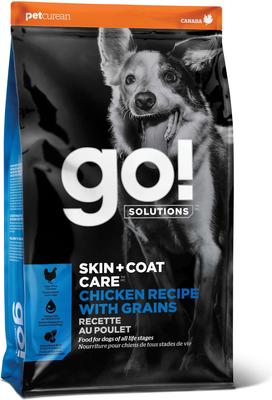
Go! Solutions Skin + Coat Care Chicken Recipe Dry Dog Food, 22-lb bag
$3.04/lb vs your seed's $4.03/lb (25% less) at a comparable score.
Surfaced from a vector similarity search across 3,491 scored dog foods. How this works.
Read why each ingredient is good or bad for dogs.
- 1de-boned turkey
Position 1: primary protein source. After cooking removes water, this may drop in proportional weight, but it anchors the recipe.
- 2protein animalturkey meal
Turkey with the water cooked out. Per pound, packs more protein than fresh turkey. See why →
Position 2: co-primary protein. Two named animal proteins in the top 2 is a strong protein build.
- 3tapioca
Starch from cassava root. Highly digestible energy source, but pure starch with minimal nutrition beyond that.
- 4legumepeas
Cheap protein bulk. Fine in small amounts, but when peas stack with lentils and chickpeas in the top ingredients, it's the pattern the FDA flagged in its heart-disease investigation. See why →
Position 4. Within the FDA's top-5 DCM-pattern threshold. Especially notable if multiple pulses stack here.
- 5legumelentils
Same concern as peas. Affordable plant protein, but when they pile up in the top 5 ingredients, it's a flag. See why →
Position 5. Within the FDA's top-5 DCM-pattern threshold. Especially notable if multiple pulses stack here.
- 6legumechickpeas
Also called garbanzo beans. Affordable plant protein source, part of the legume stack the FDA examined in its heart-disease investigation. See why →
Position 6. Moderate inclusion. Contributes carbohydrate and some plant protein.
- 7fatcanola oil
Plant oil. Some omega-3 from the parent plant, though dogs absorb it less efficiently than fish-derived omega-3. Fine in moderation.
Position 7: trace fat. Below the level that materially shifts the fat profile.
- 8fatcoconut oil
Saturated fat with medium-chain triglycerides. Mostly marketing in the doses kibble uses, but harmless.
Position 8: trace fat. Below the level that materially shifts the fat profile.
- 9natural flavour
- 10fatsalmon oil
Pure omega-3s. The thing skin-and-coat formulas are usually built around.
Position 10. Moderate marine-oil inclusion. Supplements EPA/DHA without being the primary fat.
- 11mineraldicalcium phosphate
Calcium and phosphorus combined. Required source of both minerals, especially in formulas without much bone content.
- 12mineralsodium chloride
Same as salt. Required mineral, necessary at small doses.
- 13mineralpotassium chloride
Required mineral. Sometimes used as a salt substitute. Standard inclusion in complete diets.
- 14fiberdried chicory root
Natural prebiotic. Feeds beneficial gut bacteria. The same compound (inulin) used in human gut-health products.
Position 14: trace fiber inclusion.
- 15supplementcholine chloride
Essential nutrient for liver and brain function. Standard inclusion in complete dog foods.
- 16mineralzinc proteinate
Zinc bound to protein for better absorption. The premium form of the mineral, versus zinc oxide which sits cheaper on the label.
- 17mineraliron proteinate
Iron bound to protein for better absorption. The premium form versus inorganic iron sulfate.
- 18mineralcopper proteinate
Copper bound to protein for better absorption. Common in better-formulated diets.
- 19zinc oxide
Inorganic zinc. Cheapest mineral form on the market. Functional but less bioavailable than chelated alternatives.
- 20mineralmanganese proteinate
Manganese bound to protein for better absorption. The chelated form most premium brands use.
- 21copper sulphate
- 22ferrous sulphate
- 23mineralcalcium iodate
Source of iodine for thyroid function. Functional, required in complete formulas.
- 24manganous oxide
Inorganic manganese. Functional, cheaper than chelated forms, less efficiently absorbed.
- 25mineralselenium yeast
Organic selenium grown in yeast. The form premium brands use, gentler and more bioavailable than sodium selenite.
Showing first 25 of 27. Position 1-5 has the largest weight in the recipe.
21 of 25 ingredients have a curated note. Coverage grows over time.