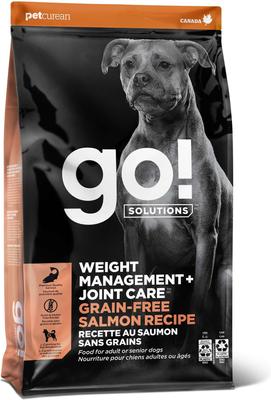
Weight Management + Joint Care Adult Grain-Free Salmon Recipe Dry Dog Food, 22-lb bag
Graded by The Sniff System
Go! Solutions Weight Management + Joint Care Adult Grain-Free Salmon Recipe Dry Dog Food is a dry formula for adult dogs, with de-boned salmon as its primary protein.
This formula features de-boned salmon as the first ingredient, providing solid amino acid coverage and good protein quality. The combination of fresh salmon with salmon meal creates a strong protein foundation, and the inclusion of named fish adds to the diverse, highly bioavailable protein sources.
Nothing concerning in the deck.
Good fit for adult dogs needing weight management or joint support. Nothing serious working against it.
Summary written by The Sniff System from the data above. Same rubric, same drivers, expressed in English.
The landmark 14-year Purina Lifespan Study on 48 Labrador Retrievers demonstrated that dogs fed 25% fewer calories lived a median of 1.8 years longer and delayed the onset of chronic diseases. Good fit for adult Labrador Retrievers navigating weight management. At 410 kcal/cup this formula runs on the rich side, with crude fiber at 10% (above the catalog median, supports satiety), and the product name signals a weight-management design. According to the Association for Pet Obesity Prevention's 2023 survey, 59% of dogs in the United States were classified as overweight or obese by their veterinary healthcare professional, representing an estimated 55 million dogs (APOP, 2023) .
Looking at this for adult Labrador Retrievers or Labrador Retrievers with weight management ? We are building dedicated pages for these combinations.
Auto-matched from this product's measurements (ingredients, life stage, calorie density) to a breed archetype. Not a substitute for vet input on your specific dog.
Research informing this analysis
MethodologyThe Sniff System grades this product against 3 cited studies relevant to its profile. Each link opens the original source.
- Brooks et al., 2014diagnostic · protocol · satiety· cited in 5 claims
- APOP, 2023prevalence
- Raffan et al., 2016genetics
Every claim on Sniff traces to a source. If you find a citation that's wrong, outdated, or misapplied, tell us.
At 68/100, this formula lands in solid B territory. The lift comes from protein quality, worth 19 points to the final number: Reasonable protein quality. de-boned salmon delivers solid amino acid coverage. Secondary contribution comes from ingredient diversity (+5 points). Named fresh meat paired with same-species meal, a strong extrusion architecture. The 7-point gap to the A-tier line is concentrated in fat-quality declaration (7 of 16 possible). Full fat-quality declaration requires a named-species animal fat (e.g., chicken fat, salmon oil) plus a marine oil with declared EPA/DHA milligram content.
Reasonable protein quality. de-boned salmon delivers solid amino acid coverage.
Named fresh meat paired with same-species meal, a strong extrusion architecture.
Includes egg, named fish, or organ meat for diverse high-bioavailability protein.
No negative drivers crossed our reporting threshold.
- Lowest DMB protein in Go! Solutions's lineup (24.4%)
- Top 4% for crude fiber in grain-free dry kibbles (11.1% DMB)
- Lowest DMB fat in Go! Solutions's lineup (11.1%)
Computed against the rest of our catalog. Percentiles refresh on each catalog update.
Similar dog foods worth considering
Three lenses on products with formulation profiles similar to this one.
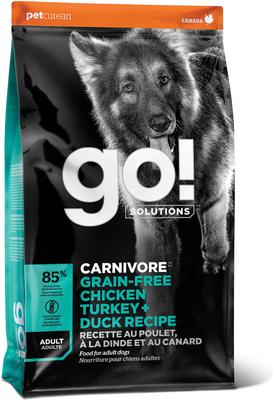
Go! Solutions Carnivore Grain-Free Chicken, Turkey + Duck Adult Recipe Dry Dog Food, 22-lb bag
Scores 11 points higher with a similar formulation profile.
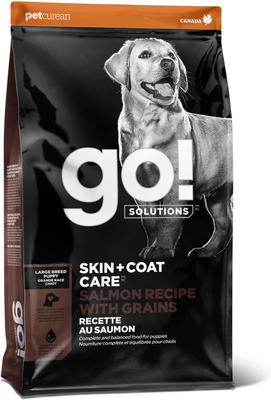
Go! Solutions Skin + Coat with Grains Puppy Large Breed Recipe Dry Dog Food, 25-lb bag
$3.36/lb vs your seed's $3.86/lb (13% less) at a comparable score.
Surfaced from a vector similarity search across 3,491 scored dog foods. How this works.
Read why each ingredient is good or bad for dogs.
- 1de-boned salmon
Position 1: primary protein source. After cooking removes water, this may drop in proportional weight, but it anchors the recipe.
- 2legumepeas
Cheap protein bulk. Fine in small amounts, but when peas stack with lentils and chickpeas in the top ingredients, it's the pattern the FDA flagged in its heart-disease investigation. See why →
Position 2. Pulse-family ingredient this high in the deck is a notable build choice. When stacked with other pulses in the top 10, matches the formulation pattern the FDA flagged in its diet-associated DCM investigation.
- 3protein animalsalmon meal
Salmon cooked into a dry concentrate. Carries both protein and natural omega-3s in one ingredient. See why →
Position 3: significant protein contributor. Adds amino-acid diversity to the top of the deck.
- 4vegetablepotato
Standard white potato. Steady carb source, common starch in grain-free recipes.
Position 4: meaningful whole-food inclusion. Source of vitamins, antioxidants, or natural fiber.
- 5legumechickpeas
Also called garbanzo beans. Affordable plant protein source, part of the legume stack the FDA examined in its heart-disease investigation. See why →
Position 5. Within the FDA's top-5 DCM-pattern threshold. Especially notable if multiple pulses stack here.
- 6tapioca
Starch from cassava root. Highly digestible energy source, but pure starch with minimal nutrition beyond that.
- 7pea fibre
Position 7. Moderate inclusion. Contributes carbohydrate and some plant protein.
- 8fatflaxseed
Plant source of omega-3. Helpful for skin and coat, though dogs absorb omega-3 from fish more efficiently.
Position 8: trace fat. Below the level that materially shifts the fat profile.
- 9supplementalfalfa
- 10natural flavour
- 11fatcanola oil
Plant oil. Some omega-3 from the parent plant, though dogs absorb it less efficiently than fish-derived omega-3. Fine in moderation.
Position 11: trace fat. Below the level that materially shifts the fat profile.
- 12mineralcalcium carbonate
Source of calcium. Functional. Required in complete dog foods, especially those without bone-in meat meals.
- 13psyllium husk
Position 13: trace fiber inclusion.
- 14fatcoconut oil
Saturated fat with medium-chain triglycerides. Mostly marketing in the doses kibble uses, but harmless.
Position 14: trace fat. Below the level that materially shifts the fat profile.
- 15fruitapples
Real fruit, some fiber and antioxidants. The amount in kibble is too small to matter much.
Position 15: garnish-level inclusion. Marketing-prominent but minimal nutritional impact at this position.
- 16tomato
- 17vegetablecarrots
Real vegetable. Fiber, beta-carotene, and a small amount of antioxidant value.
- 18fiberdried chicory root
Natural prebiotic. Feeds beneficial gut bacteria. The same compound (inulin) used in human gut-health products.
- 19ferrous sulphate
- 20mineralzinc proteinate
Zinc bound to protein for better absorption. The premium form of the mineral, versus zinc oxide which sits cheaper on the label.
- 21mineraliron proteinate
Iron bound to protein for better absorption. The premium form versus inorganic iron sulfate.
- 22mineralselenium yeast
Organic selenium grown in yeast. The form premium brands use, gentler and more bioavailable than sodium selenite.
- 23zinc oxide
Inorganic zinc. Cheapest mineral form on the market. Functional but less bioavailable than chelated alternatives.
- 24copper sulphate
- 25mineralmanganese proteinate
Manganese bound to protein for better absorption. The chelated form most premium brands use.
Showing first 25 of 41. Position 1-5 has the largest weight in the recipe.
17 of 25 ingredients have a curated note. Coverage grows over time.