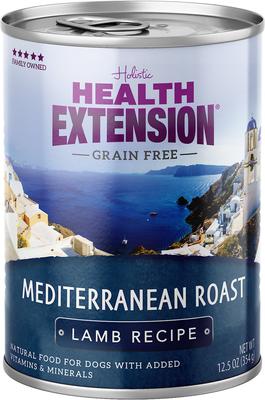
Mediterranean Roast Lamb Recipe Grain-Free Wet Dog Food, 12.5-oz can, case of 12
Graded by The Sniff System
Health Extension Mediterranean Roast Lamb Recipe is a grain-free wet food that features lamb as its primary protein.
Lamb as the first ingredient provides good protein quality and amino acid coverage. This formula also includes herring and pork liver for diverse, highly bioavailable protein sources, along with premium micronutrient forms like chelated minerals.
The biggest watch item is the lack of an AAFCO statement, meaning its nutritional completeness is unverified. This formula also contains guar gum, an emulsifier that receives a minor penalty in canned foods.
Good fit for dogs who thrive on lamb and organ meats. Less ideal if you require an AAFCO statement for nutritional completeness.
Summary written by The Sniff System from the data above. Same rubric, same drivers, expressed in English.
In its 2022 update on diet-associated DCM, the FDA identified Golden Retrievers as the most reported breed, with 121 cases out of 1,382 total canine reports (8.8%) received between January 1, 2014, and November 1, 2022 (FDA, 2022) . Good fit for active large sporting breeds like Golden Retrievers, Labrador Retrievers, and Irish Setters navigating diet-associated DCM concerns. Lamb anchors position 1, with 2 pulse-family ingredients in the top 15 (peas at position 5, red lentils at position 7), plus pork liver at position 4 (a natural taurine precursor) and herring at position 3.
Looking at this for adult Golden Retrievers or Golden Retrievers with diet-associated DCM concerns ? We are building dedicated pages for these combinations.
Auto-matched from this product's measurements (ingredients, life stage, calorie density) to a breed archetype. Not a substitute for vet input on your specific dog.
Research informing this analysis
MethodologyThe Sniff System grades this product against 3 cited studies relevant to its profile. Each link opens the original source.
- FDA, 2022cardiac · epidemiology · breed predisposition· cited in 5 claims
- FDA, 2019diet composition· cited in 2 claims
- NRC, 2006nutrient bioavailability
Every claim on Sniff traces to a source. If you find a citation that's wrong, outdated, or misapplied, tell us.
At 51/100, this formula lands mid-pack. The lift comes from protein quality, worth 19.5 points to the final number: Reasonable protein quality. lamb delivers solid amino acid coverage. The ceiling on this score is 59, set because the AAFCO nutritional adequacy statement isn't disclosed on the retailer page (so our methodology can't verify the formula meets adult, growth, or all-life-stages standards). The cap isn't the binding constraint here. AAFCO compliance would also need to improve to reach the next band.
Reasonable protein quality. lamb delivers solid amino acid coverage.
Includes egg, named fish, or organ meat for diverse high-bioavailability protein.
Premium micronutrient forms such as chelated minerals or natural vitamin E.
No AAFCO statement. Nutritional completeness unverified.
Contains guar gum. Emerging microbiome data on emulsifiers; no canine clinical evidence. Minor penalty in canned food..
- Bottom 10% for carb quality in Health Extension's lineup (8/16)
- Top quartile for DMB fat in Health Extension's lineup (31.8%)
- Bottom quartile for crude fiber in Health Extension's lineup (4.5% DMB)
Computed against the rest of our catalog. Percentiles refresh on each catalog update.
Similar dog foods worth considering
Three lenses on products with formulation profiles similar to this one.
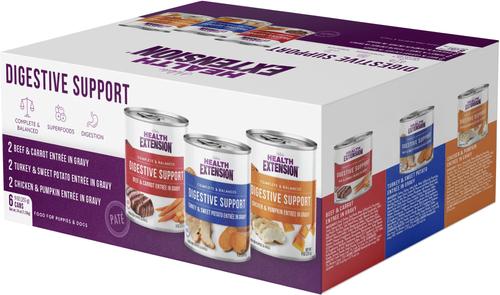
Health Extension Digestive Support Variety Pack -Chicken, Beef & Turkey Dog Food, 9-oz can, case of 6
Scores 8 points higher with a similar formulation profile.
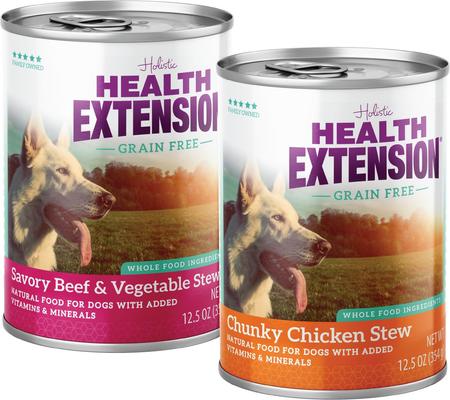
Health Extension Stew Variety Pack: Beef & Chicken Wet Dog Food, 12-oz can, 12 count
$4.11/lb vs your seed's $4.13/lb (0% less) at a comparable score.
Surfaced from a vector similarity search across 3,491 scored dog foods. How this works.
Wet and fresh foods contain more water than kibble (typically 65-78%). On a dry-matter basis, this food's protein content is roughly 39%, comparable to premium kibble (typically 30-45% DMB protein).
Read why each ingredient is good or bad for dogs.
- 1protein animallamb
Real meat. Often used for dogs with chicken or beef sensitivities. Slightly higher fat content than chicken.
Position 1: primary protein source. After cooking removes water, this may drop in proportional weight, but it anchors the recipe.
- 2lamb broth
Position 2: co-primary protein. Two named animal proteins in the top 2 is a strong protein build.
- 3herring
Whole fish, naturally high in omega-3s and very digestible protein. Common in premium formulas.
Position 3: significant protein contributor. Adds amino-acid diversity to the top of the deck.
- 4protein animalpork liver
Organ meat. Dense in B vitamins, iron, and vitamin A. Among the most nutritious ingredients on any label.
Position 4. Named organ meat this high is a strong build choice. Concentrated source of taurine, glutamine, and B-vitamins.
- 5legumepeas
Cheap protein bulk. Fine in small amounts, but when peas stack with lentils and chickpeas in the top ingredients, it's the pattern the FDA flagged in its heart-disease investigation. See why →
Position 5. Within the FDA's top-5 DCM-pattern threshold. Especially notable if multiple pulses stack here.
- 6legumenavy beans
Position 6. Moderate inclusion. Contributes carbohydrate and some plant protein.
- 7legumered lentils
Same concern as other lentils. Affordable plant protein, part of the legume stack the FDA examined. See why →
Position 7. Moderate inclusion. Contributes carbohydrate and some plant protein.
- 8mineralcalcium carbonate
Source of calcium. Functional. Required in complete dog foods, especially those without bone-in meat meals.
- 9fiberguar gum
Thickener common in wet food. Emerging research on emulsifiers and the gut microbiome, but no smoking gun in dogs yet. See why →
Position 9: functional fiber for digestion or satiety.
- 10fatcoconut oil
Saturated fat with medium-chain triglycerides. Mostly marketing in the doses kibble uses, but harmless.
Position 10: trace fat. Below the level that materially shifts the fat profile.
- 11mineralsalt
Sodium chloride. Required at small doses for normal physiology. Not a quality concern in standard amounts.
- 12supplementcholine chloride
Essential nutrient for liver and brain function. Standard inclusion in complete dog foods.
- 13vegetablepumpkin
Soluble fiber that supports stool quality. Mild and well-tolerated.
Position 13: garnish-level inclusion. Marketing-prominent but minimal nutritional impact at this position.
- 14fruitapples
Real fruit, some fiber and antioxidants. The amount in kibble is too small to matter much.
Position 14: garnish-level inclusion. Marketing-prominent but minimal nutritional impact at this position.
- 15fruitblueberries
Antioxidants, real. But the amount in any kibble is too small to do much. Mostly marketing.
Position 15: garnish-level inclusion. Marketing-prominent but minimal nutritional impact at this position.
- 16fruitblackberries
- 17fruitraspberries
- 18fruitcranberries
Often added with a urinary-tract-support marketing angle. Real cranberry compounds help in concentrate form, but kibble doses are small.
- 19fruitpomegranate
Antioxidants, real. Like other fruit additions, the dose in kibble is mostly cosmetic.
- 20vegetablebroccoli
Real vegetable. Adds fiber and some antioxidants. Fine in the small amounts used in kibble.
- 21vegetablekale
Leafy green with antioxidants and fiber. Small dose in kibble, but it's not just for marketing.
- 22sage
- 23chia seed
Plant source of omega-3 and fiber. Like flaxseed, useful in trace amounts.
- 24tomato
- 25beets
Whole beets, not to be confused with beet pulp. Real vegetable, fiber and antioxidants.
Showing first 25 of 50. Position 1-5 has the largest weight in the recipe.
19 of 25 ingredients have a curated note. Coverage grows over time.