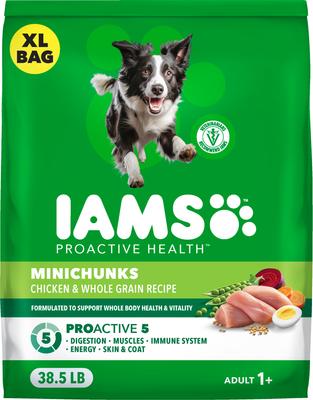
Proactive Health Minichunks with Real Chicken & Whole Grains Dry Dog Food, 38.5-lb bag
Graded by The Sniff System
Iams Proactive Health Minichunks with Real Chicken & Whole Grains is a dry dog food featuring chicken and whole grains, though its specific life stage isn't stated.
This formula provides quality carbohydrate sources that include fermentable fiber, which is good for gut health. It also offers reasonable protein quality, with chicken delivering solid amino acid coverage. The product has undergone AAFCO feeding trial substantiation, which is a strong indicator of nutritional adequacy.
Nothing concerning in the deck.
Good fit for adult dogs of any size. Nothing serious working against it.
Summary written by The Sniff System from the data above. Same rubric, same drivers, expressed in English.
Frenchies have notoriously sensitive GI tracts plus a tendency toward obesity given their low activity needs. Limited-ingredient formulas with moderate calorie density tend to fit them well. Good fit for adult French Bulldogs and similar lower-energy companion breeds navigating a sensitive stomach. Chicken leads at position 1, with dried plain beet pulp (prebiotic fiber) at position 6 on the deck.
Looking at this for adult French Bulldogs or French Bulldogs with a sensitive stomach ? We are building dedicated pages for these combinations.
Auto-matched from this product's measurements (ingredients, life stage, calorie density) to a breed archetype. Not a substitute for vet input on your specific dog.
Research informing this analysis
MethodologyThe Sniff System grades this product against 3 cited studies relevant to its profile. Each link opens the original source.
- NRC, 2006digestibility · fiber· cited in 2 claims
- AAFCO, 2024zinc
- Swanson et al., 2002prebiotics
Every claim on Sniff traces to a source. If you find a citation that's wrong, outdated, or misapplied, tell us.
At 69/100, this formula lands in solid B territory. The lift comes from carbohydrate quality, worth 15 points to the final number: Quality carbohydrate sources with fermentable fiber. Secondary contribution comes from protein quality (+14 points). Reasonable protein quality. chicken delivers solid amino acid coverage. The 6-point gap to the A-tier line is concentrated in protein quality (14 of 27 possible). Full protein quality requires named-species named-cut proteins in the top of the deck (e.g., "deboned chicken" rather than "chicken meal" or "poultry meal").
Quality carbohydrate sources with fermentable fiber.
Reasonable protein quality. chicken delivers solid amino acid coverage.
AAFCO feeding trial substantiation for not stated.
No negative drivers crossed our reporting threshold.
- Bottom 10% for crude fiber in Iams's lineup (4.4% DMB)
- Bottom quartile for DMB protein in Iams's lineup (27.8%)
- Bottom quartile for fat quality in Iams's lineup (10/16)
Computed against the rest of our catalog. Percentiles refresh on each catalog update.
Similar dog foods worth considering
Three lenses on products with formulation profiles similar to this one.

Surfaced from a vector similarity search across 3,491 scored dog foods. How this works.
Read why each ingredient is good or bad for dogs.
- 1protein animalchicken
Real meat. Primary protein source, with the amino acid profile dogs actually evolved to eat.
Position 1: primary protein source. After cooking removes water, this may drop in proportional weight, but it anchors the recipe.
- 2ground whole grain corn
Whole corn with the kernel intact. Decent fiber and B vitamins, though it can crowd out meat in cheaper recipes.
Position 2: major carbohydrate source.
- 3ground whole grain sorghum
Position 3: major carbohydrate source.
- 4protein animalchicken by-product meal
Ground organs, bone, and tissue. Nutritionally dense, especially the liver and gizzard fractions. Named species ('chicken') is what matters. Generic 'poultry by-product meal' is the one to worry about. See why →
Position 4: significant protein contributor. Adds amino-acid diversity to the top of the deck.
- 5protein plantsoybean meal
Concentrated soy protein. Cheap plant protein that pads the label number, common in budget formulas.
Position 5: plant protein in the top 5. Stacked with animal protein, can inflate the crude protein number without matching the amino-acid quality of named animal sources.
- 6dried plain beet pulp
Beet fiber, with the sugar removed. Long unfairly maligned. It's a real soluble fiber that supports stool quality. See why →
Position 6: functional fiber for digestion or satiety.
- 7othernatural flavors
Same as natural flavor. Usually hydrolyzed liver or broth, adds palatability.
- 8brewers dried yeast
Yeast left over from brewing. Rich in B vitamins and amino acids. A traditional and well-tolerated inclusion.
- 9dried egg product
Whole eggs with the water removed. Same nutritional value as fresh eggs, just shelf-stable.
Position 9: supporting protein. Modest contribution to total protein weight.
- 10fatchicken fat
Despite the name, a high-quality energy source. Concentrated calories plus essential fatty acids like linoleic acid. See why →
Position 10: trace fat. Below the level that materially shifts the fat profile.
- 11fatflaxseed
Plant source of omega-3. Helpful for skin and coat, though dogs absorb omega-3 from fish more efficiently.
Position 11: trace fat. Below the level that materially shifts the fat profile.
- 12legumepeas
Cheap protein bulk. Fine in small amounts, but when peas stack with lentils and chickpeas in the top ingredients, it's the pattern the FDA flagged in its heart-disease investigation. See why →
Position 12. Trace inclusion. Below the level associated with the FDA's DCM-pattern concerns.
- 13caramel color
Artificial coloring made by heating sugars. Cosmetic. Some forms contain trace 4-MEI, a compound the IARC lists as possibly carcinogenic.
- 14mineralpotassium chloride
Required mineral. Sometimes used as a salt substitute. Standard inclusion in complete diets.
- 15fiberfructooligosaccharides
Prebiotic fiber, often called FOS. Feeds beneficial gut bacteria, similar in function to inulin.
Position 15: trace fiber inclusion.
- 16supplementcholine chloride
Essential nutrient for liver and brain function. Standard inclusion in complete dog foods.
- 17vegetablecarrots
Real vegetable. Fiber, beta-carotene, and a small amount of antioxidant value.
- 18preservative naturalmixed tocopherols
Natural vitamin E used to keep fats from going rancid. The good kind of preservative. See why →
- 19preservative naturalcitric acid
Natural antioxidant preservative. Helps keep fats from going rancid.
- 20mineralferrous sulfate
Inorganic iron. Standard mineral source. Iron proteinate is the gentler, better-absorbed premium form.
- 21zinc oxide
Inorganic zinc. Cheapest mineral form on the market. Functional but less bioavailable than chelated alternatives.
- 22mineralsodium selenite Flagged
Inorganic selenium. Effective at AAFCO levels, no documented safety concern in dogs despite what some pet food blogs claim. Selenium yeast is a marginal upgrade, not a necessity. See why →
- 23mineralmanganese sulfate
Inorganic manganese. Functional but less well-absorbed than the chelated proteinate form.
- 24mineralcopper sulfate
Inorganic copper. Standard, effective at small doses. Premium formulas tend to use copper proteinate instead.
- 25mineralpotassium iodide
Source of iodine, an essential trace mineral for thyroid function. Required for AAFCO-complete formulas.
Showing first 25 of 27. Position 1-5 has the largest weight in the recipe.
24 of 25 ingredients have a curated note. Coverage grows over time.