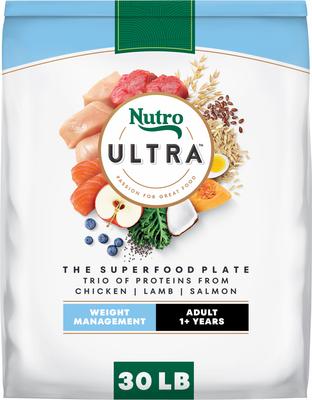
Ultra Adult Weight Management Chicken, Lamb & Salmon Recipe Dry Dog Food, 30-lb bag
Graded by The Sniff System
Nutro Ultra Adult Weight Management Chicken, Lamb & Salmon Recipe is a dry food for adult dogs, with chicken as its primary protein.
This formula features a strong protein profile, starting with chicken as the main ingredient, which offers high biological value. It also uses quality carbohydrate sources that provide fermentable fiber. The combination of fresh chicken with chicken meal is a good sign for how the food is made.
Nothing concerning in the deck.
Good fit for adult dogs who need weight management. Nothing serious working against it.
Summary written by The Sniff System from the data above. Same rubric, same drivers, expressed in English.
Miniature Schnauzers have a high prevalence of idiopathic hypertriglyceridemia. One study found 32.6% of 192 apparently healthy Miniature Schnauzers had elevated triglyceride levels, a primary risk factor for pancreatitis. Good fit for moderately active small terriers, including the Miniature Schnauzer, navigating pancreatitis recovery. DMB fat sits at 10%, in the low-fat (post-recovery range), with chicken at position 1.
Looking at this for adult Miniature Schnauzers or Miniature Schnauzers with pancreatitis recovery ? We are building dedicated pages for these combinations.
Auto-matched from this product's measurements (ingredients, life stage, calorie density) to a breed archetype. Not a substitute for vet input on your specific dog.
Research informing this analysis
MethodologyThe Sniff System grades this product against 4 cited studies relevant to its profile. Each link opens the original source.
- ACVIMfat content · recovery protocol· cited in 2 claims
- Watson, 2015fat content · risk factors· cited in 2 claims
- Hand et al., 2010protein
- IDEXXdiagnostics
Every claim on Sniff traces to a source. If you find a citation that's wrong, outdated, or misapplied, tell us.
At 73/100, this formula lands in solid B territory. The lift comes from protein quality, worth 22.5 points to the final number: Strong protein profile with chicken as the primary ingredient, delivering high biological value. Secondary contribution comes from carbohydrate quality (+15 points). Quality carbohydrate sources with fermentable fiber. The 2-point gap to the A-tier line is concentrated in fat-quality declaration (10 of 16 possible). Full fat-quality declaration requires a named-species animal fat (e.g., chicken fat, salmon oil) plus a marine oil with declared EPA/DHA milligram content.
Strong protein profile with chicken as the primary ingredient, delivering high biological value.
Quality carbohydrate sources with fermentable fiber.
Named fresh meat paired with same-species meal, a strong extrusion architecture.
No negative drivers crossed our reporting threshold.
- Bottom 4% for DMB fat in Nutro's lineup (10.0%)
- Top 10% for protein quality in Nutro's lineup (22.4/27)
- Bottom quartile for crude fiber in Nutro's lineup (4.4% DMB)
Computed against the rest of our catalog. Percentiles refresh on each catalog update.
Similar dog foods worth considering
Three lenses on products with formulation profiles similar to this one.
Nutro Ultra Puppy Large Breed High Protein Trio of Proteins Chicken, Lamb & Salmon Dry Dog Food, 22-lb bag
Scores 3 points higher with a similar formulation profile.

Nutro Natural Choice Adult Chicken & Brown Rice Recipe Dry Dog Food, 30-lb bag
$2.50/lb vs your seed's $2.90/lb (14% less) at a comparable score.
Surfaced from a vector similarity search across 3,491 scored dog foods. How this works.
Read why each ingredient is good or bad for dogs.
- 1protein animalchicken
Real meat. Primary protein source, with the amino acid profile dogs actually evolved to eat.
Position 1: primary protein source. After cooking removes water, this may drop in proportional weight, but it anchors the recipe.
- 2protein animalchicken meal
Chicken with the water cooked out. Per pound, packs more protein than fresh chicken. See why →
Position 2: co-primary protein. Two named animal proteins in the top 2 is a strong protein build.
- 3grainbarley
Whole grain with a low glycemic profile and some soluble fiber. Easy on blood sugar.
Position 3: major carbohydrate source.
- 4grainbrown rice
Whole grain that's easy to digest. Steady carb energy plus a little fiber.
Position 4: supporting grain. Smaller contribution to the carb deck.
- 5grainsorghum
Whole grain with a low glycemic index. Gluten-free, well-tolerated, decent fiber content.
Position 5: supporting grain. Smaller contribution to the carb deck.
- 6grain oatmeal
Position 6: supporting grain. Smaller contribution to the carb deck.
- 7brewers rice
Broken rice kernels left over from milling, usually destined for human beer-making. Cheaper than whole or even white rice. Same carbs, less nutrition than the brown version. See why →
Position 7: supporting grain. Smaller contribution to the carb deck.
- 8protein animallamb meal
Lamb cooked down to a dry concentrate. Per pound, more protein than fresh lamb. See why →
Position 8: supporting protein. Modest contribution to total protein weight.
- 9protein plantpea protein
Concentrated plant protein. Inflates the protein number on the label without matching the amino acid quality of meat.
Position 9. Moderate inclusion. Contributes carbohydrate and some plant protein.
- 10othernatural flavors
Same as natural flavor. Usually hydrolyzed liver or broth, adds palatability.
- 11protein animalsalmon meal
Salmon cooked into a dry concentrate. Carries both protein and natural omega-3s in one ingredient. See why →
Position 11: trace protein. Likely there for amino-acid diversity or label appeal more than nutritional weight.
- 12dried plain beet pulp
Beet fiber, with the sugar removed. Long unfairly maligned. It's a real soluble fiber that supports stool quality. See why →
Position 12: trace fiber inclusion.
- 13mineralsalt
Sodium chloride. Required at small doses for normal physiology. Not a quality concern in standard amounts.
- 14fatchicken fat
Despite the name, a high-quality energy source. Concentrated calories plus essential fatty acids like linoleic acid. See why →
Position 14: trace fat. Below the level that materially shifts the fat profile.
- 15fatflaxseed
Plant source of omega-3. Helpful for skin and coat, though dogs absorb omega-3 from fish more efficiently.
Position 15: trace fat. Below the level that materially shifts the fat profile.
- 16mineralpotassium chloride
Required mineral. Sometimes used as a salt substitute. Standard inclusion in complete diets.
- 17supplementcholine chloride
Essential nutrient for liver and brain function. Standard inclusion in complete dog foods.
- 18preservative naturalcitric acid
Natural antioxidant preservative. Helps keep fats from going rancid.
- 19preservative naturalmixed tocopherols
Natural vitamin E used to keep fats from going rancid. The good kind of preservative. See why →
- 20supplementdl-methionine
Essential amino acid. Often added when plant proteins dominate, since methionine is naturally lower in pulses than meat.
- 21chia seed
Plant source of omega-3 and fiber. Like flaxseed, useful in trace amounts.
- 22dried coconut
- 23dried egg product
Whole eggs with the water removed. Same nutritional value as fresh eggs, just shelf-stable.
- 24dried tomato pomace
The fiber-rich byproduct of tomato processing. Sometimes flagged unfairly. It's a real fiber source, not a filler shortcut.
- 25dried kale
Leafy green with antioxidants and fiber. Small dose in kibble, but it's not just for marketing.
Showing first 25 of 50. Position 1-5 has the largest weight in the recipe.
23 of 25 ingredients have a curated note. Coverage grows over time.