
Wild Reserve Free-Run Chicken Dry Dog Food, 20-lb bag
Graded by The Sniff System
ORIJEN Wild Reserve Free-Run Chicken is a dry dog food that uses chicken, turkey, and salmon as its primary protein sources, formulated for an unspecified life stage.
This formula boasts a strong protein profile, with chicken as the first ingredient, which means high biological value for your dog. It also uses quality named fat sources, like chicken fat, and has AAFCO feeding trial substantiation.
You'll find multiple pulse-family ingredients, like red lentils, in the top 15, which is considered high legume stacking. This is partially mitigated by the inclusion of organ meat, a natural taurine precursor.
Good fit for dogs needing a high-protein diet. Less ideal if you prefer foods without significant legume content.
Summary written by The Sniff System from the data above. Same rubric, same drivers, expressed in English.
Good fit for active large herding breeds like German Shepherds, Australian Shepherds, and German Shorthaired Pointers navigating a sensitive stomach. Working in its favor: prebiotic fiber (chicory or FOS) for gut health. Chicken leads at position 1, but 6 stacked proteins make isolating triggers harder. What we'd flag: multiple protein sources stacked (harder to isolate triggers). Shepherds have a documented tendency toward sensitive GI tracts and hip/elbow dysplasia. Limited-ingredient formulas with marine omega-3 source consistently fit better.
Looking at this for adult German Shepherds or German Shepherds with a sensitive stomach ? We are building dedicated pages for these combinations.
Auto-matched from this product's measurements (ingredients, life stage, calorie density) to a breed archetype. Not a substitute for vet input on your specific dog.
Research informing this analysis
MethodologyThe Sniff System grades this product against 3 cited studies relevant to its profile. Each link opens the original source.
- NRC, 2006digestibility · fiber· cited in 2 claims
- AAFCO, 2024zinc
- Swanson et al., 2002prebiotics
Every claim on Sniff traces to a source. If you find a citation that's wrong, outdated, or misapplied, tell us.
Solid grade. 73/100 (B) reflects the structural fit of this formula against The Sniff System's eight scoring components. Protein quality did the heavy lifting (+25 points): Strong protein profile with chicken as the primary ingredient, delivering high biological value. What we'd flag for vet discussion: controversial-ingredient penalty (-2 points). Contains high legume stacking. Multiple pulse-family ingredients in top 15. Mitigated by taurine supplementation or organ meat (natural taurine precursor) in top 10. A-tier is 2.0 points away. Trimming controversial-ingredient penalty is the most direct route.
Strong protein profile with chicken as the primary ingredient, delivering high biological value.
Quality fat sources: named fat with declared fat sources.
AAFCO feeding trial substantiation for not stated.
Contains high legume stacking. Multiple pulse-family ingredients in top 15. Mitigated by taurine supplementation or organ meat (natural taurine precursor) in top 10..
- Lowest DMB protein in ORIJEN's lineup (43.2%)
- Top 2% for crude fiber in grain-free dry kibbles (14.8% DMB)
- Lowest carb quality in ORIJEN's lineup (8/16)
Computed against the rest of our catalog. Percentiles refresh on each catalog update.
Similar dog foods worth considering
Three lenses on products with formulation profiles similar to this one.
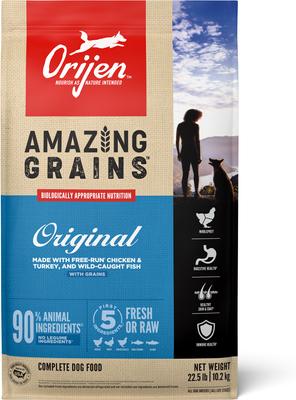
ORIJEN Amazing Grains Original High-Protein Dry Dog Food, 22.5-lb bag
Scores 8 points higher with a similar formulation profile.
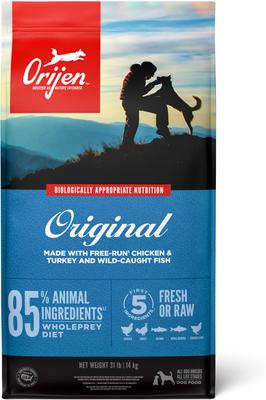
ORIJEN Original Grain-Free High-Protein Dry Dog Food, 31-lb bag
$4.32/lb vs your seed's $5.60/lb (23% less) at a comparable score.
Surfaced from a vector similarity search across 3,491 scored dog foods. How this works.
Read why each ingredient is good or bad for dogs.
- 1protein animalchicken
Real meat. Primary protein source, with the amino acid profile dogs actually evolved to eat.
Position 1: primary protein source. After cooking removes water, this may drop in proportional weight, but it anchors the recipe.
- 2protein animalturkey
Real meat. Lean protein, good amino acid profile, often well-tolerated by dogs sensitive to chicken.
Position 2: co-primary protein. Two named animal proteins in the top 2 is a strong protein build.
- 3protein animalsalmon
Real fish meat. Natural source of omega-3s, which kibble usually has to add back from oil.
Position 3: significant protein contributor. Adds amino-acid diversity to the top of the deck.
- 4herring
Whole fish, naturally high in omega-3s and very digestible protein. Common in premium formulas.
Position 4: significant protein contributor. Adds amino-acid diversity to the top of the deck.
- 5chicken giblets
Position 5. Named organ meat this high is a strong build choice. Concentrated source of taurine, glutamine, and B-vitamins.
- 6dehydrated chicken
Real meat. Primary protein source, with the amino acid profile dogs actually evolved to eat.
Position 6: supporting protein. Modest contribution to total protein weight.
- 7dehydrated turkey
Real meat. Lean protein, good amino acid profile, often well-tolerated by dogs sensitive to chicken.
Position 7: supporting protein. Modest contribution to total protein weight.
- 8dehydrated chicken liver
Organ meat. Dense in protein, iron, vitamin A, and the B vitamins. Among the most nutrient-rich ingredients a dog can eat.
Position 8. Functional organ inclusion. Adds amino acids and micronutrients even at smaller weight.
- 9dehydrated egg
Whole eggs. The highest-quality protein on any ingredient label, by amino acid score.
Position 9: supporting protein. Modest contribution to total protein weight.
- 10dehydrated sardine
Position 10: supporting protein. Modest contribution to total protein weight.
- 11fatchicken fat
Despite the name, a high-quality energy source. Concentrated calories plus essential fatty acids like linoleic acid. See why →
Position 11: trace fat. Below the level that materially shifts the fat profile.
- 12legumered lentils
Same concern as other lentils. Affordable plant protein, part of the legume stack the FDA examined. See why →
Position 12. Trace inclusion. Below the level associated with the FDA's DCM-pattern concerns.
- 13legumepinto beans
Position 13. Trace inclusion. Below the level associated with the FDA's DCM-pattern concerns.
- 14legumenavy beans
Position 14. Trace inclusion. Below the level associated with the FDA's DCM-pattern concerns.
- 15legumelentils
Same concern as peas. Affordable plant protein, but when they pile up in the top 5 ingredients, it's a flag. See why →
Position 15. Trace inclusion. Below the level associated with the FDA's DCM-pattern concerns.
- 16legumechickpeas
Also called garbanzo beans. Affordable plant protein source, part of the legume stack the FDA examined in its heart-disease investigation. See why →
- 17legumepeas
Cheap protein bulk. Fine in small amounts, but when peas stack with lentils and chickpeas in the top ingredients, it's the pattern the FDA flagged in its heart-disease investigation. See why →
- 18freeze-dried chicken
- 19turkey giblets
- 20eggs
Whole eggs. The highest-quality protein on any ingredient label by amino acid score.
- 21othernatural flavor
Legal term for animal-derived flavoring, usually hydrolyzed liver or broth. Adds taste, says nothing about quality.
- 22dried apple pomace
- 23pollock oil
- 24vitaminvitamin e supplement
Required nutrient and a natural antioxidant. Often pulls double duty as a preservative.
- 25fruitcranberries
Often added with a urinary-tract-support marketing angle. Real cranberry compounds help in concentrate form, but kibble doses are small.
Showing first 25 of 57. Position 1-5 has the largest weight in the recipe.
17 of 25 ingredients have a curated note. Coverage grows over time.