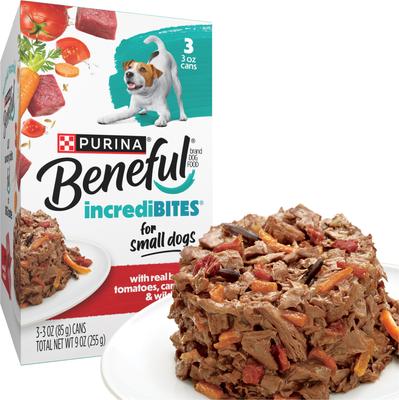
IncrediBites with Real Beef, Carrots, Wild Rice & Gravy Small Breed Wet Dog Food, 3-oz, case of 24
Graded by The Sniff System
Purina Beneful IncrediBites with Real Beef, Carrots, Wild Rice & Gravy is a wet food for small breed dogs, featuring beef as its primary protein.
This wet food offers reasonable protein quality, with beef providing solid amino acid coverage. It also includes liver in the top ingredients, which adds diverse, high-bioavailability protein to the formula.
A major concern is the absence of an AAFCO statement, which means its nutritional completeness is unverified. Additionally, the formula includes unspecified meat by-products, making quality and consistency difficult to audit.
Good fit for small breed dogs who enjoy wet food. Less ideal if you prioritize verified nutritional completeness or transparent ingredient sourcing.
Summary written by The Sniff System from the data above. Same rubric, same drivers, expressed in English.
Strong fit for adult Cavalier King Charles Spaniels and similar moderately active toy breeds navigating diet-associated DCM concerns. Working in its favor: explicitly formulated for small-breed dogs. Beef broth anchors position 1, with zero pulses in the top 15, plus liver at position 4 (a natural taurine precursor). The FDA's 2019 investigation update on diet-associated DCM included 13 reported cases in Cavalier King Charles Spaniels, making them one of the top 15 most frequently reported breeds at that time (FDA, 2019) .
Looking at this for adult Cavalier King Charles Spaniels or Cavalier King Charles Spaniels with diet-associated DCM concerns ? We are building dedicated pages for these combinations.
Auto-matched from this product's measurements (ingredients, life stage, calorie density) to a breed archetype. Not a substitute for vet input on your specific dog.
Research informing this analysis
MethodologyThe Sniff System grades this product against 3 cited studies relevant to its profile. Each link opens the original source.
- FDA, 2022epidemiology · breed predisposition· cited in 4 claims
- FDA, 2019cardiac · diet composition· cited in 3 claims
- NRC, 2006nutrient bioavailability
Every claim on Sniff traces to a source. If you find a citation that's wrong, outdated, or misapplied, tell us.
Middle-of-pack grade. 45/100 (C) reflects the structural fit of this formula against The Sniff System's eight scoring components. Protein quality did the heavy lifting (+15.5 points): Reasonable protein quality. beef delivers solid amino acid coverage. What capped it: the score can't exceed 59 because the AAFCO nutritional adequacy statement isn't disclosed on the retailer page (so our methodology can't verify the formula meets adult, growth, or all-life-stages standards). Removing the cap alone wouldn't change the band. Fat quality is the deeper issue.
Reasonable protein quality. beef delivers solid amino acid coverage.
Includes egg, named fish, or organ meat for diverse high-bioavailability protein.
No declared omega-3 source. Fish oil, salmon oil, and algae oil all absent.
No AAFCO statement. Nutritional completeness unverified.
- Lowest fat quality in Purina Beneful's lineup (4/16)
- Top quartile for DMB protein in grain-inclusive wet foods (45.8%)
- Bottom 3% for carb quality in Purina Beneful's lineup (9/16)
Computed against the rest of our catalog. Percentiles refresh on each catalog update.
Similar dog foods worth considering
Three lenses on products with formulation profiles similar to this one.

Purina Beneful IncrediBites with Real Salmon & Gravy Small Breed Wet Dog Food, 3-oz, case of 24
Scores 4 points higher with a similar formulation profile.
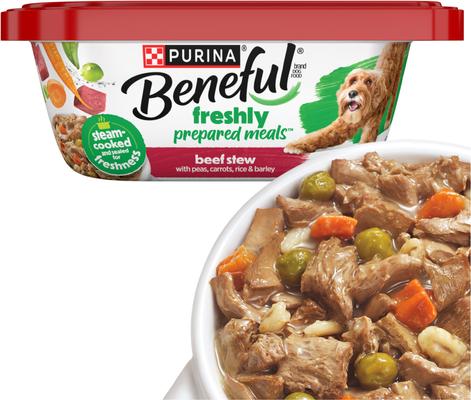
Purina Beneful Freshly Prepared Meals Beef Stew with Peas, Carrots, Rice & Barley Wet Dog Food, 10-oz, case of 8
$3.60/lb vs your seed's $4.50/lb (20% less) at a comparable score.
Surfaced from a vector similarity search across 3,491 scored dog foods. How this works.
Controversial ingredients · 1
- meat by-productsUnspecified species. AAFCO definition allows organs, blood, bone. but the lack of a named source means quality and consistency are not auditable.
Every flagged ingredient has a published basis (confirmed harm / regulatory action / precautionary). See methodology →
Wet and fresh foods contain more water than kibble (typically 65-78%). On a dry-matter basis, this food's protein content is roughly 46%, comparable to premium kibble (typically 30-45% DMB protein).
Read why each ingredient is good or bad for dogs.
- 1beef broth
Real broth. Adds flavor and moisture, signals the recipe leans on real meat.
Position 1: primary protein source. After cooking removes water, this may drop in proportional weight, but it anchors the recipe.
- 2protein animalbeef
Real meat. Dense in protein and iron. Some dogs are sensitive to it, but for most it's an excellent base.
Position 2: co-primary protein. Two named animal proteins in the top 2 is a strong protein build.
- 3protein plantwheat gluten
Concentrated wheat protein. Like other plant gluten meals, it pads the protein number on the label without contributing meat-quality amino acids.
Position 3: plant protein in the top 5. Stacked with animal protein, can inflate the crude protein number without matching the amino-acid quality of named animal sources.
- 4liver
Generic liver, usually chicken or beef. Among the most nutrient-dense ingredients a dog can eat. Named species is more informative.
- 5protein animalmeat by-products Flagged
Unnamed organ meats and tissue. Could be nutritious, but no species is listed, so quality varies by batch.
Position 5: significant protein contributor. Adds amino-acid diversity to the top of the deck.
- 6tomatoes
Real fruit. Lycopene and trace antioxidants. Different from tomato pomace, which is the fiber byproduct.
- 7vegetablecarrots
Real vegetable. Fiber, beta-carotene, and a small amount of antioxidant value.
Position 7: meaningful whole-food inclusion. Source of vitamins, antioxidants, or natural fiber.
- 8wild rice
Position 8: supporting grain. Smaller contribution to the carb deck.
- 9corn starch-modified
Position 9: minor grain inclusion.
- 10soy flour
Refined soy. Cheap plant protein, common in budget formulas. Pads the protein percent without matching meat amino acids.
- 11mineralpotassium chloride
Required mineral. Sometimes used as a salt substitute. Standard inclusion in complete diets.
- 12mineralzinc sulfate
Inorganic zinc. Effective at AAFCO doses but less well-absorbed than chelated forms like zinc proteinate.
- 13mineralferrous sulfate
Inorganic iron. Standard mineral source. Iron proteinate is the gentler, better-absorbed premium form.
- 14mineralcopper sulfate
Inorganic copper. Standard, effective at small doses. Premium formulas tend to use copper proteinate instead.
- 15mineralmanganese sulfate
Inorganic manganese. Functional but less well-absorbed than the chelated proteinate form.
- 16mineralpotassium iodide
Source of iodine, an essential trace mineral for thyroid function. Required for AAFCO-complete formulas.
- 17mineralsodium selenite Flagged
Inorganic selenium. Effective at AAFCO levels, no documented safety concern in dogs despite what some pet food blogs claim. Selenium yeast is a marginal upgrade, not a necessity. See why →
- 18mineraltricalcium phosphate
Calcium and phosphorus source. Same role as dicalcium phosphate, slightly different ratio.
- 19supplementcholine chloride
Essential nutrient for liver and brain function. Standard inclusion in complete dog foods.
17 of 19 ingredients have a curated note. Coverage grows over time.