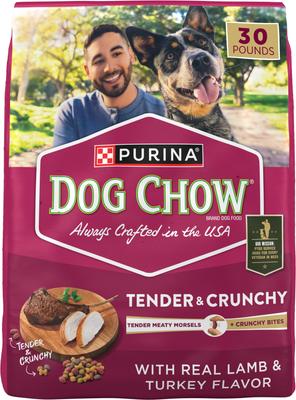
Purina Dog Chow Tender & Crunchy Adult Real Lamb & Turkey Flavor Dry Dog Food, 30-lb bag
Graded by The Sniff System
Purina Dog Chow Tender & Crunchy Adult Real Lamb & Turkey Flavor is a dry food for adult dogs, primarily flavored with lamb and turkey.
Not much to highlight here. While the formula includes lamb and egg, and is likely AAFCO complete for adult maintenance, these are basic expectations for commercial dog food.
This formula is heavily plant-protein dominated, with whole grain corn as the first ingredient. It also contains multiple flagged ingredients: animal digest, red 40, yellow 5, and blue 2. These artificial colors have no nutritional value.
Hard to recommend for any dog. The numerous flagged ingredients and plant-protein dominance are significant concerns.
Summary written by The Sniff System from the data above. Same rubric, same drivers, expressed in English.
In its 2022 update on diet-associated DCM, the FDA identified Golden Retrievers as the most reported breed, with 121 cases out of 1,382 total canine reports (8.8%) received between January 1, 2014, and November 1, 2022 (FDA, 2022) . Good fit for adult Golden Retrievers navigating diet-associated DCM concerns. Beef fat preserved with mixed-tocopherols anchors position 6, with zero pulses in the top 15.
Looking at this for adult Golden Retrievers or Golden Retrievers with diet-associated DCM concerns ? We are building dedicated pages for these combinations.
Auto-matched from this product's measurements (ingredients, life stage, calorie density) to a breed archetype. Not a substitute for vet input on your specific dog.
Research informing this analysis
MethodologyThe Sniff System grades this product against 3 cited studies relevant to its profile. Each link opens the original source.
- FDA, 2022cardiac · epidemiology · breed predisposition· cited in 5 claims
- FDA, 2019diet composition· cited in 2 claims
- NRC, 2006nutrient bioavailability
Every claim on Sniff traces to a source. If you find a citation that's wrong, outdated, or misapplied, tell us.
At 1/100, this formula sits in territory where we recommend switching. The lift comes from ingredient diversity, worth 5 points to the final number: Includes egg, named fish, or organ meat for diverse high-bioavailability protein. The ceiling on this score is 39, set because multiple FLAG-tier ingredients are stacked in the formula. The cap isn't the binding constraint here. Protein quality would also need to improve to reach the next band.
Includes egg, named fish, or organ meat for diverse high-bioavailability protein.
AAFCO formulation inferred from declared adult maintenance. Verbatim statement not published by retailer.
Plant-protein-dominated formula. whole grain corn as the #1 ingredient.
Contains red 40. EU mandatory warning label since 2010. California AB 2316 banned 6 dyes from school foods (2024). HHS phase-out announced April 2025..
- Bottom 4% for fat quality in grain-inclusive dry kibbles (4/16)
- Bottom 2% for carb quality in grain-inclusive dry kibbles (9/16)
- Bottom 2% for overall Sniff Score in grain-inclusive dry kibbles (1/100)
Computed against the rest of our catalog. Percentiles refresh on each catalog update.
Similar dog foods worth considering
Three lenses on products with formulation profiles similar to this one.
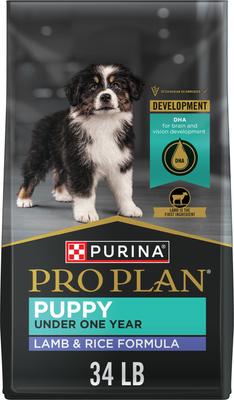
Purina Pro Plan High Protein DHA Lamb & Rice Formula Puppy Food, 34-lb bag
Scores 65 points higher with a similar formulation profile.
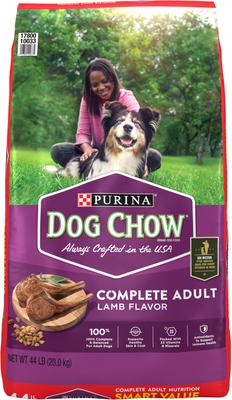
Dog Chow Complete Adult Lamb Flavor Dry Dog Food, 44-lb bag
$0.69/lb vs your seed's $0.83/lb (17% less) at a comparable score.
Surfaced from a vector similarity search across 3,491 scored dog foods. How this works.
Controversial ingredients · 4
- animal digestChemically or enzymatically hydrolyzed animal tissue from unspecified species. Used as a flavor coating. Source quality cannot be verified.
- red 40Artificial color with no nutritional value. Linked to behavioral effects in children; relevance to dogs is unclear but the ingredient serves only marketing purposes.
- yellow 5Artificial color with no nutritional value. Some dogs show allergic-type reactions.
- blue 2Artificial color. A 1990s industry-funded study reported brain tumors in male rats; subsequent reviews disputed methodology, but the additive provides no nutritional benefit.
Every flagged ingredient has a published basis (confirmed harm / regulatory action / precautionary). See methodology →
Read why each ingredient is good or bad for dogs.
- 1grainwhole grain corn
Whole corn with the kernel intact. Decent fiber and B vitamins, though it can crowd out meat in cheaper recipes.
Position 1 grain: primary carbohydrate base. This is a grain-inclusive formula with whole grain corn as the dominant carb.
- 2grainwheat
Whole wheat. Fine for most dogs, though a portion are sensitive. Not a quality concern, just a fit-for-your-dog question.
Position 2: major carbohydrate source.
- 3meat and bone meal
Unnamed animal protein with bone included. Cheap, vague, and not traceable to a specific species.
- 4protein plantcorn gluten meal
Concentrated corn protein. Inflates the protein percent on the label without matching meat-quality amino acids.
Position 4: plant protein in the top 5. Stacked with animal protein, can inflate the crude protein number without matching the amino-acid quality of named animal sources.
- 5protein plantsoybean meal
Concentrated soy protein. Cheap plant protein that pads the label number, common in budget formulas.
Position 5: plant protein in the top 5. Stacked with animal protein, can inflate the crude protein number without matching the amino-acid quality of named animal sources.
- 6beef fat preserved with mixed-tocopherols
Real animal fat from a named species, with natural vitamin E doing the preservation. The clean version.
Position 6: supporting protein. Modest contribution to total protein weight.
- 7protein animallamb
Real meat. Often used for dogs with chicken or beef sensitivities. Slightly higher fat content than chicken.
Position 7: supporting protein. Modest contribution to total protein weight.
- 8egg and chicken flavor
Position 8: supporting protein. Modest contribution to total protein weight.
- 9glycerin
Humectant used in soft-moist foods to keep them chewy. Safe in moderation but a signal of a processed semi-moist product.
- 10grainground rice
Cracked rice for binding and texture. Fine but unremarkable as a nutrient source.
Position 10: minor grain inclusion.
- 11protein animalanimal digest Flagged
A liquid flavoring made from hydrolyzed animal tissue, sprayed onto kibble for palatability. Common, not directly harmful, but vague about source.
Position 11: trace protein. Likely there for amino-acid diversity or label appeal more than nutritional weight.
- 12turkey by-product meal
Position 12: trace protein. Likely there for amino-acid diversity or label appeal more than nutritional weight.
- 13mineralsalt
Sodium chloride. Required at small doses for normal physiology. Not a quality concern in standard amounts.
- 14mineralpotassium chloride
Required mineral. Sometimes used as a salt substitute. Standard inclusion in complete diets.
- 15l-lysine monohydrochloride
Stable form of L-lysine, an essential amino acid. Common in plant-heavy formulas to balance the amino acid profile.
- 16supplementcholine chloride
Essential nutrient for liver and brain function. Standard inclusion in complete dog foods.
- 17mineralzinc sulfate
Inorganic zinc. Effective at AAFCO doses but less well-absorbed than chelated forms like zinc proteinate.
- 18mineralferrous sulfate
Inorganic iron. Standard mineral source. Iron proteinate is the gentler, better-absorbed premium form.
- 19mineralmanganese sulfate
Inorganic manganese. Functional but less well-absorbed than the chelated proteinate form.
- 20mineralcopper sulfate
Inorganic copper. Standard, effective at small doses. Premium formulas tend to use copper proteinate instead.
- 21mineralcalcium iodate
Source of iodine for thyroid function. Functional, required in complete formulas.
- 22mineralsodium selenite Flagged
Inorganic selenium. Effective at AAFCO levels, no documented safety concern in dogs despite what some pet food blogs claim. Selenium yeast is a marginal upgrade, not a necessity. See why →
- 23otherred 40 Flagged
Artificial coloring. Dogs don't care about color. Banned in several countries over hyperactivity and allergic-reaction concerns. See why →
- 24otheryellow 5 Flagged
Artificial coloring. Strictly cosmetic. Banned or restricted in several countries. See why →
- 25otherblue 2 Flagged
Artificial coloring. No nutritional or functional purpose. Banned or restricted in several countries. See why →
Showing first 25 of 26. Position 1-5 has the largest weight in the recipe.
23 of 25 ingredients have a curated note. Coverage grows over time.