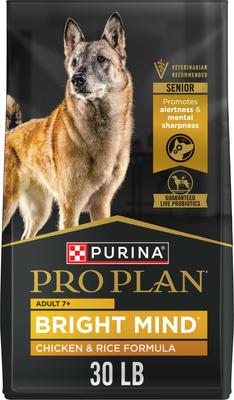
Bright Mind Adult 7+ Chicken & Rice Formula Dry Dog Food, 30-lb bag
Graded by The Sniff System
Purina Pro Plan Bright Mind Adult 7+ Chicken & Rice Formula Dry Dog Food is a dry food for adult dogs aged 7 and older, with chicken as its primary protein.
This formula offers reasonable protein quality, with chicken providing solid amino acid coverage. It also includes quality carbohydrate sources that declare their fiber content, and good fat sources like named fat with marine oil, which is a source of EPA and DHA.
Nothing concerning in the deck.
Good fit for adult dogs aged 7 and older. Nothing serious working against it.
Summary written by The Sniff System from the data above. Same rubric, same drivers, expressed in English.
Strong fit for adult Australian Shepherds navigating skin allergies. The protein deck is built around a single species (chicken), with fish oil at position 13 for EPA/DHA skin support. Aussies are working-line dogs that thrive on high-protein performance formulas. Coat quality also benefits from EPA+DHA. Zinc is essential for skin immunity and healing; the NRC (2006) established a recommended allowance of 20 mg of zinc per 1000 kcal ME for adult dogs at maintenance (NRC, 2006) .
Looking at this for adult Australian Shepherds or Australian Shepherds with skin allergies ? We are building dedicated pages for these combinations.
Auto-matched from this product's measurements (ingredients, life stage, calorie density) to a breed archetype. Not a substitute for vet input on your specific dog.
Sniff scored this formula 66/100, landing in B-tier territory. The biggest contributor was protein quality (+17 points): Reasonable protein quality. chicken delivers solid amino acid coverage. Also adding to the lift: carbohydrate quality (+13). Quality carbohydrate sources with declared fiber. The 9-point gap to A-tier sits mostly in protein quality (17 of 27 possible). Full protein quality requires named-species named-cut proteins in the top of the deck (e.g., "deboned chicken" rather than "chicken meal" or "poultry meal").
Reasonable protein quality. chicken delivers solid amino acid coverage.
Quality carbohydrate sources with declared fiber.
Quality fat sources: named fat with marine oil (EPA and DHA source).
No negative drivers crossed our reporting threshold.
- Bottom 2% for crude fiber in Purina Pro Plan's lineup (3.4% DMB)
- Top quartile for overall Sniff Score in Purina Pro Plan's lineup (66/100)
- Top quartile for DMB protein in grain-inclusive dry kibbles (33.0%)
Computed against the rest of our catalog. Percentiles refresh on each catalog update.
Similar dog foods worth considering
Three lenses on products with formulation profiles similar to this one.
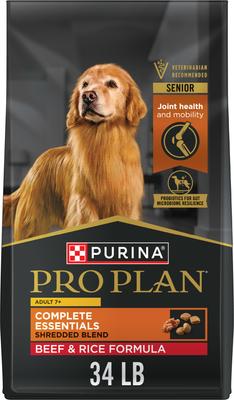
Purina Pro Plan Complete Essentials Adult 7+ Shredded Blend Beef & Rice High Protein Formula with Probiotics Dog Food, 34-lb bag
Scores 4 points higher with a similar formulation profile.
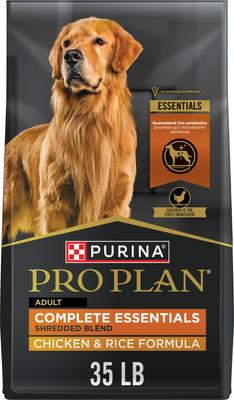
Purina Pro Plan Complete Essentials Adult Shredded Blend Chicken & Rice High Protein Formula with Probiotics Dry Dog Food, 35-lb bag
$2.13/lb vs your seed's $2.90/lb (27% less) at a comparable score.
Surfaced from a vector similarity search across 3,491 scored dog foods. How this works.
Read why each ingredient is good or bad for dogs.
- 1protein animalchicken
Real meat. Primary protein source, with the amino acid profile dogs actually evolved to eat.
Position 1: primary protein source. After cooking removes water, this may drop in proportional weight, but it anchors the recipe.
- 2protein animalpoultry by-product meal
Unnamed poultry. The mix can include any combination of chicken, turkey, or other birds, with no traceability. Named by-product meals are fine. This one isn't.
Position 2: co-primary protein. Two named animal proteins in the top 2 is a strong protein build.
- 3grainrice
Generic rice. Could be white or brown, the label doesn't say. Brown rice would be specified if it were.
Position 3: major carbohydrate source.
- 4grainwhole grain corn
Whole corn with the kernel intact. Decent fiber and B vitamins, though it can crowd out meat in cheaper recipes.
Position 4: supporting grain. Smaller contribution to the carb deck.
- 5corn protein meal
Concentrated corn protein. Similar in role to corn gluten meal, pads the protein number on the label without matching meat amino acids.
Position 5: supporting grain. Smaller contribution to the carb deck.
- 6grainwheat
Whole wheat. Fine for most dogs, though a portion are sensitive. Not a quality concern, just a fit-for-your-dog question.
Position 6: supporting grain. Smaller contribution to the carb deck.
- 7corn germ meal
Position 7: supporting grain. Smaller contribution to the carb deck.
- 8vegetable oil
Unnamed plant oil. Could be soy, canola, corn, or a blend. Named oils like sunflower or canola are more transparent.
Position 8: trace fat. Below the level that materially shifts the fat profile.
- 9grainbarley
Whole grain with a low glycemic profile and some soluble fiber. Easy on blood sugar.
Position 9: minor grain inclusion.
- 10protein animalfish meal
Concentrated fish protein, usually whitefish, herring, or mackerel. Strong amino acid profile. See why →
Position 10: supporting protein. Modest contribution to total protein weight.
- 11dried egg product
Whole eggs with the water removed. Same nutritional value as fresh eggs, just shelf-stable.
Position 11: trace protein. Likely there for amino-acid diversity or label appeal more than nutritional weight.
- 12othernatural flavor
Legal term for animal-derived flavoring, usually hydrolyzed liver or broth. Adds taste, says nothing about quality.
- 13fatfish oil
Concentrated omega-3s. The reason 'EPA' and 'DHA' get to show up on the bag.
Position 13. Trace marine oil. Contributes some omega-3 but well below the level that drives EPA/DHA totals.
- 14supplementl-arginine
- 15soybean oil
Plant oil. High in omega-6, which is required but commonly oversupplied. Fine in moderation.
Position 15: trace fat. Below the level that materially shifts the fat profile.
- 16mineralcalcium carbonate
Source of calcium. Functional. Required in complete dog foods, especially those without bone-in meat meals.
- 17mineralpotassium chloride
Required mineral. Sometimes used as a salt substitute. Standard inclusion in complete diets.
- 18mineralsalt
Sodium chloride. Required at small doses for normal physiology. Not a quality concern in standard amounts.
- 19mono and dicalcium phosphate
Source of calcium and phosphorus. Standard inclusion in complete dog foods.
- 20beef fat preserved with mixed-tocopherols
Real animal fat from a named species, with natural vitamin E doing the preservation. The clean version.
- 21supplementcholine chloride
Essential nutrient for liver and brain function. Standard inclusion in complete dog foods.
- 22mineralzinc sulfate
Inorganic zinc. Effective at AAFCO doses but less well-absorbed than chelated forms like zinc proteinate.
- 23mineralferrous sulfate
Inorganic iron. Standard mineral source. Iron proteinate is the gentler, better-absorbed premium form.
- 24mineralmanganese sulfate
Inorganic manganese. Functional but less well-absorbed than the chelated proteinate form.
- 25mineralcopper sulfate
Inorganic copper. Standard, effective at small doses. Premium formulas tend to use copper proteinate instead.
Showing first 25 of 31. Position 1-5 has the largest weight in the recipe.
23 of 25 ingredients have a curated note. Coverage grows over time.