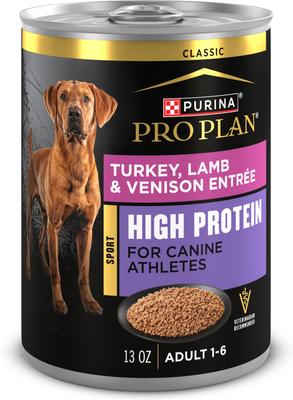
Sport High Protein Turkey, Lamb & Venison Entrée Wet Dog Food, 13-oz can, case of 12
Graded by The Sniff System
Purina Pro Plan Sport High Protein Turkey, Lamb & Venison Entrée is a wet dog food featuring turkey, lamb, and venison, designed for active dogs.
Turkey is a primary protein, which helps deliver good amino acid coverage. The formula also includes quality fat sources with marine oil, providing beneficial EPA and DHA. It has AAFCO feeding trial substantiation, which is a strong indicator of nutritional adequacy.
This food contains carrageenan, a thickener that some studies link to gastrointestinal inflammation, especially for dogs with IBD. There are also unnamed meat by-products, which lack species traceability and make it hard to audit quality and consistency.
Good fit for active dogs who need a wet food with good protein and fat sources. Less ideal if your dog has a sensitive stomach or you prefer full ingredient transparency.
Summary written by The Sniff System from the data above. Same rubric, same drivers, expressed in English.
Good fit for active large sporting breeds like Golden Retrievers, Labrador Retrievers, and Irish Setters navigating diet-associated DCM concerns. Turkey anchors position 1, with zero pulses in the top 15, plus liver at position 4 (a natural taurine precursor). In its 2022 update on diet-associated DCM, the FDA identified Golden Retrievers as the most reported breed, with 121 cases out of 1,382 total canine reports (8.8%) received between January 1, 2014, and November 1, 2022 (FDA, 2022) .
Looking at this for adult Golden Retrievers or Golden Retrievers with diet-associated DCM concerns ? We are building dedicated pages for these combinations.
Auto-matched from this product's measurements (ingredients, life stage, calorie density) to a breed archetype. Not a substitute for vet input on your specific dog.
Research informing this analysis
MethodologyThe Sniff System grades this product against 3 cited studies relevant to its profile. Each link opens the original source.
- FDA, 2022cardiac · epidemiology · breed predisposition· cited in 5 claims
- FDA, 2019diet composition· cited in 2 claims
- NRC, 2006nutrient bioavailability
Every claim on Sniff traces to a source. If you find a citation that's wrong, outdated, or misapplied, tell us.
Middle-of-pack grade. 55/100 (C) reflects the structural fit of this formula against The Sniff System's eight scoring components. Protein quality did the heavy lifting (+19.5 points): Reasonable protein quality. turkey delivers solid amino acid coverage. What capped it: the score can't exceed 64 because three or more WATCH-tier ingredients appear in the deck. Removing the cap alone wouldn't change the band. Controversial-ingredient penalty is the deeper issue.
Reasonable protein quality. turkey delivers solid amino acid coverage.
Quality fat sources: named fat with marine oil (EPA and DHA source).
AAFCO feeding trial substantiation for not stated.
Contains carrageenan. Plausible rodent colitis mechanism, no direct canine clinical evidence at food-grade levels. Concern elevated for dogs with IBD..
Contains meat by-products. Unnamed by-products lack species traceability. Named by-products (chicken by-products) are CLEAR..
- Bottom 3% for carb quality in Purina Pro Plan's lineup (9/16)
- Top 10% for protein quality in Purina Pro Plan's lineup (19.5/27)
- Top 10% for DMB fat in grain-inclusive wet foods (31.8%)
Computed against the rest of our catalog. Percentiles refresh on each catalog update.
Similar dog foods worth considering
Three lenses on products with formulation profiles similar to this one.
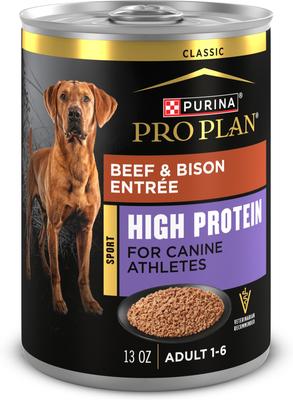
Purina Pro Plan Sport High Protein Beef & Bison Entrée Wet Dog Food, 13-oz can, case of 12
Scores 4 points higher with a similar formulation profile.
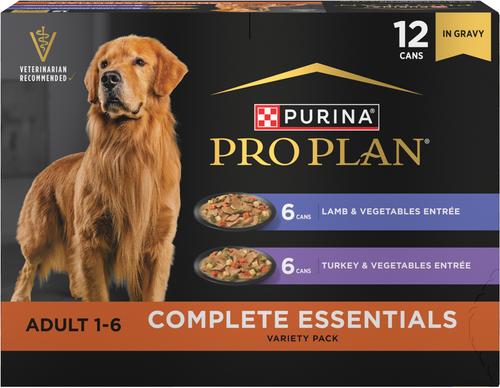
Purina Pro Plan Complete Essentials Variety Pack Adult High Protein Lamb & Vegetables, Turkey & Vegetables Slices in Gravy Wet Dog Food, 13-oz can, case of 12
$3.53/lb vs your seed's $4.05/lb (13% less) at a comparable score.
Surfaced from a vector similarity search across 3,491 scored dog foods. How this works.
Controversial ingredients · 2
- meat by-productsUnspecified species. AAFCO definition allows organs, blood, bone. but the lack of a named source means quality and consistency are not auditable.
- carrageenanSeaweed-derived thickener; some studies link it to gastrointestinal inflammation. Most common in wet foods but appears in some kibble gravies.
Every flagged ingredient has a published basis (confirmed harm / regulatory action / precautionary). See methodology →
Wet and fresh foods contain more water than kibble (typically 65-78%). On a dry-matter basis, this food's protein content is roughly 45%, comparable to premium kibble (typically 30-45% DMB protein).
Read why each ingredient is good or bad for dogs.
- 1protein animalturkey
Real meat. Lean protein, good amino acid profile, often well-tolerated by dogs sensitive to chicken.
Position 1: primary protein source. After cooking removes water, this may drop in proportional weight, but it anchors the recipe.
- 2water
Just water. Counted on the label of any wet or fresh food. The number tells you the moisture content.
- 3protein animalchicken
Real meat. Primary protein source, with the amino acid profile dogs actually evolved to eat.
Position 3: significant protein contributor. Adds amino-acid diversity to the top of the deck.
- 4liver
Generic liver, usually chicken or beef. Among the most nutrient-dense ingredients a dog can eat. Named species is more informative.
- 5protein animalmeat by-products Flagged
Unnamed organ meats and tissue. Could be nutritious, but no species is listed, so quality varies by batch.
Position 5: significant protein contributor. Adds amino-acid diversity to the top of the deck.
- 6protein animallamb
Real meat. Often used for dogs with chicken or beef sensitivities. Slightly higher fat content than chicken.
Position 6: supporting protein. Modest contribution to total protein weight.
- 7protein animalvenison
Real meat, lean and gamey. Used as a novel protein for dogs with sensitivities.
Position 7: supporting protein. Modest contribution to total protein weight.
- 8protein animalegg product
Processed whole eggs. Same nutritional profile as fresh eggs, just shelf-stable.
Position 8: supporting protein. Modest contribution to total protein weight.
- 9grainrice
Generic rice. Could be white or brown, the label doesn't say. Brown rice would be specified if it were.
Position 9: minor grain inclusion.
- 10mineralpotassium chloride
Required mineral. Sometimes used as a salt substitute. Standard inclusion in complete diets.
- 11mineralmagnesium sulfate
Source of magnesium, a required mineral. Standard inclusion in complete diets.
- 12mineralzinc sulfate
Inorganic zinc. Effective at AAFCO doses but less well-absorbed than chelated forms like zinc proteinate.
- 13mineralferrous sulfate
Inorganic iron. Standard mineral source. Iron proteinate is the gentler, better-absorbed premium form.
- 14mineralcopper sulfate
Inorganic copper. Standard, effective at small doses. Premium formulas tend to use copper proteinate instead.
- 15mineralmanganese sulfate
Inorganic manganese. Functional but less well-absorbed than the chelated proteinate form.
- 16mineralpotassium iodide
Source of iodine, an essential trace mineral for thyroid function. Required for AAFCO-complete formulas.
- 17mineralsodium selenite Flagged
Inorganic selenium. Effective at AAFCO levels, no documented safety concern in dogs despite what some pet food blogs claim. Selenium yeast is a marginal upgrade, not a necessity. See why →
- 18fatfish oil
Concentrated omega-3s. The reason 'EPA' and 'DHA' get to show up on the bag.
- 19fiberguar gum
Thickener common in wet food. Emerging research on emulsifiers and the gut microbiome, but no smoking gun in dogs yet. See why →
- 20mineralsalt
Sodium chloride. Required at small doses for normal physiology. Not a quality concern in standard amounts.
- 21othercarrageenan Flagged
Seaweed-derived thickener. Some lab studies suggest gut inflammation, but the evidence in pets is mixed. See why →
- 22choline chloride. b438124
21 of 22 ingredients have a curated note. Coverage grows over time.