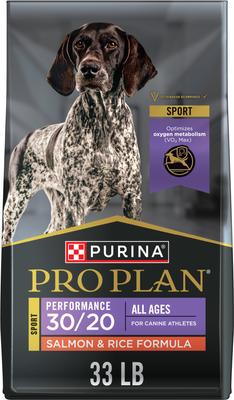
Sport Performance All Life Stages High-Protein 30/20 Salmon & Rice Formula Dry Dog Food, 33-lb bag
Graded by The Sniff System
Purina Pro Plan Sport Performance is a high-protein dry dog food, featuring salmon as its main ingredient, designed for all life stages.
This formula offers good protein quality, with salmon providing solid amino acid coverage for your dog. It also includes quality fat sources, like named fat with marine oil, which is a good source of EPA and DHA. The product has AAFCO feeding trial substantiation for all life stages.
Nothing concerning in the deck.
Good fit for active dogs of all life stages, especially those needing higher protein and fat. Nothing serious working against it.
Summary written by The Sniff System from the data above. Same rubric, same drivers, expressed in English.
Good fit for adult German Shorthaired Pointers and similar sporting breeds navigating hip and joint concerns. No glucosamine or chondroitin on the label, with fish oil at position 11 for anti-inflammatory EPA/DHA, though caloric density (534 kcal/cup) runs rich for a mobility-limited dog. Based on 28,157 evaluations through 2023, the Orthopedic Foundation for Animals reports a 5.6% hip dysplasia prevalence in German Shorthaired Pointers, with 91.5% of hips rated as excellent, good, or fair (OFA) .
Looking at this for adult German Shorthaired Pointers or German Shorthaired Pointers with hip and joint concerns ? We are building dedicated pages for these combinations.
Auto-matched from this product's measurements (ingredients, life stage, calorie density) to a breed archetype. Not a substitute for vet input on your specific dog.
Research informing this analysis
MethodologyThe Sniff System grades this product against 5 cited studies relevant to its profile. Each link opens the original source.
- OFAorthopedics · breed predisposition· cited in 4 claims
- APOP, 2023weight management
- Bhathal et al., 2017glucosamine
- Brooks et al., 2014weight management
- OFAorthopedics
Every claim on Sniff traces to a source. If you find a citation that's wrong, outdated, or misapplied, tell us.
Solid grade. 60/100 (B) reflects the structural fit of this formula against The Sniff System's eight scoring components. Protein quality did the heavy lifting (+16 points): Reasonable protein quality. salmon delivers solid amino acid coverage. The supporting beat: fat quality (+12 points). Quality fat sources: named fat with marine oil (EPA and DHA source). What's keeping it out of A-tier: protein quality (16 of 27 possible). Full protein quality requires named-species named-cut proteins in the top of the deck (e.g., "deboned chicken" rather than "chicken meal" or "poultry meal").
Reasonable protein quality. salmon delivers solid amino acid coverage.
Quality fat sources: named fat with marine oil (EPA and DHA source).
AAFCO feeding trial substantiation for all life stages.
No negative drivers crossed our reporting threshold.
- Top 2% for caloric density in Purina Pro Plan's lineup (534 kcal/cup)
- Bottom 2% for crude fiber in Purina Pro Plan's lineup (3.4% DMB)
- Top 2% for DMB fat in grain-inclusive dry kibbles (22.7%)
Computed against the rest of our catalog. Percentiles refresh on each catalog update.
Similar dog foods worth considering
Three lenses on products with formulation profiles similar to this one.
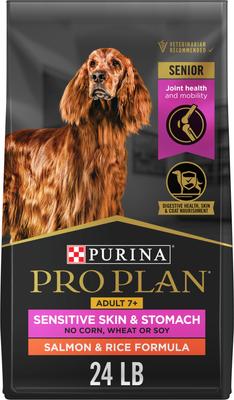
Purina Pro Plan Sensitive Skin & Stomach 7+ Salmon & Rice Formula Dry Dog Food, 24-lb bag
Scores 11 points higher with a similar formulation profile.
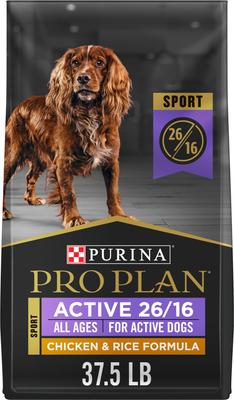
Purina Pro Plan Sport All Life Stages High-Protein Active 26/16 Formula Dry Dog Food, 37.5-lb bag
$1.60/lb vs your seed's $2.27/lb (30% less) at a comparable score.
Surfaced from a vector similarity search across 3,491 scored dog foods. How this works.
Read why each ingredient is good or bad for dogs.
- 1protein animalsalmon
Real fish meat. Natural source of omega-3s, which kibble usually has to add back from oil.
Position 1: primary protein source. After cooking removes water, this may drop in proportional weight, but it anchors the recipe.
- 2corn protein meal
Concentrated corn protein. Similar in role to corn gluten meal, pads the protein number on the label without matching meat amino acids.
Position 2: major carbohydrate source.
- 3grainrice
Generic rice. Could be white or brown, the label doesn't say. Brown rice would be specified if it were.
Position 3: major carbohydrate source.
- 4protein animalpoultry by-product meal
Unnamed poultry. The mix can include any combination of chicken, turkey, or other birds, with no traceability. Named by-product meals are fine. This one isn't.
Position 4: significant protein contributor. Adds amino-acid diversity to the top of the deck.
- 5grainwhole grain corn
Whole corn with the kernel intact. Decent fiber and B vitamins, though it can crowd out meat in cheaper recipes.
Position 5: supporting grain. Smaller contribution to the carb deck.
- 6beef fat preserved with mixed-tocopherols
Real animal fat from a named species, with natural vitamin E doing the preservation. The clean version.
Position 6: supporting protein. Modest contribution to total protein weight.
- 7corn germ meal
Position 7: supporting grain. Smaller contribution to the carb deck.
- 8dried egg product
Whole eggs with the water removed. Same nutritional value as fresh eggs, just shelf-stable.
Position 8: supporting protein. Modest contribution to total protein weight.
- 9protein animalfish meal
Concentrated fish protein, usually whitefish, herring, or mackerel. Strong amino acid profile. See why →
Position 9: supporting protein. Modest contribution to total protein weight.
- 10othernatural flavor
Legal term for animal-derived flavoring, usually hydrolyzed liver or broth. Adds taste, says nothing about quality.
- 11fatfish oil
Concentrated omega-3s. The reason 'EPA' and 'DHA' get to show up on the bag.
Position 11. Moderate marine-oil inclusion. Supplements EPA/DHA without being the primary fat.
- 12mono and dicalcium phosphate
Source of calcium and phosphorus. Standard inclusion in complete dog foods.
- 13mineralcalcium carbonate
Source of calcium. Functional. Required in complete dog foods, especially those without bone-in meat meals.
- 14mineralpotassium chloride
Required mineral. Sometimes used as a salt substitute. Standard inclusion in complete diets.
- 15mineralsalt
Sodium chloride. Required at small doses for normal physiology. Not a quality concern in standard amounts.
- 16supplementcholine chloride
Essential nutrient for liver and brain function. Standard inclusion in complete dog foods.
- 17mineralzinc sulfate
Inorganic zinc. Effective at AAFCO doses but less well-absorbed than chelated forms like zinc proteinate.
- 18mineralferrous sulfate
Inorganic iron. Standard mineral source. Iron proteinate is the gentler, better-absorbed premium form.
- 19mineralmanganese sulfate
Inorganic manganese. Functional but less well-absorbed than the chelated proteinate form.
- 20mineralcopper sulfate
Inorganic copper. Standard, effective at small doses. Premium formulas tend to use copper proteinate instead.
- 21mineralcalcium iodate
Source of iodine for thyroid function. Functional, required in complete formulas.
- 22mineralsodium selenite Flagged
Inorganic selenium. Effective at AAFCO levels, no documented safety concern in dogs despite what some pet food blogs claim. Selenium yeast is a marginal upgrade, not a necessity. See why →
- 23l-lysine monohydrochloride
Stable form of L-lysine, an essential amino acid. Common in plant-heavy formulas to balance the amino acid profile.
- 24l-ascorbyl-2-polyphosphate
A stable form of vitamin C used in pet food. Provides antioxidant support and survives processing better than plain ascorbic acid.
- 25mineralmagnesium sulfate
Source of magnesium, a required mineral. Standard inclusion in complete diets.
Showing first 25 of 26. Position 1-5 has the largest weight in the recipe.
24 of 25 ingredients have a curated note. Coverage grows over time.