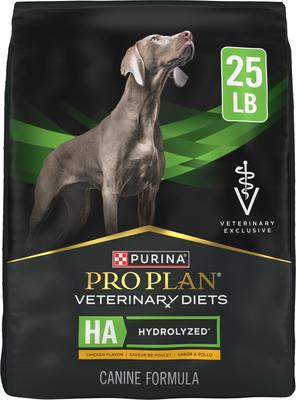
HA Hydrolyzed Chicken Flavor Dry Dog Food, 25-lb bag
Graded by The Sniff System
Purina Pro Plan Veterinary Diets HA Hydrolyzed Chicken Flavor Dry Dog Food is a dry formula for growth, featuring hydrolyzed soy protein and chicken liver.
Not much to highlight here for an F-tier product. The formula does include hydrolyzed chicken liver and giblets, which offer diverse, high-bioavailability protein sources. It also has reasonable protein quality overall.
The formula contains menadione, a synthetic vitamin K3 that's banned in human supplements due to toxicity concerns at high doses. Also, the protein and fat levels are quite low for a growth formula.
Hard to recommend for any dog, especially puppies, given the low protein and fat levels for growth and the synthetic vitamin K3.
Summary written by The Sniff System from the data above. Same rubric, same drivers, expressed in English.
Strong fit for active large sporting breeds, including the Golden Retriever, navigating diet-associated DCM concerns. Working in its favor: AAFCO growth profile (suitable for puppies). Hydrolyzed chicken liver anchors position 9, with zero pulses in the top 15, plus hydrolyzed chicken liver at position 9 (a natural taurine precursor). What we'd flag: calorie density (315 kcal/cup) is on the low side for growth. Goldens appeared disproportionately in the FDA's DCM reports. Pulse-heavy grain-free formulas warrant extra caution; named animal protein with organ meat or marine sources is the safer fit.
Looking at this for puppy Golden Retrievers or Golden Retrievers with diet-associated DCM concerns ? We are building dedicated pages for these combinations.
Auto-matched from this product's measurements (ingredients, life stage, calorie density) to a breed archetype. Not a substitute for vet input on your specific dog.
Research informing this analysis
MethodologyThe Sniff System grades this product against 2 cited studies relevant to its profile. Each link opens the original source.
- FDA, 2022epidemiology · breed predisposition· cited in 4 claims
- FDA, 2019diet composition· cited in 2 claims
Every claim on Sniff traces to a source. If you find a citation that's wrong, outdated, or misapplied, tell us.
Concerning grade. 14/100 (F) reflects the structural fit of this formula against The Sniff System's eight scoring components. Protein quality did the heavy lifting (+14.5 points): Reasonable protein quality. corn starch delivers solid amino acid coverage. What capped it: the score can't exceed 49 because the guaranteed analysis falls below AAFCO's minimum nutrient profile. Removing the cap alone wouldn't change the band. The component deck is the deeper issue.
Reasonable protein quality. corn starch delivers solid amino acid coverage.
Includes egg, named fish, or organ meat for diverse high-bioavailability protein.
- Lowest overall Sniff Score in Purina Pro Plan Veterinary Diets's lineup (14/100)
- Bottom 3% for DMB protein in Purina Pro Plan Veterinary Diets's lineup (20.2%)
- Bottom 2% for carb quality in grain-inclusive dry kibbles (9/16)
Computed against the rest of our catalog. Percentiles refresh on each catalog update.
Similar dog foods worth considering
Three lenses on products with formulation profiles similar to this one.
Surfaced from a vector similarity search across 3,491 scored dog foods. How this works.
Controversial ingredients · 1
- menadioneSynthetic vitamin K3. Banned in human supplements due to toxicity concerns at high doses. Permitted in pet food but premium brands use natural vitamin K alternatives.
Every flagged ingredient has a published basis (confirmed harm / regulatory action / precautionary). See methodology →
Read why each ingredient is good or bad for dogs.
- 1corn starch
Position 1 grain: primary carbohydrate base. This is a grain-inclusive formula with corn starch as the dominant carb.
- 2hydrolyzed soy protein isolate
- 3partially hydrogenated canola oil preserved with tbhq
Position 3: primary fat source. Drives the formula's caloric density and omega-6 content.
- 4fatcoconut oil
Saturated fat with medium-chain triglycerides. Mostly marketing in the doses kibble uses, but harmless.
Position 4: secondary fat. Often where marine oils sit when present alongside a primary land-animal fat.
- 5fiberpowdered cellulose
Plant fiber, often from wood pulp. Cheap bulk filler. Not harmful, but a tell that the recipe is reaching for inexpensive bulk.
Position 5: functional fiber for digestion or satiety.
- 6mineraltricalcium phosphate
Calcium and phosphorus source. Same role as dicalcium phosphate, slightly different ratio.
- 7corn oil
Position 7: supporting grain. Smaller contribution to the carb deck.
- 8mineraldicalcium phosphate
Calcium and phosphorus combined. Required source of both minerals, especially in formulas without much bone content.
- 9hydrolyzed chicken liver
- 10hydrolyzed chicken giblets
- 11mineralpotassium chloride
Required mineral. Sometimes used as a salt substitute. Standard inclusion in complete diets.
- 12fiberguar gum
Thickener common in wet food. Emerging research on emulsifiers and the gut microbiome, but no smoking gun in dogs yet. See why →
Position 12: trace fiber inclusion.
- 13supplementcholine chloride
Essential nutrient for liver and brain function. Standard inclusion in complete dog foods.
- 14mineralcalcium carbonate
Source of calcium. Functional. Required in complete dog foods, especially those without bone-in meat meals.
- 15mineralsalt
Sodium chloride. Required at small doses for normal physiology. Not a quality concern in standard amounts.
- 16mineralmagnesium oxide
Inorganic magnesium. Functional at AAFCO doses, less efficiently absorbed than chelated forms.
- 17supplementdl-methionine
Essential amino acid. Often added when plant proteins dominate, since methionine is naturally lower in pulses than meat.
- 18supplementtaurine
Amino acid critical for heart health. Especially important in grain-free or pulse-heavy formulas where natural taurine precursors run thin.
- 19mineralzinc sulfate
Inorganic zinc. Effective at AAFCO doses but less well-absorbed than chelated forms like zinc proteinate.
- 20vitaminvitamin e supplement
Required nutrient and a natural antioxidant. Often pulls double duty as a preservative.
- 21mineralferrous sulfate
Inorganic iron. Standard mineral source. Iron proteinate is the gentler, better-absorbed premium form.
- 22mineralmanganese sulfate
Inorganic manganese. Functional but less well-absorbed than the chelated proteinate form.
- 23soybean oil
Plant oil. High in omega-6, which is required but commonly oversupplied. Fine in moderation.
- 24vitaminniacin supplement
B vitamin (B3). Required in complete dog foods, added as a supplement to standardize the dose.
- 25mineralcopper sulfate
Inorganic copper. Standard, effective at small doses. Premium formulas tend to use copper proteinate instead.
Showing first 25 of 38. Position 1-5 has the largest weight in the recipe.
19 of 25 ingredients have a curated note. Coverage grows over time.
It provides complete and balanced nutrition for the growth of puppies and the maintenance of adult dogs.