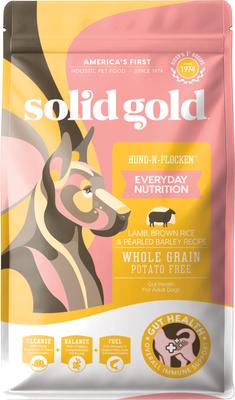
Real Lamb, Brown Rice & Pearled Barley Whole Grain Recipe Dry Dog Food for Medium & Large Dogs, 24-lb bag
Graded by The Sniff System
Solid Gold Real Lamb, Brown Rice & Pearled Barley Whole Grain Recipe is a dry food featuring lamb as its main protein, designed for medium and large dogs.
This recipe offers reasonable protein quality, with lamb providing solid amino acid coverage. It also includes quality fat sources like named chicken fat and ocean fish meal for EPA and DHA, alongside quality carbohydrate sources with fermentable fiber.
The main thing to note is the absence of an AAFCO statement, which means the nutritional completeness of this formula is unverified. This factor significantly impacted its overall score.
Good fit for medium and large adult dogs who tolerate grains. Less ideal if you require a verified AAFCO nutritional adequacy statement.
Summary written by The Sniff System from the data above. Same rubric, same drivers, expressed in English.
Good fit for active large sporting breeds like Labrador Retrievers, Golden Retrievers, and English Setters navigating weight management. At 335 kcal/cup this formula runs on the lean side, with crude fiber at 4% (above the catalog median, supports satiety). The landmark 14-year Purina Lifespan Study on 48 Labrador Retrievers demonstrated that dogs fed 25% fewer calories lived a median of 1.8 years longer and delayed the onset of chronic diseases. The 2014 AAHA Weight Management Guidelines define overweight as a Body Condition Score (BCS) of 6-7 on a 9-point scale. A score of 8 or 9 indicates obesity, representing 20-30% and >30% above ideal body weight, respectively (Brooks et al., 2014) .
Looking at this for adult Labrador Retrievers or Labrador Retrievers with weight management ? We are building dedicated pages for these combinations.
Auto-matched from this product's measurements (ingredients, life stage, calorie density) to a breed archetype. Not a substitute for vet input on your specific dog.
Research informing this analysis
MethodologyThe Sniff System grades this product against 3 cited studies relevant to its profile. Each link opens the original source.
- Brooks et al., 2014diagnostic · protocol · satiety· cited in 5 claims
- APOP, 2023prevalence
- Raffan et al., 2016genetics
Every claim on Sniff traces to a source. If you find a citation that's wrong, outdated, or misapplied, tell us.
Middle-of-pack grade. 59/100 (C) reflects the structural fit of this formula against The Sniff System's eight scoring components. Protein quality did the heavy lifting (+15 points): Reasonable protein quality. lamb delivers solid amino acid coverage. What capped it: the score can't exceed 59 because the AAFCO nutritional adequacy statement isn't disclosed on the retailer page (so our methodology can't verify the formula meets adult, growth, or all-life-stages standards). How it could climb: the brand publishing the AAFCO statement, which would lift the cap into B-band range.
Reasonable protein quality. lamb delivers solid amino acid coverage.
Quality fat sources: named fat with marine oil (EPA and DHA source).
Quality carbohydrate sources with fermentable fiber.
No AAFCO statement. Nutritional completeness unverified.
- Bottom 3% for DMB protein in Solid Gold's lineup (24.4%)
- Bottom 3% for crude fiber in Solid Gold's lineup (4.4% DMB)
- Bottom 10% for DMB fat in dry kibbles (11.1%)
Computed against the rest of our catalog. Percentiles refresh on each catalog update.
Similar dog foods worth considering
Three lenses on products with formulation profiles similar to this one.
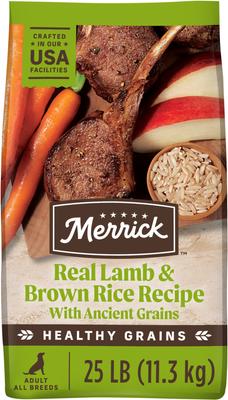
Merrick Classic Healthy Grains Dry Dog Food Real Lamb + Brown Rice Recipe with Ancient Grains, 25-lb bag
Scores 19 points higher with a similar formulation profile.
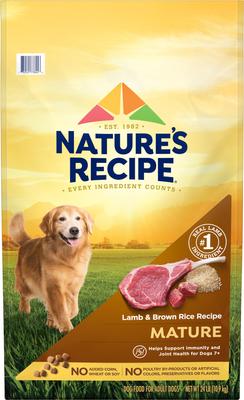
Nature's Recipe Mature Lamb & Brown Rice Recipe Dry Dog Food, 24-lb bag
$1.04/lb vs your seed's $3.12/lb (67% less) at a comparable score.
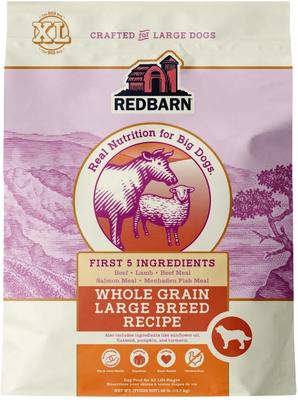
Redbarn Whole Grain Large Breed Recipe Dry Dog Food, 28-lb bag
Beef instead of lamb, matched score, different brand.
Surfaced from a vector similarity search across 3,491 scored dog foods. How this works.
Read why each ingredient is good or bad for dogs.
- 1protein animallamb
Real meat. Often used for dogs with chicken or beef sensitivities. Slightly higher fat content than chicken.
Position 1: primary protein source. After cooking removes water, this may drop in proportional weight, but it anchors the recipe.
- 2protein animallamb meal
Lamb cooked down to a dry concentrate. Per pound, more protein than fresh lamb. See why →
Position 2: co-primary protein. Two named animal proteins in the top 2 is a strong protein build.
- 3grainbrown rice
Whole grain that's easy to digest. Steady carb energy plus a little fiber.
Position 3: major carbohydrate source.
- 4grainpearled barley
Barley with the outer hull removed. Easy to digest, steady carb release.
Position 4: supporting grain. Smaller contribution to the carb deck.
- 5grainoatmeal
Gentle on the stomach. Slow-release carbs and soluble fiber that supports stool quality.
Position 5: supporting grain. Smaller contribution to the carb deck.
- 6legumechickpeas
Also called garbanzo beans. Affordable plant protein source, part of the legume stack the FDA examined in its heart-disease investigation. See why →
Position 6. Moderate inclusion. Contributes carbohydrate and some plant protein.
- 7legumepeas
Cheap protein bulk. Fine in small amounts, but when peas stack with lentils and chickpeas in the top ingredients, it's the pattern the FDA flagged in its heart-disease investigation. See why →
Position 7. Moderate inclusion. Contributes carbohydrate and some plant protein.
- 8grainrice
Generic rice. Could be white or brown, the label doesn't say. Brown rice would be specified if it were.
Position 8: supporting grain. Smaller contribution to the carb deck.
- 9protein animalocean fish meal
Position 9: supporting protein. Modest contribution to total protein weight.
- 10fatchicken fat
Despite the name, a high-quality energy source. Concentrated calories plus essential fatty acids like linoleic acid. See why →
Position 10: trace fat. Below the level that materially shifts the fat profile.
- 11dried eggs
Whole eggs. The highest-quality protein on any ingredient label by amino acid score.
Position 11: trace protein. Likely there for amino-acid diversity or label appeal more than nutritional weight.
- 12fatground flaxseed
Cracked flaxseed for better digestibility. Same plant omega-3s as whole flaxseed, just easier for the dog to extract.
Position 12: trace fat. Below the level that materially shifts the fat profile.
- 13othernatural flavor
Legal term for animal-derived flavoring, usually hydrolyzed liver or broth. Adds taste, says nothing about quality.
- 14vegetablecarrots
Real vegetable. Fiber, beta-carotene, and a small amount of antioxidant value.
Position 14: garnish-level inclusion. Marketing-prominent but minimal nutritional impact at this position.
- 15fatsalmon oil
Pure omega-3s. The thing skin-and-coat formulas are usually built around.
Position 15. Trace marine oil. Contributes some omega-3 but well below the level that drives EPA/DHA totals.
- 16vegetablepumpkin
Soluble fiber that supports stool quality. Mild and well-tolerated.
- 17fruitblueberries
Antioxidants, real. But the amount in any kibble is too small to do much. Mostly marketing.
- 18fruitcranberries
Often added with a urinary-tract-support marketing angle. Real cranberry compounds help in concentrate form, but kibble doses are small.
- 19mineralpotassium chloride
Required mineral. Sometimes used as a salt substitute. Standard inclusion in complete diets.
- 20mineralzinc sulfate
Inorganic zinc. Effective at AAFCO doses but less well-absorbed than chelated forms like zinc proteinate.
- 21mineralferrous sulfate
Inorganic iron. Standard mineral source. Iron proteinate is the gentler, better-absorbed premium form.
- 22mineralcopper sulfate
Inorganic copper. Standard, effective at small doses. Premium formulas tend to use copper proteinate instead.
- 23mineralmanganese sulfate
Inorganic manganese. Functional but less well-absorbed than the chelated proteinate form.
- 24mineralzinc proteinate
Zinc bound to protein for better absorption. The premium form of the mineral, versus zinc oxide which sits cheaper on the label.
- 25mineralmanganese proteinate
Manganese bound to protein for better absorption. The chelated form most premium brands use.
Showing first 25 of 34. Position 1-5 has the largest weight in the recipe.
24 of 25 ingredients have a curated note. Coverage grows over time.