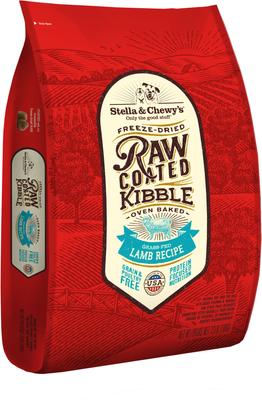
Raw Coated Grass-Fed Lamb Recipe Grain-Free Dry Dog Food, 22-lb bag
Graded by The Sniff System
Stella & Chewy's Raw Coated Grass-Fed Lamb Recipe Grain-Free Dry Dog Food is a dry kibble that features lamb as its primary protein.
This food has a strong protein profile, with lamb as the primary ingredient, offering high biological value. It also uses quality fat sources, including named fats and marine oil for EPA and DHA. The combination of fresh lamb and lamb meal is a good sign for its extrusion architecture.
The formula does contain high legume stacking, with multiple pulse-family ingredients appearing in the top 15. This is partially mitigated by the presence of lamb liver, a natural taurine precursor, in the top 12.
Good fit for adult dogs who thrive on a lamb-based diet. Less ideal if you prefer foods with minimal legumes.
Summary written by The Sniff System from the data above. Same rubric, same drivers, expressed in English.
Good fit for adult Cavalier King Charles Spaniels navigating diet-associated DCM concerns. Lamb anchors position 1, with 3 pulse-family ingredients in the top 15 (lentils at position 3, peas at position 4, pea protein at position 9), plus lamb liver at position 12 (a natural taurine precursor). The FDA's 2019 investigation update on diet-associated DCM included 13 reported cases in Cavalier King Charles Spaniels, making them one of the top 15 most frequently reported breeds at that time (FDA, 2019) .
Looking at this for adult Cavalier King Charles Spaniels or Cavalier King Charles Spaniels with diet-associated DCM concerns ? We are building dedicated pages for these combinations.
Auto-matched from this product's measurements (ingredients, life stage, calorie density) to a breed archetype. Not a substitute for vet input on your specific dog.
Research informing this analysis
MethodologyThe Sniff System grades this product against 3 cited studies relevant to its profile. Each link opens the original source.
- FDA, 2022epidemiology · breed predisposition· cited in 4 claims
- FDA, 2019cardiac · diet composition· cited in 3 claims
- NRC, 2006nutrient bioavailability
Every claim on Sniff traces to a source. If you find a citation that's wrong, outdated, or misapplied, tell us.
Sniff scored this formula 69/100, landing in B-tier territory. The biggest contributor was protein quality (+20 points): Strong protein profile with lamb as the primary ingredient, delivering high biological value. The biggest detractor was controversial-ingredient penalty (-2 points): Contains high legume stacking. Multiple pulse-family ingredients in top 15. Mitigated by taurine supplementation or organ meat (natural taurine precursor) in top 10. To reach A-tier, this formula would need to gain about 6 points, most likely through controversial-ingredient penalty.
Strong protein profile with lamb as the primary ingredient, delivering high biological value.
Quality fat sources: named fat with marine oil (EPA and DHA source).
Named fresh meat paired with same-species meal, a strong extrusion architecture.
Contains high legume stacking. Multiple pulse-family ingredients in top 15. Mitigated by taurine supplementation or organ meat (natural taurine precursor) in top 10..
- Lowest carb quality in Stella & Chewy's's lineup (8/16)
- Top quartile for overall Sniff Score in grain-free dry kibbles (69/100)
- Bottom quartile for DMB protein in Stella & Chewy's's lineup (34.1%)
Computed against the rest of our catalog. Percentiles refresh on each catalog update.
Similar dog foods worth considering
Three lenses on products with formulation profiles similar to this one.
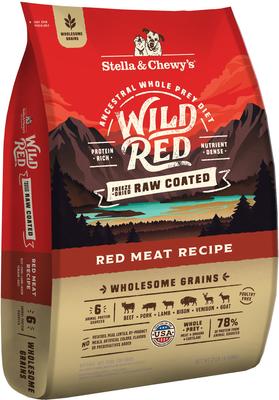
Stella & Chewy's Wild Red Raw Coated Kibble Wholesome Grains Red Meat Recipe Dry Dog Food, 21-lb bag
Scores 15 points higher with a similar formulation profile.
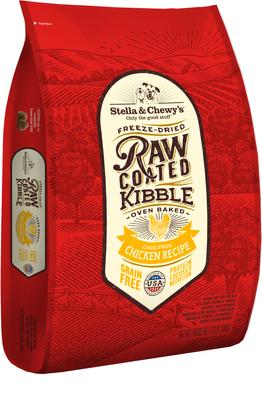
Stella & Chewy's Raw Coated Cage-Free Chicken Recipe Grain-Free Dry Dog Food, 22-lb bag
$4.09/lb vs your seed's $4.77/lb (14% less) at a comparable score.
Surfaced from a vector similarity search across 3,491 scored dog foods. How this works.
Read why each ingredient is good or bad for dogs.
- 1protein animallamb
Real meat. Often used for dogs with chicken or beef sensitivities. Slightly higher fat content than chicken.
Position 1: primary protein source. After cooking removes water, this may drop in proportional weight, but it anchors the recipe.
- 2protein animallamb meal
Lamb cooked down to a dry concentrate. Per pound, more protein than fresh lamb. See why →
Position 2: co-primary protein. Two named animal proteins in the top 2 is a strong protein build.
- 3legumelentils
Same concern as peas. Affordable plant protein, but when they pile up in the top 5 ingredients, it's a flag. See why →
Position 3. Pulse-family ingredient this high in the deck is a notable build choice. When stacked with other pulses in the top 10, matches the formulation pattern the FDA flagged in its diet-associated DCM investigation.
- 4legumepeas
Cheap protein bulk. Fine in small amounts, but when peas stack with lentils and chickpeas in the top ingredients, it's the pattern the FDA flagged in its heart-disease investigation. See why →
Position 4. Within the FDA's top-5 DCM-pattern threshold. Especially notable if multiple pulses stack here.
- 5fatsunflower oil
Common plant oil. Useful in moderation for omega-6, though too much skews the omega ratio against the dog's favor.
Position 5: secondary fat. Often where marine oils sit when present alongside a primary land-animal fat.
- 6fibertomato pomace
The fiber-rich byproduct of tomato processing. Sometimes flagged unfairly. It's a real fiber source, not a filler shortcut.
Position 6: functional fiber for digestion or satiety.
- 7beef fat
Real animal fat, a clean energy source. Stable on the shelf without synthetic preservatives.
Position 7: supporting protein. Modest contribution to total protein weight.
- 8protein animalpork meal
Pork cooked into a dry concentrate. Per pound, more protein than fresh pork.
Position 8: supporting protein. Modest contribution to total protein weight.
- 9protein plantpea protein
Concentrated plant protein. Inflates the protein number on the label without matching the amino acid quality of meat.
Position 9. Moderate inclusion. Contributes carbohydrate and some plant protein.
- 10fatflaxseed
Plant source of omega-3. Helpful for skin and coat, though dogs absorb omega-3 from fish more efficiently.
Position 10: trace fat. Below the level that materially shifts the fat profile.
- 11natural vegetable flavor
- 12protein animallamb liver
Organ meat. Same nutrient-density story as chicken or beef liver, dense in B vitamins, iron, vitamin A.
Position 12. Small organ inclusion. Functional but not a primary contributor to the protein profile.
- 13lamb heart
Position 13. Small organ inclusion. Functional but not a primary contributor to the protein profile.
- 14lamb kidney
Position 14. Small organ inclusion. Functional but not a primary contributor to the protein profile.
- 15lamb spleen
Position 15. Small organ inclusion. Functional but not a primary contributor to the protein profile.
- 16protein animalsalmon meal
Salmon cooked into a dry concentrate. Carries both protein and natural omega-3s in one ingredient. See why →
- 17suncured alfalfa
- 18fenugreek seed
Herb seed. Trace inclusion, mostly for flavor and label appeal.
- 19coconut flour
- 20pumpkin seed
Real seed. Source of magnesium, zinc, and traditionally used as a mild dewormer (the evidence is folkloric, not clinical).
- 21fruitcranberries
Often added with a urinary-tract-support marketing angle. Real cranberry compounds help in concentrate form, but kibble doses are small.
- 22vegetablespinach
Leafy green. Some iron, vitamin K, and fiber. The dose in kibble is small but it's real food.
- 23vegetablebroccoli
Real vegetable. Adds fiber and some antioxidants. Fine in the small amounts used in kibble.
- 24beets
Whole beets, not to be confused with beet pulp. Real vegetable, fiber and antioxidants.
- 25vegetablecarrots
Real vegetable. Fiber, beta-carotene, and a small amount of antioxidant value.
Showing first 25 of 57. Position 1-5 has the largest weight in the recipe.
19 of 25 ingredients have a curated note. Coverage grows over time.