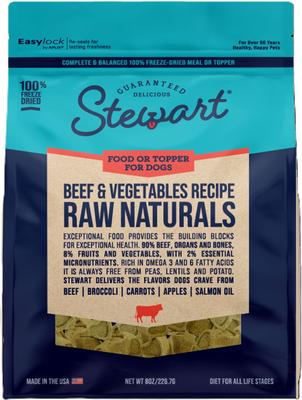
Raw Naturals Beef Limited-Ingredient Adult Freeze-Dried Dog Food, 8-oz bag
Graded by The Sniff System
Stewart Raw Naturals Beef Limited-Ingredient Adult Freeze-Dried Dog Food is a freeze-dried raw food built around beef, beef heart, beef liver, and beef kidney.
This freeze-dried raw food features beef, beef heart, beef liver, and beef kidney as its main protein sources, providing solid amino acid coverage. It also includes quality fat sources like salmon oil, which is a good source of EPA and DHA. The carbohydrate sources offer beneficial fermentable fiber.
The product does not explicitly state that it meets AAFCO nutritional standards, which is a basic expectation for commercial dog food.
Good fit for adult dogs whose owners prefer a raw, freeze-dried diet. Less ideal if you prioritize an explicit AAFCO statement.
Summary written by The Sniff System from the data above. Same rubric, same drivers, expressed in English.
Strong fit for active large sporting breeds like Golden Retrievers, Labrador Retrievers, and Irish Setters navigating diet-associated DCM concerns. Beef anchors position 1, with zero pulses in the top 15, plus beef heart at position 2 (a natural taurine precursor) and salmon oil at position 10. In its 2022 update on diet-associated DCM, the FDA identified Golden Retrievers as the most reported breed, with 121 cases out of 1,382 total canine reports (8.8%) received between January 1, 2014, and November 1, 2022 (FDA, 2022) .
Looking at this for adult Golden Retrievers or Golden Retrievers with diet-associated DCM concerns ? We are building dedicated pages for these combinations.
Auto-matched from this product's measurements (ingredients, life stage, calorie density) to a breed archetype. Not a substitute for vet input on your specific dog.
Research informing this analysis
MethodologyThe Sniff System grades this product against 3 cited studies relevant to its profile. Each link opens the original source.
- FDA, 2022cardiac · epidemiology · breed predisposition· cited in 5 claims
- FDA, 2019diet composition· cited in 2 claims
- NRC, 2006nutrient bioavailability
Every claim on Sniff traces to a source. If you find a citation that's wrong, outdated, or misapplied, tell us.
Solid grade. 70/100 (B) reflects the structural fit of this formula against The Sniff System's eight scoring components. Protein quality did the heavy lifting (+18.5 points): Reasonable protein quality. beef delivers solid amino acid coverage. The supporting beat: fat quality (+12 points). Quality fat sources: named fat with marine oil (EPA and DHA source). What's keeping it out of A-tier: protein quality (18.5 of 27 possible). Full protein quality requires named-species named-cut proteins in the top of the deck (e.g., "deboned chicken" rather than "chicken meal" or "poultry meal").
Reasonable protein quality. beef delivers solid amino acid coverage.
Quality fat sources: named fat with marine oil (EPA and DHA source).
Quality carbohydrate sources with fermentable fiber.
No negative drivers crossed our reporting threshold.
- Top quartile for DMB protein in grain-free freeze-dried foods (48.9%)
- Bottom quartile for crude fiber in grain-free freeze-dried foods (3.3% DMB)
- Top quartile for overall Sniff Score in grain-free freeze-dried foods (70/100)
Computed against the rest of our catalog. Percentiles refresh on each catalog update.
Similar dog foods worth considering
Three lenses on products with formulation profiles similar to this one.
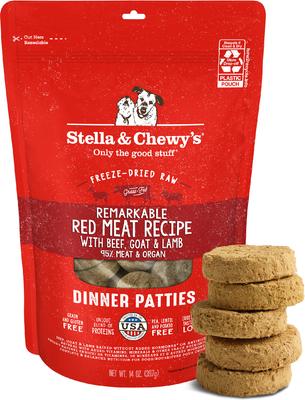
Stella & Chewy's Remarkable Red Meat Recipe Dinner Patties Freeze-Dried Raw Dog Food, 14-oz bag
Scores 3 points higher with a similar formulation profile.
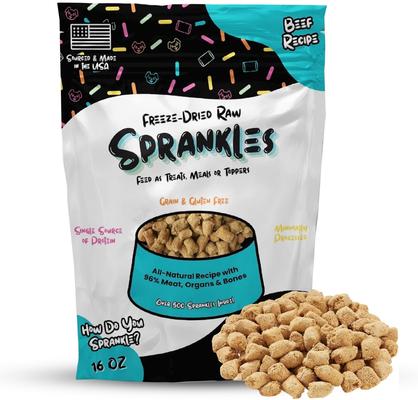
Sprankles Beef Recipe Freeze-Dried Raw Dog Food, 16-oz bag
$29.95/lb vs your seed's $36.46/lb (18% less) at a comparable score.
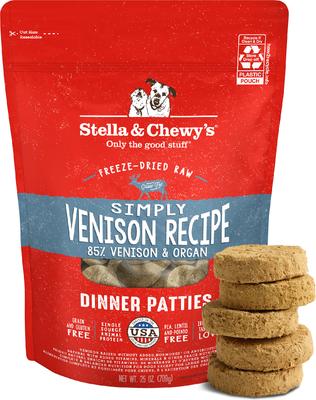
Stella & Chewy's Freeze-Dried Raw Simply Venison Dinner Patties Dog Food, 25-oz bag
Venison instead of beef, 1 point lower, different brand.
Surfaced from a vector similarity search across 3,491 scored dog foods. How this works.
Read why each ingredient is good or bad for dogs.
- 1protein animalbeef
Real meat. Dense in protein and iron. Some dogs are sensitive to it, but for most it's an excellent base.
Position 1: primary protein source. After cooking removes water, this may drop in proportional weight, but it anchors the recipe.
- 2protein animalbeef heart
Position 2. Named organ meat this high is a strong build choice. Concentrated source of taurine, glutamine, and B-vitamins.
- 3protein animalbeef liver
Organ meat. Among the most nutrient-dense ingredients available, rich in B vitamins, iron, and vitamin A.
Position 3. Named organ meat this high is a strong build choice. Concentrated source of taurine, glutamine, and B-vitamins.
- 4protein animalbeef kidney
Organ meat. Dense in B vitamins, iron, and trace minerals. Among the most nutritious ingredients on any label.
Position 4. Named organ meat this high is a strong build choice. Concentrated source of taurine, glutamine, and B-vitamins.
- 5beef bones
Position 5: significant protein contributor. Adds amino-acid diversity to the top of the deck.
- 6vegetablebroccoli
Real vegetable. Adds fiber and some antioxidants. Fine in the small amounts used in kibble.
Position 6: meaningful whole-food inclusion. Source of vitamins, antioxidants, or natural fiber.
- 7vegetablecarrots
Real vegetable. Fiber, beta-carotene, and a small amount of antioxidant value.
Position 7: meaningful whole-food inclusion. Source of vitamins, antioxidants, or natural fiber.
- 8lettuce
- 9fruitapples
Real fruit, some fiber and antioxidants. The amount in kibble is too small to matter much.
Position 9: garnish-level inclusion. Marketing-prominent but minimal nutritional impact at this position.
- 10fatsalmon oil
Pure omega-3s. The thing skin-and-coat formulas are usually built around.
Position 10. Moderate marine-oil inclusion. Supplements EPA/DHA without being the primary fat.
- 11fruitblueberries
Antioxidants, real. But the amount in any kibble is too small to do much. Mostly marketing.
Position 11: garnish-level inclusion. Marketing-prominent but minimal nutritional impact at this position.
- 12fruitcranberries
Often added with a urinary-tract-support marketing angle. Real cranberry compounds help in concentrate form, but kibble doses are small.
Position 12: garnish-level inclusion. Marketing-prominent but minimal nutritional impact at this position.
- 13supplementparsley
Real herb. Trace amount of vitamins K and C. The dose in kibble is small, mostly there for label appeal.
- 14fiberinulin
Prebiotic fiber that feeds beneficial gut bacteria. Same compound found in chicory root.
Position 14: trace fiber inclusion.
- 15ginger root
- 16preservative naturalmixed tocopherols
Natural vitamin E used to keep fats from going rancid. The good kind of preservative. See why →
- 17mineralpotassium chloride
Required mineral. Sometimes used as a salt substitute. Standard inclusion in complete diets.
- 18mineralsalt
Sodium chloride. Required at small doses for normal physiology. Not a quality concern in standard amounts.
- 19supplementdried kelp
Natural source of iodine and trace minerals. A common premium-brand inclusion.
- 20mineralzinc proteinate
Zinc bound to protein for better absorption. The premium form of the mineral, versus zinc oxide which sits cheaper on the label.
- 21mineraliron proteinate
Iron bound to protein for better absorption. The premium form versus inorganic iron sulfate.
- 22supplementtaurine
Amino acid critical for heart health. Especially important in grain-free or pulse-heavy formulas where natural taurine precursors run thin.
- 23vitaminvitamin e supplement
Required nutrient and a natural antioxidant. Often pulls double duty as a preservative.
- 24mineralcopper proteinate
Copper bound to protein for better absorption. Common in better-formulated diets.
- 25mineralmanganese proteinate
Manganese bound to protein for better absorption. The chelated form most premium brands use.
Showing first 25 of 33. Position 1-5 has the largest weight in the recipe.
21 of 25 ingredients have a curated note. Coverage grows over time.