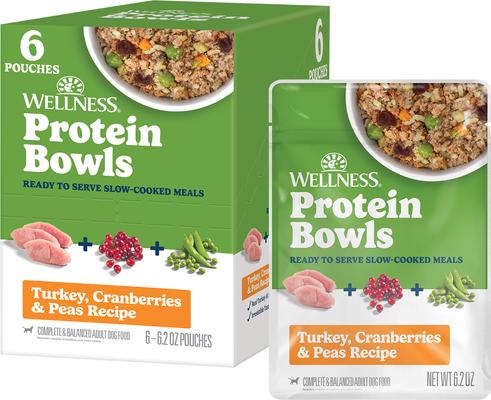
Protein Bowls Adult Wholesome Grains Turkey, Cranberries & Peas Fresh Alternative Dog Food, 6.2-oz pouch, case of 6
Graded by The Sniff System
Wellness Protein Bowls Adult Wholesome Grains Turkey, Cranberries & Peas Fresh Alternative Dog Food is a wet food featuring turkey, chicken, and duck, designed for adult dogs.
This wet food offers reasonable protein quality, with turkey, chicken, and duck as the top three ingredients. Turkey, in particular, provides solid amino acid coverage, which is a good foundation for your dog's diet.
One thing to note is the absence of a declared omega-3 source. Ingredients like fish oil, salmon oil, or algae oil, which provide these beneficial fatty acids, are not listed.
Good fit for adult dogs who enjoy a wet food with multiple protein sources. Less ideal if you prioritize a clear omega-3 source.
Summary written by The Sniff System from the data above. Same rubric, same drivers, expressed in English.
Good fit for active large sporting breeds like Golden Retrievers, Labrador Retrievers, and Irish Setters navigating diet-associated DCM concerns. Turkey anchors position 1, with one pulse (peas at position 6). In its 2022 update on diet-associated DCM, the FDA identified Golden Retrievers as the most reported breed, with 121 cases out of 1,382 total canine reports (8.8%) received between January 1, 2014, and November 1, 2022 (FDA, 2022) .
Looking at this for adult Golden Retrievers or Golden Retrievers with diet-associated DCM concerns ? We are building dedicated pages for these combinations.
Auto-matched from this product's measurements (ingredients, life stage, calorie density) to a breed archetype. Not a substitute for vet input on your specific dog.
Research informing this analysis
MethodologyThe Sniff System grades this product against 3 cited studies relevant to its profile. Each link opens the original source.
- FDA, 2022cardiac · epidemiology · breed predisposition· cited in 5 claims
- FDA, 2019diet composition· cited in 2 claims
- NRC, 2006nutrient bioavailability
Every claim on Sniff traces to a source. If you find a citation that's wrong, outdated, or misapplied, tell us.
Sniff scored this formula 59/100, landing in C-tier (acceptable-with-notes). The biggest contributor was protein quality (+17 points): Reasonable protein quality. turkey delivers solid amino acid coverage. The biggest detractor was fat quality (-8 points): No declared omega-3 source. Fish oil, salmon oil, and algae oil all absent. The gap to B-tier is small (1.0 points). Addressing fat quality would likely close it.
Reasonable protein quality. turkey delivers solid amino acid coverage.
No declared omega-3 source. Fish oil, salmon oil, and algae oil all absent.
- Lowest fat quality in Wellness's lineup (4/16)
- Top quartile for DMB fat in Wellness's lineup (23.3%)
- Bottom quartile for crude fiber in grain-inclusive wet foods (5.0% DMB)
Computed against the rest of our catalog. Percentiles refresh on each catalog update.
Similar dog foods worth considering
Three lenses on products with formulation profiles similar to this one.
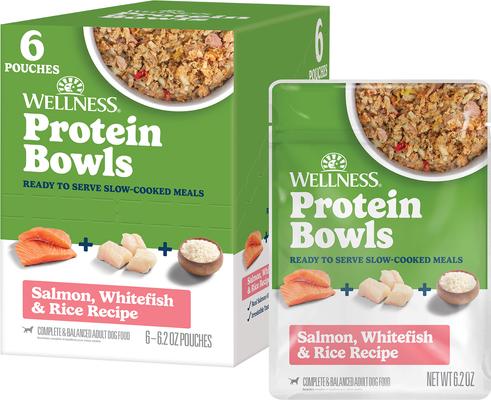
Wellness Protein Bowls Adult Wholesome Grains Salmon, Whitefish & Rice Fresh Alternative Dog Food, 6.2-oz pouch, case of 6
Scores 8 points higher with a similar formulation profile.
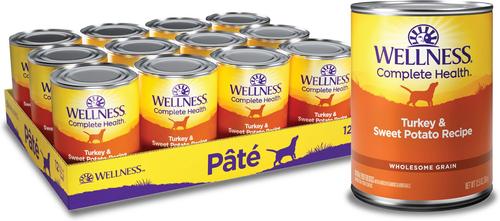
Wellness Complete Health Turkey
$3.92/lb vs your seed's $12.46/lb (69% less) at a comparable score.
Surfaced from a vector similarity search across 3,491 scored dog foods. How this works.
Wet and fresh foods contain more water than kibble (typically 65-78%). On a dry-matter basis, this food's protein content is roughly 37%, comparable to premium kibble (typically 30-45% DMB protein).
Read why each ingredient is good or bad for dogs.
- 1protein animalturkey
Real meat. Lean protein, good amino acid profile, often well-tolerated by dogs sensitive to chicken.
Position 1: primary protein source. After cooking removes water, this may drop in proportional weight, but it anchors the recipe.
- 2protein animalchicken
Real meat. Primary protein source, with the amino acid profile dogs actually evolved to eat.
Position 2: co-primary protein. Two named animal proteins in the top 2 is a strong protein build.
- 3protein animalduck
Real meat. Often used as a novel protein for dogs with sensitivities to chicken or beef.
Position 3: significant protein contributor. Adds amino-acid diversity to the top of the deck.
- 4grainrice
Generic rice. Could be white or brown, the label doesn't say. Brown rice would be specified if it were.
Position 4: supporting grain. Smaller contribution to the carb deck.
- 5fruitcranberries
Often added with a urinary-tract-support marketing angle. Real cranberry compounds help in concentrate form, but kibble doses are small.
Position 5: meaningful whole-food inclusion. Source of vitamins, antioxidants, or natural fiber.
- 6legumepeas
Cheap protein bulk. Fine in small amounts, but when peas stack with lentils and chickpeas in the top ingredients, it's the pattern the FDA flagged in its heart-disease investigation. See why →
Position 6. Moderate inclusion. Contributes carbohydrate and some plant protein.
- 7vegetablecarrots
Real vegetable. Fiber, beta-carotene, and a small amount of antioxidant value.
Position 7: meaningful whole-food inclusion. Source of vitamins, antioxidants, or natural fiber.
- 8white sweet potatoes
- 9potato starch
Refined potato. Pure carb energy, low on other nutrition. Often used as a binder in grain-free recipes.
- 10turkey bone broth
Position 10: supporting protein. Modest contribution to total protein weight.
- 11chicken bone broth
Position 11: trace protein. Likely there for amino-acid diversity or label appeal more than nutritional weight.
- 12duck bone broth
Position 12: trace protein. Likely there for amino-acid diversity or label appeal more than nutritional weight.
- 13sugar
Added sugar. No nutritional purpose for dogs. Most often found in budget semi-moist foods. See why →
- 14mineralsodium tripolyphosphate
Preservative and texture agent in wet food. Functional at small doses, not a major concern, but some brands avoid it.
- 15mineraltricalcium phosphate
Calcium and phosphorus source. Same role as dicalcium phosphate, slightly different ratio.
- 16marine microalgae oil
Plant-source omega-3 from algae. Useful especially in vegetarian or limited-fish formulas.
- 17mineralsalt
Sodium chloride. Required at small doses for normal physiology. Not a quality concern in standard amounts.
- 18mineralpotassium chloride
Required mineral. Sometimes used as a salt substitute. Standard inclusion in complete diets.
- 19sage
- 20fiberdried chicory root
Natural prebiotic. Feeds beneficial gut bacteria. The same compound (inulin) used in human gut-health products.
- 21supplementtaurine
Amino acid critical for heart health. Especially important in grain-free or pulse-heavy formulas where natural taurine precursors run thin.
- 22vegetablekale
Leafy green with antioxidants and fiber. Small dose in kibble, but it's not just for marketing.
- 23mineralmagnesium sulfate
Source of magnesium, a required mineral. Standard inclusion in complete diets.
- 24thyme
- 25supplementcholine chloride
Essential nutrient for liver and brain function. Standard inclusion in complete dog foods.
Showing first 25 of 44. Position 1-5 has the largest weight in the recipe.
19 of 25 ingredients have a curated note. Coverage grows over time.
Wellness Protein Bowls Turkey, Cranberries and Peas Recipeis formulated to meet the nutritional levels established by the AAFCO Dog Food Nutrient Profiles for maintenance.