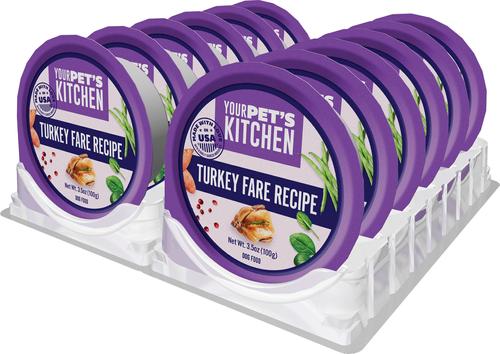
Turkey Fare Wet Dog Food, 3.5-oz cup, case of 12
Graded by The Sniff System
Your Pet's Kitchen Turkey Fare Wet Dog Food is a wet food featuring turkey and chicken as its main protein sources.
This food uses quality carbohydrate sources that provide fermentable fiber, which is good for gut health. It also includes quality fat sources, like named fat with marine oil, providing beneficial EPA and DHA.
The biggest thing to note is the lack of an AAFCO statement, which means its nutritional completeness is unverified. Also, the formula contains added sugar, which isn't really justifiable in a dog's diet.
Good fit for dogs whose owners are comfortable with an unverified nutritional profile. Less ideal if you need assurance of complete and balanced nutrition.
Summary written by The Sniff System from the data above. Same rubric, same drivers, expressed in English.
Frenchies have notoriously sensitive GI tracts plus a tendency toward obesity given their low activity needs. Limited-ingredient formulas with moderate calorie density tend to fit them well. Good fit for adult French Bulldogs navigating a sensitive stomach. Turkey leads at position 1.
Looking at this for adult French Bulldogs or French Bulldogs with a sensitive stomach ? We are building dedicated pages for these combinations.
Auto-matched from this product's measurements (ingredients, life stage, calorie density) to a breed archetype. Not a substitute for vet input on your specific dog.
Research informing this analysis
MethodologyThe Sniff System grades this product against 3 cited studies relevant to its profile. Each link opens the original source.
- NRC, 2006digestibility · fiber· cited in 2 claims
- AAFCO, 2024zinc
- Swanson et al., 2002prebiotics
Every claim on Sniff traces to a source. If you find a citation that's wrong, outdated, or misapplied, tell us.
At 54/100, this formula lands mid-pack. The lift comes from carbohydrate quality, worth 15 points to the final number: Quality carbohydrate sources with fermentable fiber. The ceiling on this score is 59, set because the AAFCO nutritional adequacy statement isn't disclosed on the retailer page (so our methodology can't verify the formula meets adult, growth, or all-life-stages standards). The cap isn't the binding constraint here. AAFCO compliance would also need to improve to reach the next band.
Quality carbohydrate sources with fermentable fiber.
Quality fat sources: named fat with marine oil (EPA and DHA source).
No AAFCO statement. Nutritional completeness unverified.
Contains added sugar. Nutritionally unjustifiable in any complete dog diet..
- Top 10% for carb quality in grain-free wet foods (15/16)
- Bottom quartile for DMB fat in grain-free wet foods (13.6%)
Computed against the rest of our catalog. Percentiles refresh on each catalog update.
Similar dog foods worth considering
Three lenses on products with formulation profiles similar to this one.
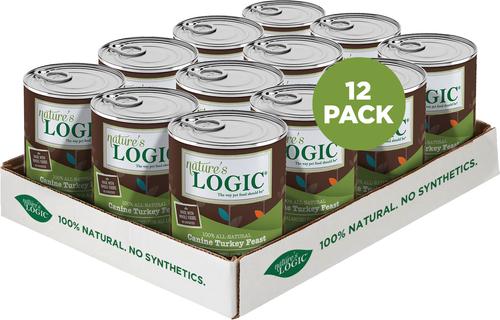
Nature's Logic 100% Natural Canine Turkey Feast All Life Stages Grain-Free Wet Dog Food, 13.2-oz, case of 12
Scores 10 points higher with a similar formulation profile.
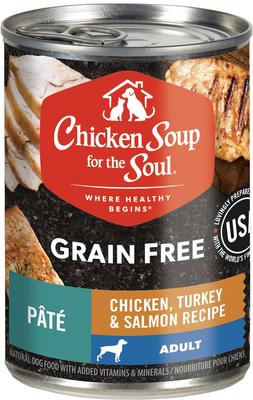
Chicken Soup for the Soul Chicken, Turkey & Salmon Recipe Grain-Free Canned Dog Food, 13-oz can, case of 12
$3.56/lb vs your seed's $9.10/lb (61% less) at a comparable score.
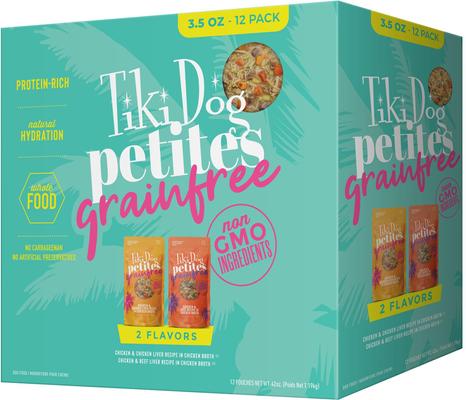
Tiki Dog Petites Variety Pack Grain-Free Wet Dog Food, 3.5-oz pouch, case of 12
Chicken instead of turkey, 5 points higher, different brand.
Surfaced from a vector similarity search across 3,491 scored dog foods. How this works.
Wet and fresh foods contain more water than kibble (typically 65-78%). On a dry-matter basis, this food's protein content is roughly 41%, comparable to premium kibble (typically 30-45% DMB protein).
Read why each ingredient is good or bad for dogs.
- 1protein animalturkey
Real meat. Lean protein, good amino acid profile, often well-tolerated by dogs sensitive to chicken.
Position 1: primary protein source. After cooking removes water, this may drop in proportional weight, but it anchors the recipe.
- 2protein animalchicken
Real meat. Primary protein source, with the amino acid profile dogs actually evolved to eat.
Position 2: co-primary protein. Two named animal proteins in the top 2 is a strong protein build.
- 3green beans
Real vegetable. Fiber and a small amount of vitamins. Often used in weight-management formulas because it bulks up a meal without adding calories.
- 4vegetablesweet potato
Complex carb with fiber and beta-carotene. Gentle on the stomach.
Position 4: meaningful whole-food inclusion. Source of vitamins, antioxidants, or natural fiber.
- 5vegetablepotato
Standard white potato. Steady carb source, common starch in grain-free recipes.
Position 5: meaningful whole-food inclusion. Source of vitamins, antioxidants, or natural fiber.
- 6fruitcranberries
Often added with a urinary-tract-support marketing angle. Real cranberry compounds help in concentrate form, but kibble doses are small.
Position 6: meaningful whole-food inclusion. Source of vitamins, antioxidants, or natural fiber.
- 7othernatural flavor
Legal term for animal-derived flavoring, usually hydrolyzed liver or broth. Adds taste, says nothing about quality.
- 8yellow squash
- 9tapioca starch
Refined cassava starch, used as a binder. Easy to digest, low on nutrition.
- 10vegetablespinach
Leafy green. Some iron, vitamin K, and fiber. The dose in kibble is small but it's real food.
Position 10: garnish-level inclusion. Marketing-prominent but minimal nutritional impact at this position.
- 11grainquinoa
Pseudo-grain with a complete amino acid profile. Rare in dog food because it's expensive.
Position 11: minor grain inclusion.
- 12turkey broth
Real broth from named meat. Adds flavor and moisture, signals a recipe that leans on real meat.
Position 12: trace protein. Likely there for amino-acid diversity or label appeal more than nutritional weight.
- 13fatfish oil
Concentrated omega-3s. The reason 'EPA' and 'DHA' get to show up on the bag.
Position 13. Trace marine oil. Contributes some omega-3 but well below the level that drives EPA/DHA totals.
- 14cane molasses
Added sugar from sugar cane. Used for palatability or texture. Dogs don't need added sugar.
- 15mineralsalt
Sodium chloride. Required at small doses for normal physiology. Not a quality concern in standard amounts.
- 16mineralcalcium carbonate
Source of calcium. Functional. Required in complete dog foods, especially those without bone-in meat meals.
- 17fiberinulin
Prebiotic fiber that feeds beneficial gut bacteria. Same compound found in chicory root.
- 18mineralpotassium chloride
Required mineral. Sometimes used as a salt substitute. Standard inclusion in complete diets.
- 19yeast culture
Fermented yeast. Source of B vitamins and beta-glucans that some research suggests support immune function.
- 20thyme
- 21sage
- 22mineralmagnesium sulfate
Source of magnesium, a required mineral. Standard inclusion in complete diets.
- 23supplementcholine chloride
Essential nutrient for liver and brain function. Standard inclusion in complete dog foods.
- 24l ascorbyl-2-polyphosphate
- 25vitaminvitamin e supplement
Required nutrient and a natural antioxidant. Often pulls double duty as a preservative.
Showing first 25 of 42. Position 1-5 has the largest weight in the recipe.
21 of 25 ingredients have a curated note. Coverage grows over time.