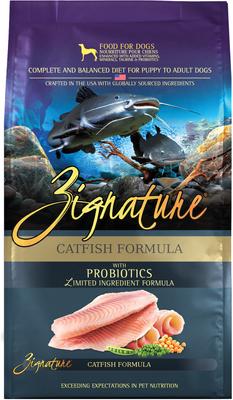
Catfish Limited Ingredient Formula Dry Dog Food, 25-lb bag
Graded by The Sniff System
Zignature Catfish Limited Ingredient Formula is a dry dog food that features catfish as its main protein source.
This formula does include some premium micronutrient forms, like chelated minerals or natural vitamin E, which are generally better absorbed by your dog's body compared to cheaper alternatives.
A major concern is the lack of an AAFCO statement, which means its nutritional completeness is unverified. Also, the protein quality from catfish is considered low, delivering limited bioavailable amino acids.
Hard to recommend for any dog due to the unverified nutritional completeness and low protein quality.
Summary written by The Sniff System from the data above. Same rubric, same drivers, expressed in English.
The landmark 14-year Purina Lifespan Study on 48 Labrador Retrievers demonstrated that dogs fed 25% fewer calories lived a median of 1.8 years longer and delayed the onset of chronic diseases. Good fit for adult Labrador Retrievers and similar active sporting breeds navigating weight management. At 395 kcal/cup this formula runs on the moderate side, with crude fiber at 4.5% (above the catalog median, supports satiety). The 2014 AAHA Weight Management Guidelines define overweight as a Body Condition Score (BCS) of 6-7 on a 9-point scale. A score of 8 or 9 indicates obesity, representing 20-30% and >30% above ideal body weight, respectively (Brooks et al., 2014) .
Looking at this for adult Labrador Retrievers or Labrador Retrievers with weight management ? We are building dedicated pages for these combinations.
Auto-matched from this product's measurements (ingredients, life stage, calorie density) to a breed archetype. Not a substitute for vet input on your specific dog.
Research informing this analysis
MethodologyThe Sniff System grades this product against 3 cited studies relevant to its profile. Each link opens the original source.
- Brooks et al., 2014diagnostic · protocol · satiety· cited in 5 claims
- APOP, 2023prevalence
- Raffan et al., 2016genetics
Every claim on Sniff traces to a source. If you find a citation that's wrong, outdated, or misapplied, tell us.
At 31/100, this formula sits below where we look for everyday picks. The lift comes from micronutrient inclusion, worth 4 points to the final number: Premium micronutrient forms such as chelated minerals or natural vitamin E. The ceiling on this score is 59, set because the AAFCO nutritional adequacy statement isn't disclosed on the retailer page (so our methodology can't verify the formula meets adult, growth, or all-life-stages standards). The cap isn't the binding constraint here. Protein quality would also need to improve to reach the next band.
Premium micronutrient forms such as chelated minerals or natural vitamin E.
Low protein quality. catfish delivers limited bioavailable amino acids.
No AAFCO statement. Nutritional completeness unverified.
- Lowest protein quality in Zignature's lineup (1.1/27)
- Top quartile for DMB protein in dry kibbles (34.4%)
- Lowest carb quality in Zignature's lineup (5/16)
Computed against the rest of our catalog. Percentiles refresh on each catalog update.
Similar dog foods worth considering
Three lenses on products with formulation profiles similar to this one.
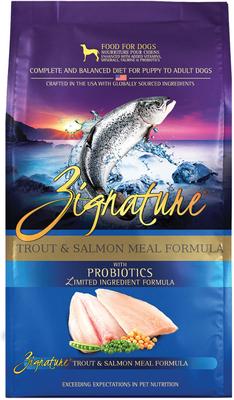
Surfaced from a vector similarity search across 3,491 scored dog foods. How this works.
Read why each ingredient is good or bad for dogs.
- 1catfish
Position 1: primary protein source. After cooking removes water, this may drop in proportional weight, but it anchors the recipe.
- 2catfish meal
Position 2: co-primary protein. Two named animal proteins in the top 2 is a strong protein build.
- 3legumepeas
Cheap protein bulk. Fine in small amounts, but when peas stack with lentils and chickpeas in the top ingredients, it's the pattern the FDA flagged in its heart-disease investigation. See why →
Position 3. Pulse-family ingredient this high in the deck is a notable build choice. When stacked with other pulses in the top 10, matches the formulation pattern the FDA flagged in its diet-associated DCM investigation.
- 4legumepea flour
Powdered peas, usually used as a binder or filler. Counts toward the legume stack the FDA flagged.
Position 4. Within the FDA's top-5 DCM-pattern threshold. Especially notable if multiple pulses stack here.
- 5legumechickpeas
Also called garbanzo beans. Affordable plant protein source, part of the legume stack the FDA examined in its heart-disease investigation. See why →
Position 5. Within the FDA's top-5 DCM-pattern threshold. Especially notable if multiple pulses stack here.
- 6fatsunflower oil
Common plant oil. Useful in moderation for omega-6, though too much skews the omega ratio against the dog's favor.
Position 6: secondary fat. Often where marine oils sit when present alongside a primary land-animal fat.
- 7fatflaxseed
Plant source of omega-3. Helpful for skin and coat, though dogs absorb omega-3 from fish more efficiently.
Position 7: trace fat. Below the level that materially shifts the fat profile.
- 8othernatural flavor
Legal term for animal-derived flavoring, usually hydrolyzed liver or broth. Adds taste, says nothing about quality.
- 9mineralsalt
Sodium chloride. Required at small doses for normal physiology. Not a quality concern in standard amounts.
- 10mineralcalcium carbonate
Source of calcium. Functional. Required in complete dog foods, especially those without bone-in meat meals.
- 11supplementcholine chloride
Essential nutrient for liver and brain function. Standard inclusion in complete dog foods.
- 12mineraltricalcium phosphate
Calcium and phosphorus source. Same role as dicalcium phosphate, slightly different ratio.
- 13vitaminvitamin e supplement
Required nutrient and a natural antioxidant. Often pulls double duty as a preservative.
- 14vitaminvitamin a supplement
Vitamin A in stable, standardized form. Required for vision, immune function, and growth.
- 15niacinamide
- 16vitamind-calcium pantothenate
B vitamin (B5). Standard inclusion in complete dog foods.
- 17vitaminriboflavin supplement
B vitamin (B2). Required in complete dog foods. The standardized form ensures consistent dosing.
- 18vitaminthiamine mononitrate
B vitamin (B1). Essential for nervous system function. Cooked-in vitamin loss is why thiamine is always added back.
- 19vitaminvitamin b12 supplement
Essential for red blood cell formation and neurological function. Plant ingredients lack B12, so it has to be added.
- 20vitaminpyridoxine hydrochloride
B vitamin (B6). Essential for protein metabolism. Standard inclusion in complete formulas.
- 21vitaminfolic acid
B vitamin (B9), essential for cell function. Standard in complete dog foods.
- 22vitaminbiotin
B vitamin that supports skin and coat health. Required for AAFCO-complete formulas.
- 23mineralzinc proteinate
Zinc bound to protein for better absorption. The premium form of the mineral, versus zinc oxide which sits cheaper on the label.
- 24mineraliron proteinate
Iron bound to protein for better absorption. The premium form versus inorganic iron sulfate.
- 25mineralpotassium chloride
Required mineral. Sometimes used as a salt substitute. Standard inclusion in complete diets.
Showing first 25 of 37. Position 1-5 has the largest weight in the recipe.
22 of 25 ingredients have a curated note. Coverage grows over time.