Old Mother Hubbard Classic Puppy (Chicken & Oatmeal)
Graded by The Sniff System
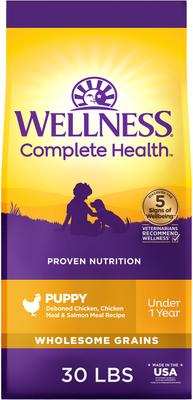
Wellness Old Mother Hubbard Classic Puppy (Chicken & Oatmeal) is a dry food with chicken as a primary protein, marketed for puppies.
The formula includes quality carbohydrate sources with declared fiber, which is a good sign. It also uses premium micronutrient forms like chelated minerals, which are more bioavailable. The AAFCO formulation is inferred for growth, though a verbatim statement isn't published.
The formula is plant-protein-dominated, with wheat flour as the first ingredient, ahead of chicken. It also contains added sugar, cane molasses, which isn't nutritionally justified. Protein and fat levels are quite low.
Good fit for owners seeking a crunchy treat. Less ideal for growing puppies due to low protein, fat, and plant-protein dominance.
Summary written by The Sniff System from the data above. Same rubric, same drivers, expressed in English.
Good fit for puppy Labrador Retrievers and similar active sporting breeds navigating weight management. Working in its favor: crude fiber (5.5%) helps satiety. Caloric density is not declared, with crude fiber at 5.5% (above the catalog median, supports satiety). Labs are the canonical food-motivated breed. Weight management is the dominant practical concern, even more than breed-specific health risks. The 2014 AAHA Weight Management Guidelines define overweight as a Body Condition Score (BCS) of 6-7 on a 9-point scale. A score of 8 or 9 indicates obesity, representing 20-30% and >30% above ideal body weight, respectively (Brooks et al., 2014) .
Looking at this for puppy Labrador Retrievers or Labrador Retrievers with weight management ? We are building dedicated pages for these combinations.
Auto-matched from this product's measurements (ingredients, life stage, calorie density) to a breed archetype. Not a substitute for vet input on your specific dog.
Research informing this analysis
MethodologyThe Sniff System grades this product against 2 cited studies relevant to its profile. Each link opens the original source.
- Brooks et al., 2014diagnostic · protocol · satiety· cited in 3 claims
- Raffan et al., 2016genetics
Every claim on Sniff traces to a source. If you find a citation that's wrong, outdated, or misapplied, tell us.
Below-average grade. 42/100 (D) reflects the structural fit of this formula against The Sniff System's eight scoring components. Carbohydrate quality did the heavy lifting (+13 points): Quality carbohydrate sources with declared fiber. What capped it: the score can't exceed 49 because the guaranteed analysis falls below AAFCO's minimum nutrient profile. Removing the cap alone wouldn't change the band. Protein quality is the deeper issue.
Quality carbohydrate sources with declared fiber.
AAFCO formulation inferred from declared growth. Verbatim statement not published by retailer.
Premium micronutrient forms such as chelated minerals or natural vitamin E.
Plant-protein-dominated formula. wheat flour as the #1 ingredient.
Contains added sugar. Nutritionally unjustifiable in any complete dog diet..
- Bottom 4% for DMB fat in grain-inclusive dry kibbles (7.9%)
- Top quartile for crude fiber in Wellness's lineup (6.2% DMB)
- Bottom 3% for protein quality in grain-inclusive dry kibbles (2.8/27)
Computed against the rest of our catalog. Percentiles refresh on each catalog update.
Similar dog foods worth considering
Three lenses on products with formulation profiles similar to this one.
Surfaced from a vector similarity search across 3,491 scored dog foods. How this works.
Read why each ingredient is good or bad for dogs.
- 1wheat flour
Refined wheat, usually used as a binder. Cheap, not harmful, not a nutrition contributor.
Position 1 grain: primary carbohydrate base. This is a grain-inclusive formula with wheat flour as the dominant carb.
- 2grainoatmeal
Gentle on the stomach. Slow-release carbs and soluble fiber that supports stool quality.
Position 2: major carbohydrate source.
- 3protein animalchicken
Real meat. Primary protein source, with the amino acid profile dogs actually evolved to eat.
Position 3: significant protein contributor. Adds amino-acid diversity to the top of the deck.
- 4wheat bran
Position 4: supporting grain. Smaller contribution to the carb deck.
- 5fatchicken fat
Despite the name, a high-quality energy source. Concentrated calories plus essential fatty acids like linoleic acid. See why →
Position 5: secondary fat. Often where marine oils sit when present alongside a primary land-animal fat.
- 6cane molasses
Added sugar from sugar cane. Used for palatability or texture. Dogs don't need added sugar.
- 7fruitapples
Real fruit, some fiber and antioxidants. The amount in kibble is too small to matter much.
Position 7: meaningful whole-food inclusion. Source of vitamins, antioxidants, or natural fiber.
- 8vegetablecarrots
Real vegetable. Fiber, beta-carotene, and a small amount of antioxidant value.
Position 8: meaningful whole-food inclusion. Source of vitamins, antioxidants, or natural fiber.
- 9fatground flaxseed
Cracked flaxseed for better digestibility. Same plant omega-3s as whole flaxseed, just easier for the dog to extract.
Position 9: trace fat. Below the level that materially shifts the fat profile.
- 10mineralsalt
Sodium chloride. Required at small doses for normal physiology. Not a quality concern in standard amounts.
- 11preservative naturalmixed tocopherols
Natural vitamin E used to keep fats from going rancid. The good kind of preservative. See why →
Natural preservative. Methodologically preferred over synthetic alternatives.
- 12mineralzinc proteinate
Zinc bound to protein for better absorption. The premium form of the mineral, versus zinc oxide which sits cheaper on the label.
- 13beta-carotene
- 14mineralpotassium chloride
Required mineral. Sometimes used as a salt substitute. Standard inclusion in complete diets.
- 15mineraliron proteinate
Iron bound to protein for better absorption. The premium form versus inorganic iron sulfate.
- 16vitaminvitamin e supplement
Required nutrient and a natural antioxidant. Often pulls double duty as a preservative.
- 17mineralcopper proteinate
Copper bound to protein for better absorption. Common in better-formulated diets.
- 18mineralmanganese proteinate
Manganese bound to protein for better absorption. The chelated form most premium brands use.
- 19vitaminniacin supplement
B vitamin (B3). Required in complete dog foods, added as a supplement to standardize the dose.
- 20vitaminvitamin a supplement
Vitamin A in stable, standardized form. Required for vision, immune function, and growth.
- 21vitamind-calcium pantothenate
B vitamin (B5). Standard inclusion in complete dog foods.
- 22vitaminriboflavin supplement
B vitamin (B2). Required in complete dog foods. The standardized form ensures consistent dosing.
- 23vitaminthiamine mononitrate
B vitamin (B1). Essential for nervous system function. Cooked-in vitamin loss is why thiamine is always added back.
- 24vitaminvitamin d3 supplement
The active form of vitamin D dogs need. Required for calcium absorption and bone health.
- 25vitaminvitamin b12 supplement
Essential for red blood cell formation and neurological function. Plant ingredients lack B12, so it has to be added.
Showing first 25 of 32. Position 1-5 has the largest weight in the recipe.
23 of 25 ingredients have a curated note. Coverage grows over time.