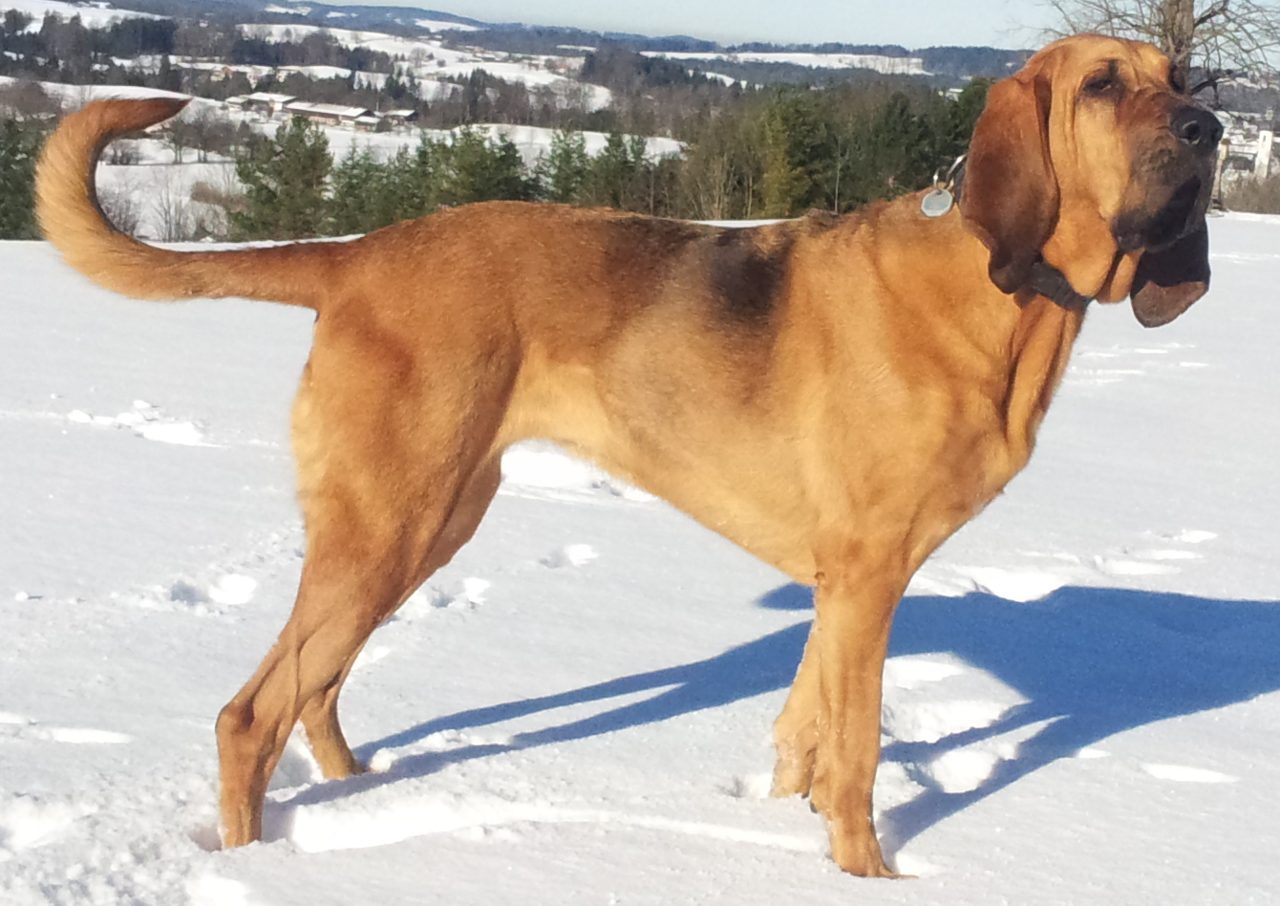
Which Mendelian variants matter most for Bloodhounds?
The Mendelian-disease table above lists seven variants screened in 280 Bloodhounds (Donner 2023). Two matter most by carrier frequency and impact on daily life.
Cone-Rod Dystrophy (cord1-PRA/crd4)
Cone-rod dystrophy in Bloodhounds is a progressive retinal degeneration caused by a recessive variant in RPGRIP1. Affected dogs lose cone-mediated (bright-light) vision first, then rod-mediated (dim-light) vision as the disease advances. The disease typically emerges in middle age. 21.8% of Bloodhounds in the Donner cohort carry one copy (n=280).
Like degenerative myelopathy, the inheritance carries incomplete penetrance. Testing is available. Annual ophthalmologic screening (OFA CAER exam, formerly CERF) is recommended for breeding stock and for any dog with a known carrier status.
What should I feed a Bloodhound?
Bloodhounds were bred for eight-hour hunting days and their metabolism still expects them. Food-motivated weight gain is the most common Bloodhound health failure, and the food bowl is where it starts.
Weight management is the single most consequential feeding decision for this breed. Bloodhounds are scent-driven, food-motivated, and built lean for endurance work. A pet Bloodhound eating maintenance calories while spending most days in a suburban yard will gain weight steadily. Excess body condition accelerates joint wear, complicates cardiac function, and shortens lifespan. The breed’s median lifespan in the sniff.world atlas is 9.3 years (McMillan 2024 / VetCompass) (sniff.world atlas, n=18); owners who keep their dogs lean into their senior years extend that window meaningfully.
Feed measured portions, not ad libitum. A Bloodhound’s appetite does not self-limit. Use a kitchen scale to portion each meal to the target caloric density recommended by the food manufacturer for the dog’s weight and activity level. Most Bloodhounds in pet homes require 15 to 25 percent fewer calories than a kibble’s “active” recommendation suggests. Work with your veterinarian to establish a target weight based on body condition score, not breed standard weight.
Joint health and the growth phase matter, but Bloodhounds are not giant-breed giants. Adult Bloodhounds weigh 80 to 110 pounds. A puppy-stage formulation with controlled calcium (no more than 1.8% dry-matter calcium, per NRC 2006) and a calcium-to-phosphorus ratio between 1.1:1 and 2:1 is appropriate during growth. After 12 months, transition to a maintenance formula with moderate protein (18 to 22 percent) and fat (12 to 15 percent). The breed’s 22.5% carrier frequency for degenerative myelopathy (Donner 2023, n=280) means spinal health is a long-term concern; moderate, consistent weight and adequate but not excessive protein support that.
What we don’t know
The penetrance of degenerative myelopathy and cone-rod dystrophy in Bloodhounds specifically is not yet well characterized. Both variants carry incomplete penetrance in the Donner dataset, but we do not yet know what proportion of Bloodhounds with two disease-associated copies will become symptomatic or at what age. The breed’s small atlas size (18 dogs) limits our ability to track long-term outcomes in genotyped individuals.
Bloodhound lifespan data in the literature is sparse and conflicting. The atlas median of 9.3 years (McMillan 2024 / VetCompass) (sniff.world atlas, n=18) is shorter than some breed-club estimates. This gap may reflect a cohort that skews toward dogs with early health crises, or it may reflect the tendency of owner-reported estimates to exceed verified lifespans. The honest summary is that the gap remains unresolved until more genotyped Bloodhounds are followed longitudinally.
Frequently asked questions about Bloodhounds
Are Bloodhounds good with kids? Yes. Bloodhounds are gentle, pack-oriented dogs with low aggression drive. They were selectively bred for 1,000 years to work cooperatively in large hunts. They are patient with children but will knock over toddlers with their size and enthusiasm; supervision is necessary as with any large dog.
How long do Bloodhounds live? Cited life expectancy is 9.3 years (McMillan 2024 / VetCompass, n=134, 95% CI 8.6 to 11).world atlas, n=18), though some breed-club estimates are higher. Weight management and early screening for degenerative myelopathy and vision loss are the clearest levers owners control to extend lifespan.
What is the most common health problem in Bloodhounds? Obesity is the most common preventable health problem. Degenerative myelopathy (carrier frequency 22.5%, Donner 2023, n=280) and cone-rod dystrophy (carrier frequency 21.8%, Donner 2023, n=280) are the most common genetic risks.
Should I do a DNA test on my Bloodhound? For breeding stock, yes. For a pet Bloodhound, testing for degenerative myelopathy and cone-rod dystrophy will inform screening intervals; dogs with two disease-associated copies benefit from early ophthalmologic exams and neurologic monitoring in middle age.
What causes ear infections in Bloodhounds? Bloodhounds’ long, pendulous ears trap moisture and restrict airflow, creating an ideal environment for bacterial and yeast overgrowth. Weekly ear cleaning with a vet-approved cleanser and prompt drying after swimming or baths are preventive. Otitis externa is common and can become chronic; topical treatment is usually effective.
Are Bloodhounds prone to bloat? Bloat (gastric dilatation-volvulus) is a surgical emergency in large, deep-chested dogs. Bloodhounds are at elevated risk. Feeding multiple small meals rather than one large meal, avoiding exercise immediately after feeding, and knowing the signs of bloat (restlessness, abdominal distension, unsuccessful vomiting attempts) are essential. Consider discussing prophylactic gastropexy with your veterinarian.
Do Bloodhounds shed a lot? Yes. Bloodhounds shed year-round, heavily twice annually. Brush 3 to 4 times weekly to manage loose hair and reduce what ends up on furniture and clothing.
What is the best diet for a Bloodhound? A measured-portion, grain-inclusive, moderate-protein kibble or whole-food diet matched to the individual dog’s activity level and weight. Bloodhounds thrive on consistency and portion control; the best diet is the one the owner can sustain and that keeps the dog lean. Annual body-condition scoring with your veterinarian is more important than the brand name on the bag.