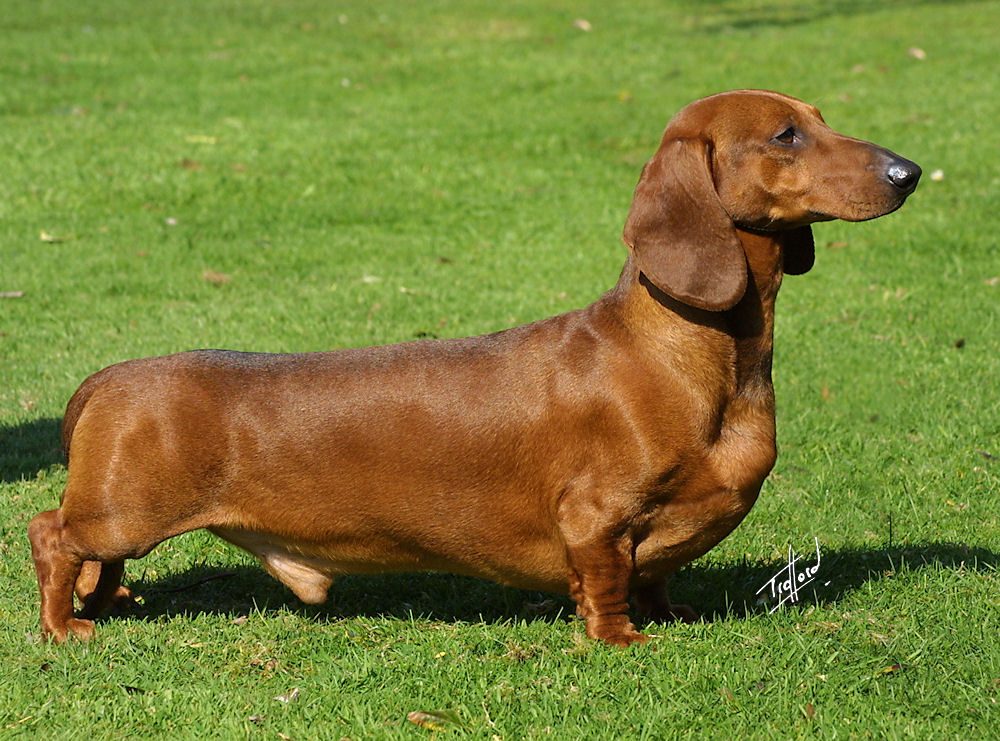
Which Mendelian variants matter most for Dachshunds?
The Donner 2023 cohort did not identify Mendelian variants at observable carrier frequency in Dachshunds. That absence of a long list is unusual and meaningful. It does not mean Dachshunds are genetically simple. It means the breed’s known heritable architecture, the traits that make a Dachshund a Dachshund, traces most clearly to morphology genes rather than to recessive disease variants found at clinical frequency.
An FGF4 retrogene on chromosome 12 drives chondrodystrophic dwarfism (CDDY), which includes shortened limbs and predisposition to intervertebral disc disease (IVDD), the spinal condition Dachshunds are most associated with. The variant does not cause IVDD in every carrier; penetrance is incomplete and modulated by age, weight, activity, and spine anatomy. How many Dachshunds carry it has not been measured in the cohorts this page draws on, so no frequency is given here.
Dachshunds do not show the classical chondrodystrophic limb phenotype as uniformly as they once did, especially in show lines trending toward longer legs. The IVDD risk remains. The shortened-limb phenotype varies across lines, with some show-line dogs trending toward relatively longer legs.
How should I test my Dachshund?
A Dachshund does not need a Mendelian-disease panel because the breed has not shown publishable Mendelian variants at clinical frequency. That said, spinal health matters more for this breed than for almost any other. Work with your vet to keep your Dachshund at a lean weight, avoid high-impact jumping from furniture, and, if your Dachshund shows signs of hind-limb weakness, reluctance to jump, or back pain, get imaging promptly. Early imaging can catch disc bulging before acute extrusion. An MRI is the gold standard; a CT is a practical alternative if MRI is not available.
What should I feed a Dachshund?
Feeding a Dachshund well means managing the breed’s intervertebral disc disease risk through weight control and joint support, because spinal health is non-negotiable in a dog built this low to the ground.
Weight management is the single most important nutritional intervention for Dachshund spine health. Excess weight increases the mechanical load on discs that are already compressed by the breed’s anatomy. A Dachshund at 12 pounds instead of 10 is not just 20% heavier; the force on each disc increases non-linearly with body weight. The National Research Council (NRC 2006) energy requirements for a 10-pound adult dog are roughly 400 kcal per day at maintenance. Many commercial Dachshund formulations are denser than that, and portion creep is common because Dachshunds are relentless scavengers. Measure portions carefully. Use a kitchen scale if you can. Treats should be no more than 10% of daily calories.
A large-breed puppy formula designed for slower growth is not appropriate for a Dachshund, which grows to adult size (standard up to 32 pounds; miniature 8 to 11 pounds, per AKC breed standard) within 8 to 10 months. A small-breed puppy formula with calcium between 1.0% and 1.8% and phosphorus between 0.8% and 1.6% on a dry-matter basis (NRC 2006 guidance) is the standard starting point. Avoid puppy formulas designed to maximize growth rate. A Dachshund that reaches adult size quickly and then maintains that size will have healthier discs than one that grows slowly then gains weight in middle age.
Once your Dachshund is an adult, a small-breed adult formula with moderate fat (12% to 15%) and high-quality protein (18% to 22%) supports lean-mass maintenance. Joint support ingredients like glucosamine and chondroitin sulfate are common in small-breed formulations but lack definitive evidence in dogs without active joint disease. If your Dachshund develops disc-bulge signs or clinical IVDD, work with your vet on a therapeutic diet designed for joint and spine support, often paired with restricted activity and medications like gabapentin or NSAIDs depending on severity.
Grain-free diets carry the same cardiac risk for Dachshunds as they do for other breeds. Adin et al. 2019 (JVIM 33:2691-2699) documented diet-associated dilated cardiomyopathy across multiple breeds fed certain grain-free formulations. A grain-inclusive, taurine-complete formulation is the safer default. Dachshunds are not a breed with particular reported susceptibility to DCM in the literature, but the general risk applies.
What we don’t know
The honest summary is that Dachshund genetics research has a severe data gap. The Donner 2023 cohort is the largest genetic survey of the breed, and it identified no Mendelian variants at observable carrier frequency. That finding is valuable, it means the breed is not burdened by the recessive-disease load that characterizes some breeds, but it also means we have almost no population-level data on disease incidence, age of onset, or penetrance for the conditions Dachshund owners encounter most.
IVDD is the defining health problem in Dachshunds. The FGF4 retrogene on chromosome 12 causes chondrodystrophy (CDDY) and is established as an IVDD risk factor across multiple breeds (Brown et al. 2017, PNAS). We do not yet know which Dachshunds with the variant will develop symptomatic disc disease and which will not. We do not have published prospective follow-up studies tracking cohorts of Dachshunds over their lifespans to map the interaction between the FGF4 variant, weight, activity level, age, and actual disease onset. The breed-club health programs focus on owner education about weight and activity, which is the right move, but the mechanistic research is still missing.
Cancer data, survivorship data, and cardiac screening prevalence are all absent from published peer-reviewed literature specific to Dachshunds. We know the breed’s median lifespan from atlas records is 13.2 years (McMillan 2024 / VetCompass), which is longer than many larger breeds. Beyond that, the epidemiology is mostly unmapped.
Frequently asked questions about Dachshunds
Are Dachshunds prone to back problems? Yes. The breed’s long spine and short legs create mechanical load that predisposes to intervertebral disc disease. The FGF4 retrogene on chromosome 12 is an additional genetic risk factor. Weight management and activity restriction (avoiding jumping from furniture) reduce risk substantially.
What is the most common health problem in Dachshunds? Intervertebral disc disease (IVDD), which ranges from mild disc bulging to severe extrusion causing hind-limb paralysis. Early signs include reluctance to jump, back pain, or dragging hind legs. Imaging and prompt veterinary care improve outcomes.
How long do Dachshunds live? Cited life expectancy is 13.2 years (McMillan 2024 / VetCompass, n=2,305, 95% CI 13 to 13.5). Dachshunds are among the longest-lived dog breeds, and many live into their mid-to-late teens with good care.
Should I do a DNA test on my Dachshund? Dachshunds do not have a recommended Mendelian-disease panel because the breed has not shown observable carriers of single-gene recessive diseases at clinical frequency. Testing for the FGF4 retrogene is available but not yet routine, because penetrance for IVDD is incomplete and clinical guidelines for acting on a positive result are still developing.
What is the best diet for a Dachshund? A small-breed adult formula with moderate fat (12% to 15%), high-quality protein (18% to 22%), and grain inclusion is the standard. Weight management is more important than the specific formula. Keep portions measured, treats under 10% of daily calories, and maintain a lean body condition score to reduce spinal stress.
Are Dachshunds good with kids? Dachshunds are alert and affectionate but were originally bred as independent hunters. They can be territorial and may snap if startled or handled roughly. Supervision with young children is important. Teach children to approach calmly and not pick up the dog, which stresses the spine.
How much exercise does a Dachshund need? A healthy adult Dachshund needs 30 to 60 minutes of moderate exercise per day, usually satisfied by walks and indoor play. Avoid jumping from furniture or high-impact activities that stress the spine. Swimming is an excellent low-impact option.
Do Dachshunds shed a lot? Shedding varies by coat type. Smooth-coated Dachshunds shed year-round at moderate levels. Wirehaired and longhaired varieties shed less but require regular grooming to prevent matting.