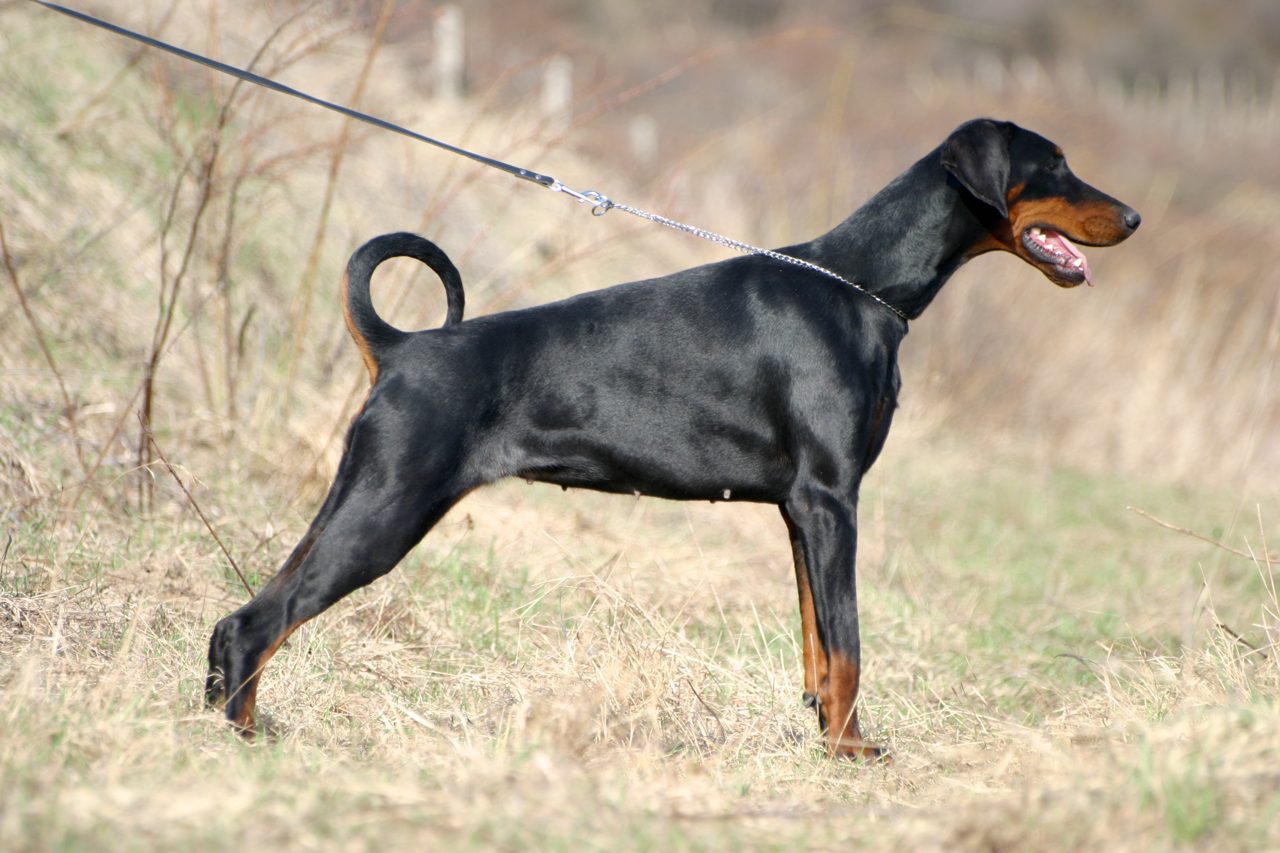
Which Mendelian variants matter most for Doberman Pinschers?
The Mendelian-disease table above lists 15 variants at observable carrier frequency in 2,219 Doberman Pinschers (Donner 2023). Two of them are carried by more than a third of the dogs tested, which makes this one of the densest carrier pictures in the atlas. Three matter most by frequency and impact.
Von Willebrand’s Disease, Type 1 (vWD 1)
Von Willebrand’s Disease, Type 1 in Doberman Pinschers is an autosomal recessive clotting disorder, the mildest of the three vWD types, in which affected dogs make too little von Willebrand factor and can bleed longer after injury or surgery. 36.5% of Doberman Pinschers in the Donner cohort carry one copy (n=2,218). With a carrier rate that high, two-copy dogs are not rare in the breed.
Testing is available, and a von Willebrand factor antigen test measures what the dog actually makes. Name either result to the veterinarian before any surgery.
Deafness and Vestibular Dysfunction (DINGS)
Deafness and Vestibular Dysfunction in Doberman Pinschers is an autosomal recessive condition first described in this breed, in which affected puppies are deaf and show balance problems from early life. 1.4% of Doberman Pinschers carry the main variant (n=2,219) and 0.3% carry a second, PTPRQ-related variant.
Testing is available. The frequency is low; it matters for breeders pairing two carriers.
The breed’s genetic structure is tight. Dobermans rank 10th of 107 ranked breeds for genetic diversity, with a mean heterozygosity of 0.235, which is low relative to the most genetically diverse breeds in the atlas. Four founder cohorts dominate the reconstruction: Momozawa (39), Hayward (25), Shannon (23), and Chen (18). That founder concentration, combined with the small atlas, means the absence of detected Mendelian variants is informative but not reassuring. A larger cohort would likely surface low-frequency recessives.
What should I feed a Doberman Pinscher?
Feeding a Doberman well means feeding around the breed’s known cardiac vulnerabilities and the management of a moderately large frame across a relatively short lifespan. Dobermans live a median 11.2 years (atlas-derived), which is typical for a large working breed. The cardiac risk, not joint disease, dominates the feeding calculus.
Dilated cardiomyopathy in Dobermans is a breed-signature condition with both genetic and dietary components. A documented susceptibility to DCM is well established in the breed, and the FDA’s 2018 advisory on diet-associated DCM flagged grain-free and pulse-heavy diets as a potential contributing factor (FDA 2018 advisory, updated 2022). The FDA’s 2018 advisory on diet-associated DCM did not isolate Dobermans as a top-reported breed the way it did Goldens, but the breed-club health community has documented cases clustering around grain-free formulations. The conservative position is a grain-inclusive, taurine-supplemented adult diet from a manufacturer with published feeding trials.
Measure taurine before supplementing it. NRC 2006 sets a minimal taurine requirement, and many veterinary cardiologists recommend diets delivering at least 2,000 mg/kg taurine for meat-based formulations (NRC 2006, Nutrient Requirements of Dogs and Cats). Dobermans fed grain-free diets warrant periodic serum and whole-blood taurine measurement; target values should be discussed with your veterinary cardiologist, as consensus thresholds are not yet uniformly established.
Adult weight management matters as much as cardiac support. Dobermans are lean dogs by standard, but obesity exacerbates cardiac load and shortens the lifespan window. A diet that keeps a Doberman in the mid-range of ideal body condition (BCS 4-5 out of 9) from adulthood onward is the right target. Portion control is often more important than formula choice.
Electrolyte balance and the sodium question. Dobermans with early DCM or arrhythmia may benefit from moderate sodium restriction under cardiologist guidance; specific targets vary by case and should be set by your cardiologist. Healthy Dobermans on regular maintenance diets need not be sodium-restricted; NRC 2006 minimal is around 0.06% dry matter, and most commercial diets sit well above that. Work with your cardiologist if your dog has a murmur or documented arrhythmia.
What we don’t know
The Doberman Pinscher atlas cohort is small (117 dogs), so the population-structure figures above are provisional. The Mendelian carrier figures rest on a different and much larger cohort, the 2,219 Dobermans Donner 2023 genotyped, and they are not provisional in the same way.
The genetic basis of dilated cardiomyopathy in Dobermans is only partially understood. Prospective studies in Dobermans would be high-yield, but the breed’s relatively small population and tight genetic structure complicate recruitment.
The breed’s high founder concentration (four founders account for most of the pedigree reconstruction) is consistent with carrier rates above a third for two separate variants: a tight population carries what its founders carried. Whether the same structure has fixed other alleles that no panel yet names is not known.
Frequently asked questions about Doberman Pinschers
Are Doberman Pinschers prone to heart disease? Yes. Dilated cardiomyopathy is the breed’s most common cardiac disease and a leading cause of morbidity and mortality in Dobermans (Wess et al. 2010, J Vet Intern Med 24:1074-1083). Annual cardiac screening by echocardiography is recommended starting at age 3 to 4 years by the DPCA cardiac screening program. Some breeders and cardiologists screen earlier.
How long do Doberman Pinschers live? Cited life expectancy is 11.2 years (McMillan 2024 / VetCompass, n=3,531, 95% CI 11 to 11.5). Some Dobermans live into their early teens; others die earlier from cardiac disease, orthopedic trauma, or cancer. The breed standard assumes a relatively short lifespan compared to smaller breeds.
What is the best diet for a Doberman Pinscher? A grain-inclusive, taurine-supplemented adult formula from a manufacturer with published feeding trials. Taurine content should be at least 2,000 mg/kg for meat-based diets. Avoid grain-free and pulse-heavy formulations, which may increase cardiac risk in this breed.
Can Doberman Pinschers eat grain-free food? The breed has documented susceptibility to dilated cardiomyopathy, the FDA’s diet-associated advisory names grain-free and pulse-heavy diets, and those diets are associated with lower bioavailable taurine in some formulations. The conservative recommendation is grain-inclusive diets with verified taurine levels (2,000 mg/kg minimum).
Are Doberman Pinschers good with children? Dobermans are alert, loyal dogs often used as family and personal protection dogs. They can be excellent with children in well-socialized families. Early socialization and consistent training are essential. Supervision with young children is standard practice for any large, athletic breed.
What is the Doberman Pinscher’s typical temperament? Dobermans are intelligent, driven, and responsive to their handlers. They were bred for personal protection and have a natural wariness of strangers. With their own family, well-bred Dobermans are affectionate and eager to please. They require consistent leadership and regular mental and physical exercise.