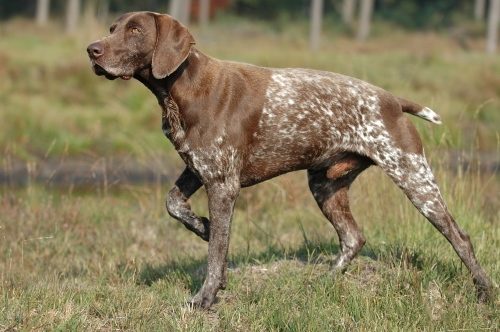
Which Mendelian variants matter most for German Shorthaired Pointers?
The Mendelian-disease table above lists variants screened in 1,252 German Shorthaired Pointers (Donner 2023). Thirteen variants appear at observable carrier frequency; eight sit above 0.2%, and three rise above 2%.
Factor VII Deficiency
Factor VII Deficiency in German Shorthaired Pointers is an autosomal recessive clotting-factor deficiency. In the dogs Donner 2023 measured, every homozygote showed a prolonged prothrombin time with a normal aPTT, and the paper describes the deficiency as a mild propensity for prolonged clotting that typically stays clinically undetected (Donner 2023, PLOS Genetics, doi:10.1371/journal.pgen.1010651). 2.8% of German Shorthaired Pointers in the Donner cohort carry one copy (n=1,252). Across all breeds in that study, 6 of 33 at-risk dogs showed clinical signs (max 18% penetrance); no breed-specific figure exists for German Shorthaired Pointers.
Testing is available. A dog with two copies is worth naming to the veterinarian before surgery; the paper reports nothing about carriers (one copy) needing a surgical flag.
Ehlers-Danlos Syndrome
Ehlers-Danlos Syndrome is an autosomal recessive connective-tissue disorder affecting collagen synthesis, first described in the Chihuahua and Poodle. In German Shorthaired Pointers the figure below is a carrier frequency from Donner 2023, not a case series in the breed. Affected dogs have hyperextensible skin, joint instability, and fragile blood vessels. 2.3% of German Shorthaired Pointers tested carry the variant (n=65). The sample size for this variant is smaller than for the others on this list, reflecting lower testing uptake.
Testing is available. Affected dogs require careful surgical planning and monitoring.
What should I feed a German Shorthaired Pointer?
German Shorthaired Pointers are working pointers with metabolisms tuned for all-day field work. A pet German Shorthaired Pointer eating a standard-calorie maintenance kibble in a suburban yard is being fed for a job they are not doing. Food-driven weight gain is the most common health failure in the breed outside of the genetic variants above.
The breed’s genetic disease landscape is sparse and offers less direct dietary guidance than some others. The dominant health concern is managing the working breed’s energy expenditure and preventing obesity, which amplifies joint stress and masks early signs of movement disorders like degenerative myelopathy.
Life stage matters. Puppies in this breed grow to 45 to 70 pounds, but growth is steadier and slower than in giant breeds. A large-breed puppy formula (calcium-to-phosphorus ratio between 1.1:1 and 2:1 per NRC 2006) is the right starting point from 8 weeks to 12 months. Adult maintenance from 12 months onward should match the dog’s actual activity level, not a breed average. A working German Shorthaired Pointer needs 30 to 40 percent more calories than a couch-based dog of the same weight.
Weight management is the single most important dietary lever for this breed. The combination of a working breed’s food-drive genetics and a pet environment that does not outlet that drive creates a perfect storm for obesity. Obesity in German Shorthaired Pointers accelerates joint wear, compounds any genetic predisposition to degenerative myelopathy, and increases surgical and anesthetic risk. Portion control and activity-matched calorie targets are the foundation. Avoid ad-libitum feeding.
Grain-inclusive adult diets are the practical default. The FDA’s grain-free advisory has not identified a breed-specific signal for German Shorthaired Pointers as it has for some other breeds. A grain-inclusive, taurine-supplemented formula from a manufacturer with AAFCO feeding trials is a safe and cost-effective starting point.
What we don’t know
The Donner 2023 cohort for German Shorthaired Pointers is small (12 dogs in the atlas, 1,252 genotyped). The breed’s sparse Mendelian landscape may reflect low genetic load or simply reflect the fact that few German Shorthaired Pointers have been genotyped relative to other sporting breeds. More dogs in the atlas would clarify whether the breed’s health profile is genuinely uncomplicated or whether rarer variants and polygenic conditions remain uncharacterized.
Degenerative myelopathy in German Shorthaired Pointers has not been studied in detail in the breed-specific literature. The carrier frequency (2.5%) is non-trivial, but we do not know the age of onset, the progression rate, or whether there are modifiable environmental or nutritional factors that slow decline in this breed.
Frequently asked questions about German Shorthaired Pointers
How long do German Shorthaired Pointers live? The breed’s median lifespan is typically cited in the 10 to 13.4 year (McMillan 2024 / VetCompass) range (AKC German Shorthaired Pointer breed health information, akc.org/dog-breeds/german-shorthaired-pointer/). Longevity is typical for a medium-to-large sporting breed; no study has measured whether the variants listed above change it.
What is the most common genetic disease in German Shorthaired Pointers? Factor VII Deficiency is the most common single variant by carrier frequency (2.8%, n=1,252), followed by Degenerative Myelopathy (2.5%), the Ehlers-Danlos variant (2.3%, n=65) and Dilated Cardiomyopathy risk (1.1%). All three are rare enough that most owners will not encounter them directly.
Are German Shorthaired Pointers prone to hip dysplasia? Hip dysplasia occurs in the breed at rates consistent with other medium-to-large sporting dogs. OFA hip-evaluation data for German Shorthaired Pointers is available at ofa.org; breed-specific prevalence should be verified there directly. A large-breed puppy formula and weight management reduce risk.
What is the best diet for a German Shorthaired Pointer? Match calorie intake to activity level. A working or highly active German Shorthaired Pointer needs 30 to 40 percent more calories than a sedentary dog of the same weight. A grain-inclusive, AAFCO-tested adult formula with controlled fat for lean dogs and higher fat for active dogs is the practical standard.
Are German Shorthaired Pointers good with kids? The breed was developed for field work and is generally tolerant and social. Supervision with young children is always recommended, as with any dog, but the breed’s temperament is not a known risk factor.
Do German Shorthaired Pointers shed? Yes. German Shorthaired Pointers have a short, dense coat and shed year-round, with heavier shedding during seasonal transitions. Regular brushing reduces loose hair indoors.
Why is my German Shorthaired Pointer gaining weight so easily? The breed was selected for high food drive and all-day energy output. A pet German Shorthaired Pointer in a suburban environment has the genetic appetite but not the outlet. Strict portion control and regular high-intensity exercise are the only effective interventions.