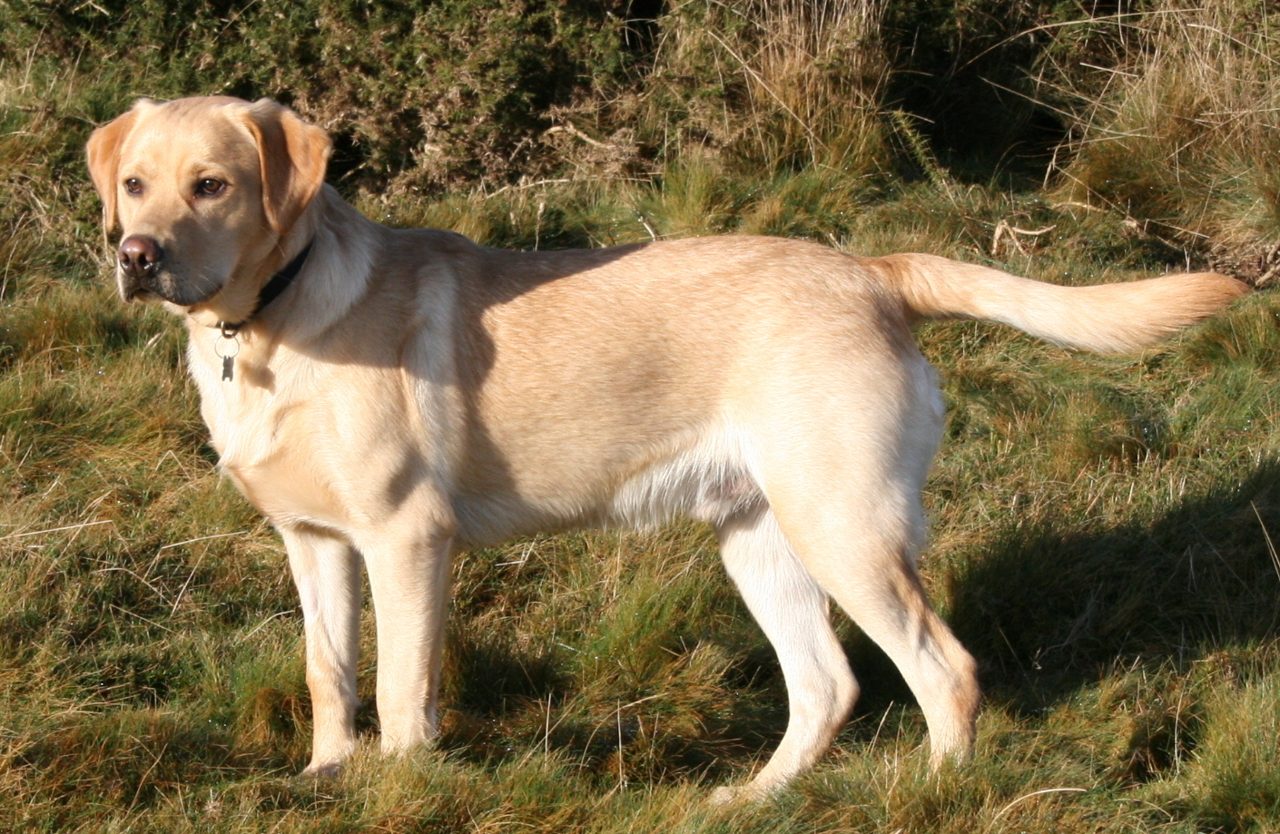
Which Mendelian variants matter most for Labrador Retrievers?
The Mendelian-disease table above lists variants screened in 16,856 Labrador Retrievers (Donner 2023). Five matter most by carrier frequency and impact.
Stargardt Disease
Stargardt Disease in Labradors is a recessive retinal degeneration caused by a variant discovered in the breed. Affected dogs lose central vision progressively, starting in early adulthood. Vision loss is irreversible and limits the dog’s ability to navigate unfamiliar environments. About 11.2% of Labradors in the Donner cohort carry the variant (n=16,856). More than one in nine.
What share of dogs with two copies go on to lose vision has not been measured in a large group yet: the Donner cohort followed one such dog, and it was affected (1 of 1), which is too few to give a rate. Testing is widely available through commercial DNA labs and breed-specific panels. Testing before breeding is standard practice in responsible Labrador lines.
Exercise-Induced Collapse (EIC)
Exercise-Induced Collapse in Labradors is a recessive neuromuscular condition that emerges during intense activity. Affected dogs lose hind-limb coordination and collapse during or shortly after sustained exercise. They recover within minutes to hours. The trait is disabling for working dogs and limits athletic activity. About 10.6% of Labradors carry the variant (n=16,853).
The registry lists EIC as recessive with incomplete penetrance, meaning not every dog with two copies collapses. What share do has not been measured here: the Donner cohort had two dogs with two copies and confirmed collapse in neither (0 of 2), too few to give a rate. Testing is available and widely used in field-trial and hunting lines.
Progressive Rod-Cone Degeneration (prcd-PRA)
Progressive Rod-Cone Degeneration in Labradors is a recessive form of progressive retinal atrophy. The disease causes gradual vision loss starting with night blindness and progressing to complete blindness by middle age. About 7.2% of Labradors carry the variant (n=16,825). Testing is available and is often included on multi-disease panels.
Hereditary Nasal Parakeratosis (HNPK)
Hereditary Nasal Parakeratosis in Labradors is a recessive condition discovered in the breed. Affected dogs develop buildup of keratin on the nasal planum, which can crack, bleed, and become infected. The condition is chronic but manageable with topical treatment and nose protection. About 2.0% of Labradors carry the variant (n=16,856).
How often dogs with two copies show signs has not been measured yet: the Donner cohort followed one such dog (0 of 1 confirmed), too few to give a rate. Testing is available.
How should I test my Labrador Retriever?
A breed-specific panel from a CLIA-accredited lab is the high-yield path. The minimum useful set for Labradors is Stargardt Disease (ABCA4), EIC (DNM1), prcd-PRA, HNPK, CNM, and DM. Carrier testing before breeding is the standard practice in responsible breeding lines.
What should I feed a Labrador Retriever?
Feeding a Labrador well means feeding around the breed’s known genetic vulnerabilities and the metabolic traits that define the breed. Labradors were selected for water-retrieval endurance and food motivation remains their signature. That same drive makes weight management the single most consequential feeding decision an owner makes.
Labradors gain weight faster than most breeds and obesity is the most common Labrador health failure. The breed’s appetite regulation is genuinely different from other large breeds. A Labrador fed free-choice will become overweight within months. Portion control and meal-feeding (twice daily, measured kibble) are not optional. The OFA reports that overweight status is a significant risk factor for hip dysplasia; hip dysplasia is present in 4.2% of Labradors across 28,652 OFA evaluations (ofa.org/diseases/hip-dysplasia/). Excess weight accelerates joint wear and reduces lifespan.
Large-breed puppy formulations with controlled calcium matter during the growth phase. Labradors reach 55 to 80 pounds at adulthood. The growth rate is rapid enough that calcium-to-phosphorus ratios between 1.1:1 and 2:1 are essential to avoid developmental orthopedic disease. NRC 2006 (Nutrient Requirements of Dogs and Cats, National Academies Press) recommends 0.8 to 1.6 grams of calcium per 1,000 kilocalories for growing large-breed dogs. Once the dog is at adult height (typically 12 to 14 months), transition to a maintenance formula and strictly meter portions.
Taurine supplementation is sensible. Grain-free and pulse-heavy diets remain under FDA scrutiny (FDA 2019 DCM advisory); Labradors have not been flagged as a breed with elevated DCM signal, but the controversy applies across large breeds. A grain-inclusive adult formula from a manufacturer that performs AAFCO feeding trials is the conservative default. If you choose a novel-protein or limited-ingredient diet, verify the taurine content on the label or confirm supplementation with the manufacturer.
What we don’t know
The mechanism behind Exercise-Induced Collapse remains incompletely characterized. The variant is well-mapped, and the registry lists it with incomplete penetrance, but nobody has yet measured what share of dogs with two copies collapse: the Donner cohort had two such dogs, too few to give a rate. Which genetic, environmental, or conditioning factors tip a homozygous dog into symptomatic collapse is not yet documented.
Stargardt Disease in Labradors is a recent discovery. Long-term prognosis, age of onset variability, and whether any dietary intervention slows progression have not been systematically studied in the breed. Veterinary ophthalmologists have limited data on typical progression rates.
The breed’s broad carrier burden across multiple retinal variants (Stargardt at 11.2%, prcd-PRA at 7.2%, GR-PRA2 at 0.91%) suggests high historical inbreeding around vision genes. The selective pressure that fixed these variants is not documented.
Frequently asked questions about Labrador Retrievers
What is the most common genetic disease in Labrador Retrievers? Stargardt Disease, caused by a variant in ABCA4. 11.2% of Labradors carry one copy (Donner 2023, n=16,856). It is recessive, so a dog needs two copies to be affected.
Are Labrador Retrievers prone to hip dysplasia? Hip dysplasia is present in 4.2% of Labradors evaluated by the OFA across 28,652 evaluations (ofa.org/diseases/hip-dysplasia/). This is moderate prevalence. Weight management during growth and maintenance is the most effective preventive strategy.
What is Exercise-Induced Collapse? EIC is a neuromuscular condition that causes temporary hind-limb paralysis during intense exercise. Dogs recover within minutes to hours. About 10.6% of Labradors carry the variant (Donner 2023, n=16,853). Testing is available and recommended for field-trial and hunting lines.
Should I do a DNA test on my Labrador Retriever? For breeding stock, yes. A panel covering Stargardt Disease, EIC, prcd-PRA, and other top variants is standard practice in responsible breeding programs. For pet dogs, testing can clarify risk for vision loss and collapse.
How long do Labrador Retrievers typically live? The atlas median is 13.1 years. Lifespan varies with individual genetics, diet, weight, and exercise. Maintaining lean body condition and regular veterinary screening are the strongest owner-controlled factors for longevity.
What is the best diet for a Labrador Retriever? A measured-portion, grain-inclusive large-breed formulation with controlled calcium and taurine supplementation. Free-choice feeding is almost certain to result in obesity. Meal-feed twice daily with portions adjusted to keep the dog at lean body condition.
Are Labrador Retrievers good family dogs? Yes. Labradors are widely used as family companions and service dogs. Their retrieving drive and food motivation make them highly trainable. They require regular exercise and mental enrichment.
Can Labrador Retrievers handle hot weather? Labradors have dense double coats and moderate heat tolerance. Exercise during peak heat should be limited. Provide shade, fresh water, and air-conditioned rest areas. The breed’s thickness makes them more prone to overheating than short-coated breeds.