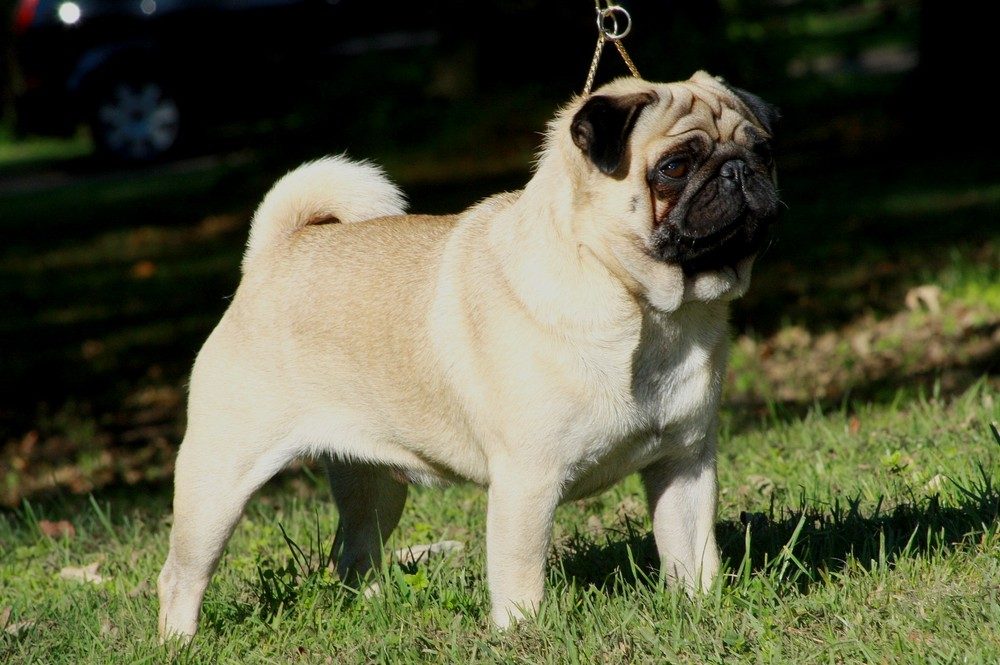
Which Mendelian variants matter most for Pugs?
The Mendelian-disease table above lists 25 variants at observable carrier frequency, from 194 variants screened in 5,154 Pugs (Donner 2023). Two matter most by carrier frequency and clinical impact.
Von Willebrand’s Disease, Type 1 (vWD 1)
Von Willebrand’s disease Type 1 in Pugs is an autosomal-recessive bleeding disorder caused by low levels of von Willebrand factor. Affected dogs have prolonged bleeding after trauma or surgery. 2.1% of Pugs carry the variant (n=5,154). The penetrance is low: Donner S4 confirmed phenotype in only 6/33 at-risk dogs (maximum 18% penetrance).
Testing is available. Affected dogs are managed through surgical precautions and transfusion support if needed.
How should I test my Pug?
A breed-specific panel from a CLIA-accredited lab is the high-yield path. The minimum useful set for Pugs is degenerative myelopathy (DM), CDDY (chondrodystrophy/IVDD), von Willebrand’s disease Type 1, and cone-rod dystrophy (crd4). These four cover the highest-frequency and highest-impact variants in the breed.
What should I feed a Pug?
Feeding a Pug well means feeding around the breed’s brachycephalic anatomy and high baseline intervertebral disc disease risk. Pugs cannot pant efficiently, which means heat-of-the-day exercise is dangerous and meal timing matters more than it does for most breeds. Add to that the breed’s near-universal CDDY variant carriage and high degenerative myelopathy carrier frequency (26.0%, n=5,154), and spinal health becomes a primary nutritional priority.
Heat management drives meal timing. Pugs overheat faster than longer-muzzled breeds because they cannot cool themselves through evaporative panting. Feed the main meal in the cool morning or evening, not midday. Small, frequent meals are safer than one large meal, which increases abdominal pressure and disc stress.
Joint and spinal support matters for a compact, heavy-fronted breed. Only about 1.5% of Pugs carry the CDDY variant that predisposes to IVDD (Donner 2023, n=5,154), so this is about body condition, not a variant every Pug has. An adult formulation with glucosamine, chondroitin, and omega-3 fatty acids is evidence-based support. A large body of peer-reviewed literature (including ACVIM guidelines on joint disease) supports these supplements in breeds at risk for degenerative joint disease and disc herniation. Maintain lean body condition aggressively: a Pug at ideal weight has better spinal support than an overweight one, and excess weight accelerates disc degeneration.
Protein adequacy and taurine sufficiency prevent secondary problems. Pugs with degenerative myelopathy (26% carrier frequency) benefit from adequate dietary protein and muscle-sparing during the symptomatic phase. A minimum of 18% crude protein in adult food is the NRC 2006 standard for adult maintenance; for Pugs with DM risk or progression, 22-25% is appropriate. Taurine supplementation is not contraindicated in Pugs. Cardiac support is a reasonable goal in a small-breed dog, though breed-specific mitral valve disease prevalence data for Pugs is not established in the Donner 2023 dataset. Standard commercial foods designed for toy breeds typically meet these targets, but verify the label.
What we don’t know
The honest summary is that we do not know which Pugs in the 26% degenerative myelopathy carrier pool become symptomatic and which do not. Donner 2023 does not publish a penetrance fraction for DM in Pugs specifically. The gap between the 26% carrier frequency and observed symptomatic cases suggests incomplete penetrance, but the degree is not yet quantified for this breed. That gap means environmental and polygenic modifiers are at work, but they are not yet mapped. Age of onset also varies widely in published case reports; symptomatic dogs in the literature present anywhere from middle age to late life.
The relationship between heat stress and IVDD symptom progression in Pugs specifically has not been formally studied. Brachycephalic overheating is well-documented (Packer et al. 2012, BMC Veterinary Research). Anecdotal owner reports link heat exposure to acute disc herniation in Pugs. We do not yet have prospective data isolating that causal link in this breed.
Frequently asked questions about Pugs
What is the most common genetic disease in Pugs? Degenerative myelopathy. 26.0% of Pugs carry the variant (Donner 2023, n=5,154), though not all carriers become symptomatic due to incomplete penetrance.
Are Pugs prone to back problems? Spinal problems are reported in Pugs, but the CDDY variant is uncommon in the breed: about 1.5% carry it (Donner 2023, n=5,154). Avoid jumping, sustained running, and rapid weight gain. Lean body condition and spinal support (glucosamine, chondroitin, omega-3) are the owner’s primary levers.
How long do Pugs typically live? Cited life expectancy is 11.6 years (McMillan 2024 / VetCompass, n=10,026, 95% CI 11.4 to 11.8). Some individual Pugs exceed the median, though published lifespan data beyond the atlas figure is limited.
Should I do a DNA test on my Pug? For breeding stock, yes. For pet Pugs, testing helps you identify degenerative myelopathy and von Willebrand’s disease carriers so you can plan preventive care and manage breeding decisions if you ever choose to breed.
Can Pugs handle heat and exercise? Pugs are brachycephalic and overheat easily. Exercise should be short, low-intensity, and in cool parts of the day. Avoid strenuous play in warm weather. Their anatomy does not permit the thermoregulation that longer-muzzled breeds have.
What do I feed a Pug with degenerative myelopathy? There is no cure, but nutrition supports quality of life. Maintain lean body condition to reduce spinal load. Use a diet with adequate protein (22-25% crude protein), glucosamine, and omega-3 fatty acids. Consult your veterinarian about pharmaceutical support as symptoms progress.
Is Von Willebrand’s disease a serious problem in Pugs? It can be. The variant is autosomal recessive with low penetrance (confirmed in only 18% of at-risk dogs), so many carriers are asymptomatic. Affected dogs have prolonged bleeding after injury or surgery. Inform your veterinarian if your Pug is a carrier before any procedure.
Do Pugs need special nutrition as puppies? Toy-breed puppy formulations are appropriate. Transition to an adult toy-breed formulation by around one year of age, following the food manufacturer’s or your veterinarian’s guidance. Avoid overfeeding: excess weight in puppyhood increases joint and spinal stress later.