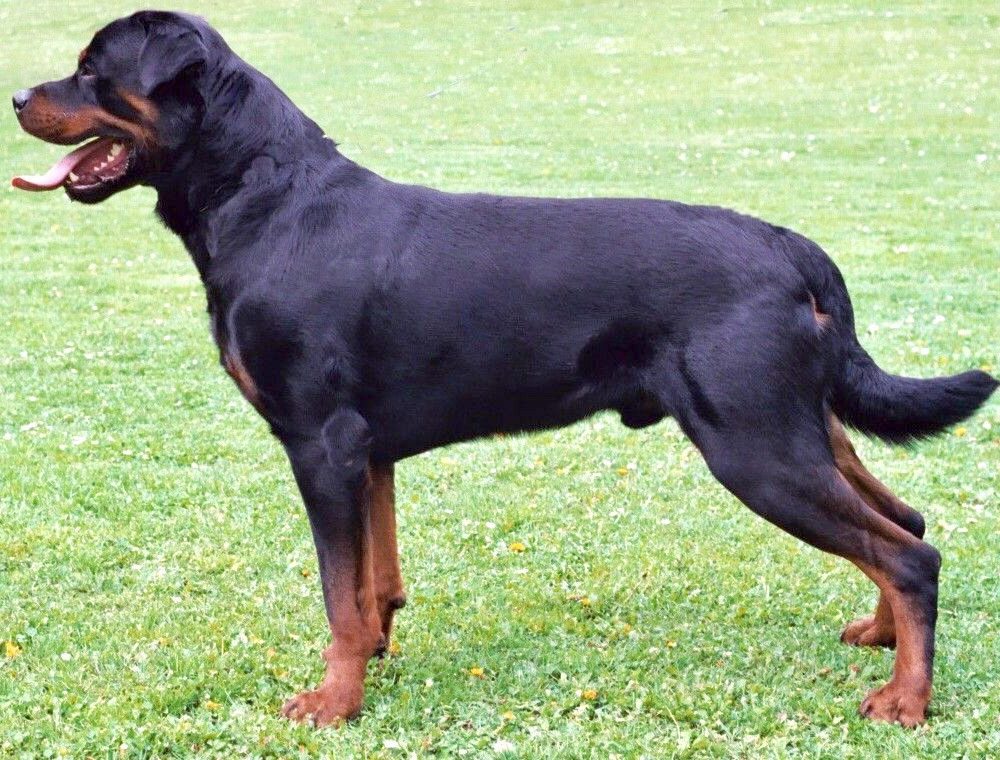
Which Mendelian variants matter most for Rottweilers?
The Mendelian-disease table above lists variants screened in 4,718 Rottweilers (Donner 2023). Twelve variants appear at measurable carrier frequency in the breed, with six carrying enough frequency to shape breeding decisions. All are recessive or incompletely penetrant; none dominates the breed’s health calculus the way ichthyosis does in Goldens. The highest-frequency variants are still uncommon, and because these are recessive or incompletely penetrant, carrying one is usually a long way from a dog being affected.
Cone-Rod Dystrophy (cord1-PRA/crd4)
Cone-rod dystrophy in Rottweilers is a recessive retinal degeneration caused by a variant in RPGRIP1 (OMIA:001432-9615). Affected dogs lose photoreceptor function over months to years, progressing from day blindness (cone loss first) toward broader vision loss as rod function declines. The disease manifests in early to middle age.
6.8% of Rottweilers in the Donner cohort carry the variant (n=4,713). That is the highest carrier frequency in the breed’s Mendelian panel. Testing is available through commercial labs and the Orthopedic Foundation for Animals (OFA).
Polyneuropathy with Ocular Abnormalities and Neuronal Vacuolation (POANV)
Polyneuropathy with Ocular Abnormalities and Neuronal Vacuolation in Rottweilers is a recessive neurological condition affecting nerve and retinal tissue. Affected dogs develop progressive hind-limb weakness and vision loss, typically in early life. The disease was first described in Black Russian Terriers and subsequently identified in Rottweilers.
3.1% of Rottweilers carry the variant (n=4,667). Testing is available. The condition is rare enough in the breed that most owners will not encounter it.
Neuroaxonal Dystrophy (VPS11-related)
Neuroaxonal dystrophy in Rottweilers is a recessive neurological condition caused by a variant in VPS11. Affected dogs develop progressive neurological decline, with onset typically in early life. The Donner 2023 cohort found phenotype confirmation in both dogs carrying two copies (n=2), too few to state a penetrance figure.
3.0% of Rottweilers carry the variant (n=4,718). Testing is available.
Nonsyndromic Hearing Loss
Nonsyndromic hearing loss in Rottweilers is a recessive form of deafness, identified first in this breed. Affected dogs have congenital or early-onset bilateral hearing loss unrelated to other systemic disease.
0.89% of Rottweilers carry the variant (n=4,718). This is a low-frequency variant in the breed. Testing is available through OFA and commercial canine genetics labs.
What should I feed a Rottweiler?
Feeding a Rottweiler well means accounting for the breed’s size, growth rate, and the emerging cardiac risk signal in the broader working-dog population. Rottweilers are large working dogs, with adult males typically weighing 95 to 135 pounds, which means the calcium-to-phosphorus ratio during the growth phase is the single most important food decision an owner makes.
Giant-breed puppies require controlled calcium and phosphorus. Excess calcium during rapid growth can cause developmental orthopedic disease and joint instability. The National Research Council recommends a calcium-to-phosphorus ratio between 1.1:1 and 2:1 for large-breed puppies (NRC 2006). A large-breed puppy formula that controls mineral levels and delivers moderate protein supports steady growth without accelerating skeletal problems. Adult Rottweilers benefit from continued attention to joint support, particularly given the breed’s size and the orthopedic load.
Weight management in adulthood prevents joint stress. Rottweilers do not have a documented high hip dysplasia rate in the Donner cohort, but the breed’s size and orthopedic load mean excess weight is costly. A moderate-protein, controlled-calorie maintenance diet that keeps adult dogs in lean body condition supports longevity and quality of life.
What we don’t know
The Rottweiler atlas contains 183 dogs, a solid sample for a large-breed specialty cohort but smaller than the Golden Retriever Lifetime Study (Morris Animal Foundation, morrisanimalfoundation.org/golden-retriever-lifetime-study). The carrier frequencies for the rarer variants (degenerative myelopathy, von Willebrand’s Disease Type 1, hyperuricosuria) rest on small numbers of at-risk dogs; confidence intervals are wide.
Cited life expectancy is 10.6 years (McMillan 2024 / VetCompass, n=6,275, 95% CI 10.4 to 10.7). The gap between atlas median and the breed-club range suggests either selection bias in which dogs are genotyped, variation in how lifespan is recorded, or genuine heterogeneity in the breed’s longevity. A larger longitudinal cohort will narrow those confidence intervals over time.
Frequently asked questions about Rottweilers
What is the most common genetic disease in Rottweilers? Cone-rod dystrophy. 6.8% of Rottweilers carry the variant (Donner 2023, n=4,713). It causes progressive vision loss but is manageable and does not affect lifespan significantly.
How long do Rottweilers live? The atlas median is 10.6 years (McMillan 2024 / VetCompass). Breed-club estimates typically cite 8 to 11 years. Large and giant breeds have shorter lifespans than smaller dogs due to the metabolic cost of size.
Should I do a DNA test on my Rottweiler? For breeding stock, a panel covering the five measurable variants (cone-rod dystrophy, POANV, neuroaxonal dystrophy, hearing loss, and degenerative myelopathy) is the practical standard. For a pet, testing is optional unless you have concerns about a specific condition.
Are Rottweilers prone to heart disease? The breed does not show high prevalence of dilated cardiomyopathy in the current data. Genetic relatives such as Leonberger and Saint Bernard carry known DCM risk variants, and a taurine-adequate, grain-inclusive diet is a reasonable precaution. A diet that avoids grain-free formulations and ensures adequate taurine is a reasonable precaution.
What should I feed my Rottweiler puppy? A large-breed puppy formula with controlled calcium and phosphorus (calcium-to-phosphorus ratio between 1.1:1 and 2:1) is essential for healthy skeletal development (NRC 2006). Avoid excessive protein and mineral supplementation.
Are Rottweilers good with children? Rottweilers are large, powerful dogs that require early socialization and training. Their size and strength demand owner responsibility and supervision around children. Temperament varies; individual dogs matter more than breed generalizations.
Do Rottweilers shed a lot? Yes. Rottweilers have a double coat and shed heavily. Regular brushing during shedding season reduces loose hair in the home and skin issues.
What is the Rottweiler’s typical adult size? Males typically weigh 95 to 135 pounds; females 80 to 100 pounds (AKC breed standard). They are among the larger working breeds, which shapes their nutritional and exercise needs.
Related reading