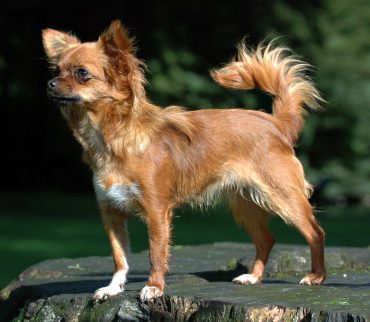
Which Mendelian variants matter most for Chihuahuas?
Chihuahuas have the most diverse gene pool of any ranked population in the atlas: 1st most diverse of 107, mean heterozygosity 0.398, which means more unique alleles are shuffling in the population than in any other ranked breed. Only 25 Chihuahuas in the atlas and 4,273 tested by Donner 2023 have shaped what we know. The Mendelian-disease table lists 194 variants screened, 41 at observable carrier frequency. Six matter most by carrier frequency and impact.
Ehlers-Danlos Syndrome (EDS)
Ehlers-Danlos Syndrome in Chihuahuas is an autosomal-recessive connective-tissue disorder discovered in the breed itself. Affected dogs have fragile skin and joints, abnormal wound healing, and tissue friability. The severity is low, but affected dogs need lifelong care. About 9.8% of Chihuahuas tested carry one copy (n=143). Let that settle: that is the highest carrier frequency in the list, and the sample size is small enough that the real frequency in the population could be materially different. A single cohort of 143 animals may not represent the whole breed equally.
Testing exists but is not yet on most commercial panels. Contact breed-club health committees for current testing recommendations.
Cone-Rod Dystrophy (cord1-PRA/crd4)
Cone-rod dystrophy in Chihuahuas is an autosomal-recessive vision disorder with incomplete penetrance. Affected dogs lose cone function first (daytime vision), then rod function (night vision), and become blind. About 3.9% of Chihuahuas carry one copy (n=4,268). The incomplete penetrance means not all dogs with two copies will develop confirmed clinical blindness.
Testing is available. Affected dogs adapt well to familiar environments.
How should I test my Chihuahua?
For breeding stock, a panel covering CDDY (FGF4), Ehlers-Danlos, dilated cardiomyopathy, cone-rod dystrophy, degenerative myelopathy, prcd-PRA, and Von Willebrand’s Disease Type 1 is reasonable. The sample sizes for some variants are small enough that future testing may refine these recommendations as more Chihuahuas are genotyped.
What should I feed a Chihuahua?
Chihuahuas typically weigh under 6 pounds at maturity per the AKC breed standard (akc.org/dog-breeds/chihuahua/), and their low muscle mass makes them prone to hypoglycemic drops when meals are skipped. The breed’s nutritional priorities are different from larger dogs: meal frequency, energy density, and the prevention of weight extremes (both obesity and dangerous thinness) shape the feeding strategy more than genetic vulnerabilities do.
The CDDY carrier frequency (6.1%) is moderate enough that joint-protective feeding matters across the lifespan, even though the visible disc-disease phenotype is less common in Chihuahuas than in Dachshunds. A small-breed adult formula with controlled calcium and a balanced calcium-to-phosphorus ratio (NRC Nutrient Requirements of Dogs and Cats, 2006, Table 15-1 recommends a minimum Ca:P ratio near 1:1 with typical adult targets around 1.2:1) supports bone and joint health without the hypernutrition that causes rapid growth.
Meal frequency is the critical variable. Most adult Chihuahuas do best on two or three small meals per day rather than one large feeding. Hypoglycemia in toy breeds is a real risk when owners follow large-breed feeding schedules. A 5-pound Chihuahua missing breakfast faces a steeper blood-glucose drop than a 75-pound Labrador missing the same meal. The caloric intake should remain consistent, but the delivery pattern prevents the dangerous fasting intervals.
Weight management is breed-critical. Obesity in a 5-pound frame stresses the spine, joints, and heart much more acutely than it does in a larger dog. The Orthopedic Foundation for Animals does not publish breed-specific prevalence data for Chihuahuas, but excess weight in a small frame is widely recognized by veterinary clinicians as accelerating spinal and joint wear. Feed to a lean body condition score, not to satiation.
Chihuahuas fed puppy formulas need the same calcium discipline as larger breeds. A small-breed puppy formula with appropriate nutrient bounds prevents developmental orthopedic disease even at the smaller end of the growth spectrum.
What we don’t know
The sample size for genetic testing in Chihuahuas is small relative to larger breeds. Only 25 Chihuahuas built the atlas; 4,273 passed through Donner screening. That is not negligible, but the small atlas sample (25 dogs) means future testing may shift carrier frequencies. Ehlers-Danlos was discovered in only 143 dogs tested, the real population frequency could differ substantially.
The penetrance landscape for Chihuahua-specific variants is incomplete. Cone-rod dystrophy and degenerative myelopathy both show incomplete penetrance, but the number of at-risk dogs who become phenotype-confirmed is still uncertain. We do not yet have solid estimates of what percentage of Chihuahuas with two copies of each variant actually develop disease.
Cardiac disease in Chihuahuas is common in breed conversations but not yet systematized in the published literature the way it is for Cavalier King Charles Spaniels. The honest summary is that owners report murmurs, arrhythmias, and congestive heart failure in middle-aged and elderly Chihuahuas, but we lack breed-club health-screening data comparable to what other breeds maintain.
Frequently asked questions about Chihuahuas
Are Chihuahuas good with children? Chihuahuas under 6 pounds are fragile and can be injured by rough handling. Older children and calm households work better than homes with toddlers. Adult supervision is always necessary.
How long do Chihuahuas live? Cited life expectancy is 11.8 years (McMillan 2024 / VetCompass, n=10,788, 95% CI 11.5 to 11.9). Some Chihuahuas live into their mid-to-late teens, though well-documented cases of dogs living past twenty are rare anecdotes rather than peer-reviewed findings.
What is the most common health problem in Chihuahuas? Dental disease is common in the breed because of crowded tooth structure in a tiny jaw. Heart disease, patellar luxation, and intervertebral disc disease are also frequent presentations.
Should I do a DNA test on my Chihuahua? For breeding stock, yes. A panel covering FGF4 (CDDY), Ehlers-Danlos, dilated cardiomyopathy, cone-rod dystrophy, degenerative myelopathy, prcd-PRA, and Von Willebrand’s Disease Type 1 is reasonable. For pet-owner curiosity, testing is lower-yield in Chihuahuas than in larger breeds with higher variant frequencies.
What is the best diet for a Chihuahua? Frequent small meals of a small-breed adult formula prevent hypoglycemia. Feed to lean body condition, not appetite. Avoid the common trap of free-feeding in this breed.
Are Chihuahuas prone to hypoglycemia? Yes. Missed meals can cause dangerous blood-glucose drops. Multiple small feedings per day, consistent timing, and high-quality small-breed formulas are preventive. Hypoglycemia is most common in puppies and in adult dogs during stress or illness.
Do Chihuahuas need special grooming? Smooth-coat Chihuahuas need minimal grooming. Long-coat Chihuahuas need regular brushing and ear cleaning to prevent mats and ear infections. Both coat types shed year-round.
Are Chihuahuas prone to patellar luxation? Yes. Patellar luxation (slipped kneecap) is common in toy breeds, including Chihuahuas. Affected dogs may skip a step or hold a hind leg up briefly. Severe cases need surgery. Weight management and controlled exercise reduce risk.
Related reading
- About Sniff
- Pomeranian, nearest genetic relative
- Papillon, nearest genetic relative
- Maltese, nearest genetic relative